From the grower's text message to action, in seconds
An associated grower texts that they're moving up harvest on a plot. The message reaches one person too late, once a tank is already reserved for a different load. iLEAN reads the alert at zero latency and returns the exact action.
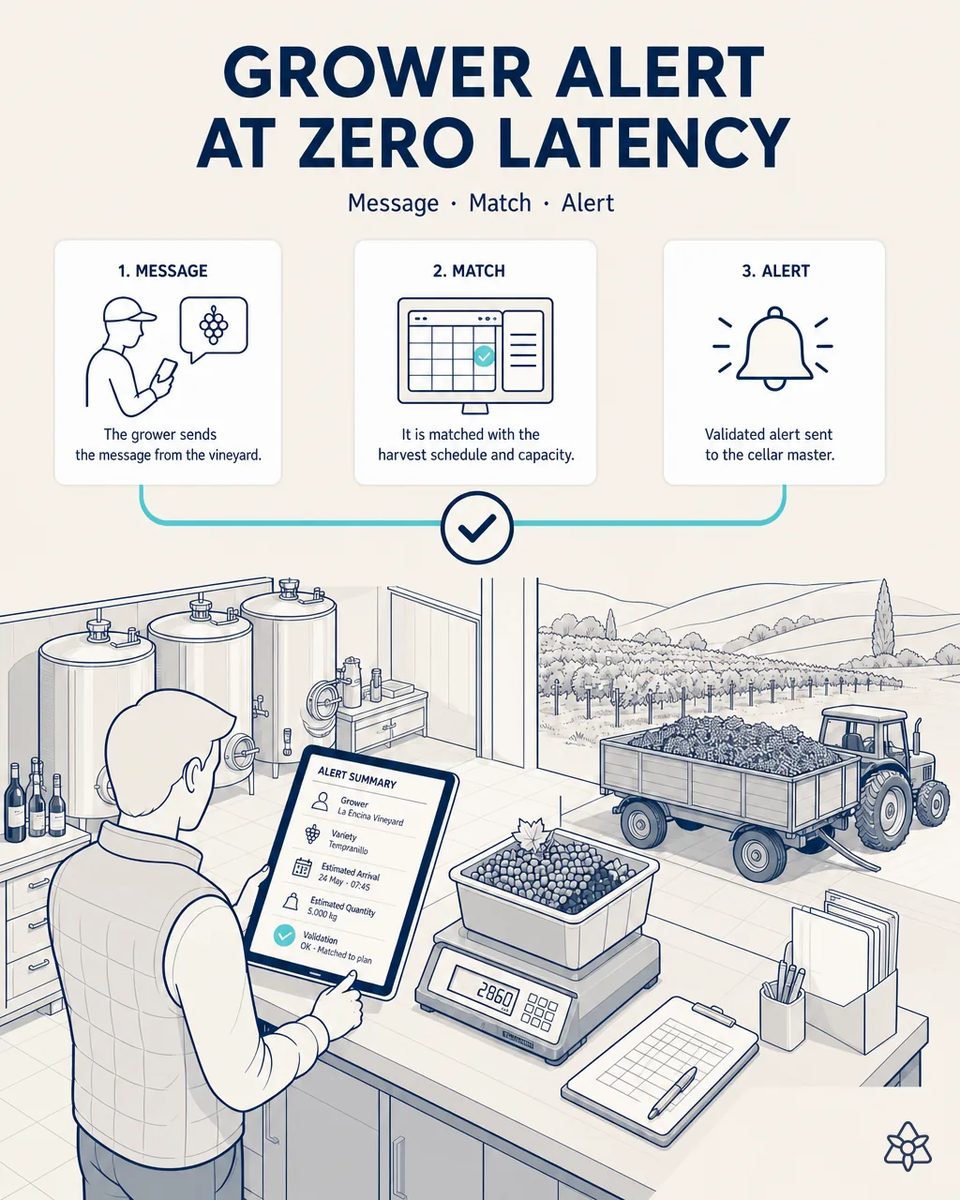
The harvest plan changes by text message, and it reaches one phone.
During harvest, dozens of associated growers send changes through informal channels that reach one person, not the planning system.
- During harvest, associated growers send changes all day long: a plot picked a day early because rain is coming, a smaller load than announced, a variety arriving before its turn.
- Those messages land on one person's phone or mailbox, mixed with everything else, not in the planning system that reserves tanks and sets the scale schedule.
- When that person reads the message late, the tank that should have taken that load is already reserved for another one.
- The result is confusion at the scale line, trailers waiting in a queue and grapes sitting in the sun while someone reshuffles tanks by hand and phones three growers back.
Connect in chaotic-sources mode — mailbox and messaging in silent copy, twenty-four seven.
Connect chaotic-sources mode — mailbox/WhatsApp Business in 24/7 silent copy. The LLM extracts intent, entities (grower, plot, variety, date) and matches against the ERP, returning the precise action to the right role.
Reading the message sooner is only half the job. What actually helps the cellar is getting it back already matched against the harvest plan: which tank changes, which load moves, who has to act. That is what comes back, to the right role and in seconds. And everything that came in stays on record, so the end-of-campaign settlement with each grower is not argued from memory.
The alert on one phone versus the alert matched to the plan
| Aspect | Today | With iLEAN Connect |
|---|---|---|
| When the grower's change is read | When its recipient gets a moment | In seconds |
| Tank reservation | Already taken by another load | Adjusted before the trailer arrives |
| Scale line during peak | Hours of confusion | Loads arrive where expected |
| Which grower, plot and variety | Read between the lines | Extracted and matched with the ERP |
| Who learns about it | Whoever owns the phone | The role that has to act |
| Final call on the tank plan | The recipient | The cellar master — iLEAN proposes |
hours of scale-line confusion → seconds; rescheduling based on the real alert, not on what got read late.
Impact estimate per harvest — to be validated with your numbers.
The block below is an estimate to be validated against your plant's actual data. We put it forward so the committee has an order of magnitude; we refine it during the assessment.
- Estimated payback 3-7 months, depending on the number of associated growers and how often they send changes.
- Hours of scale-line confusion reduced to seconds of reaction, in the weeks when every hour counts. The cellar master stops being the bottleneck through which every change has to pass.
- Rescheduling made on the real alert, not on whatever got read late.
- And fewer loads waiting in the sun while tanks are reshuffled by hand, which protects the fruit as much as the schedule. Grapes that wait less at the scale arrive at the tank in better condition.
estimated payback of 3-7 months depending on the number of associated growers and alert frequency. Estimate to validate.
And the fair question from the production manager
"Growers write however they like, with abbreviations and voice notes — will it understand them?" — extracting intent, grower, plot, variety and date from a short message is an anchored task, where the best models drop below 1.5% error [1]. And the match against the ERP is a second net: a plot that does not belong to that grower, or a variety it does not grow, is flagged instead of acted on.
[1] OpenAI paper "Why Language Models Hallucinate", 2025 — on the reliability of AI in anchored tasks.
What people ask about processing grower messages
Do growers have to install anything or change how they write?
No. They keep sending messages the way they do today to the winery's business number or mailbox, abbreviations included; iLEAN reads that channel in silent copy. Asking hundreds of associated growers to adopt a new app during harvest would never work, and it is not needed.
Does it read the personal phones of the cellar team?
No. It only sees the operational channels set up for growers. Personal conversations stay outside, and nobody's own phone is connected to anything. Growers are told which number to write to, as they already are today.
What does the cellar master actually receive?
A short summary — grower, plot, variety, new date and estimated weight — with the proposed change to the tank plan, ready to accept or adjust in one gesture. If the change affects a tank already being filled, that is highlighted first.
Does it understand voice notes from the vineyard?
Yes. Voice notes are transcribed and processed like any written message, which matters when growers are sending them from the seat of a tractor. Dialect and vineyard nicknames for plots are learned from the grower register over the first weeks.
Can it move a tank reservation on its own?
No. It proposes the action and points to who should take it; the decision stays with the cellar master or whoever plans intake that day. Once accepted, the change is reflected in the tank plan for everyone at once.
More cases from this series
- The capital pain of any winery, solved in 4 rings4 coordinated rings (ERP, labeler, Edge, evidence pack) stop the line the moment a batch or vintage…
- The audit dossier, ready before the auditor shows upEvery critical change automatically generates a photo, log and sign-off. Agents organizes the evidence…
- Nothing enters the ERP without your confirmationNothing iLEAN captures reaches the ERP without a human confirming it with 2 taps on an industrial tablet.
- The fermentation curve, digitized without touching the equipmentAn external camera digitizes the fermentation temperature curve from a legacy control panel, without…
- The grower's delivery note, from paper to ERP in secondsPhotograph the grower's weighbridge note and it goes straight to the ERP after one confirmation tap.…
- The harvest log, digitized at zero latencyPhotograph the harvest intake log with a phone and the batch is already live in the central system.…
Tell us how many grower changes reach you during a typical harvest day.
We work on your plant's real data, not ours. Assessment with no commitment.
Request estimated ROI within 48h ‹ See all cases of wineries See food industry