The harvest log, digitized at zero latency
In a winery, the cellar master fills in the harvest intake log by hand next to the scale — variety, plot, origin, weight. That log defines the destination tank, but today it sits in a folder until someone transcribes it at day's end. With iLEAN Connect, a phone photo is enough for the batch to exist in central memory at zero latency.
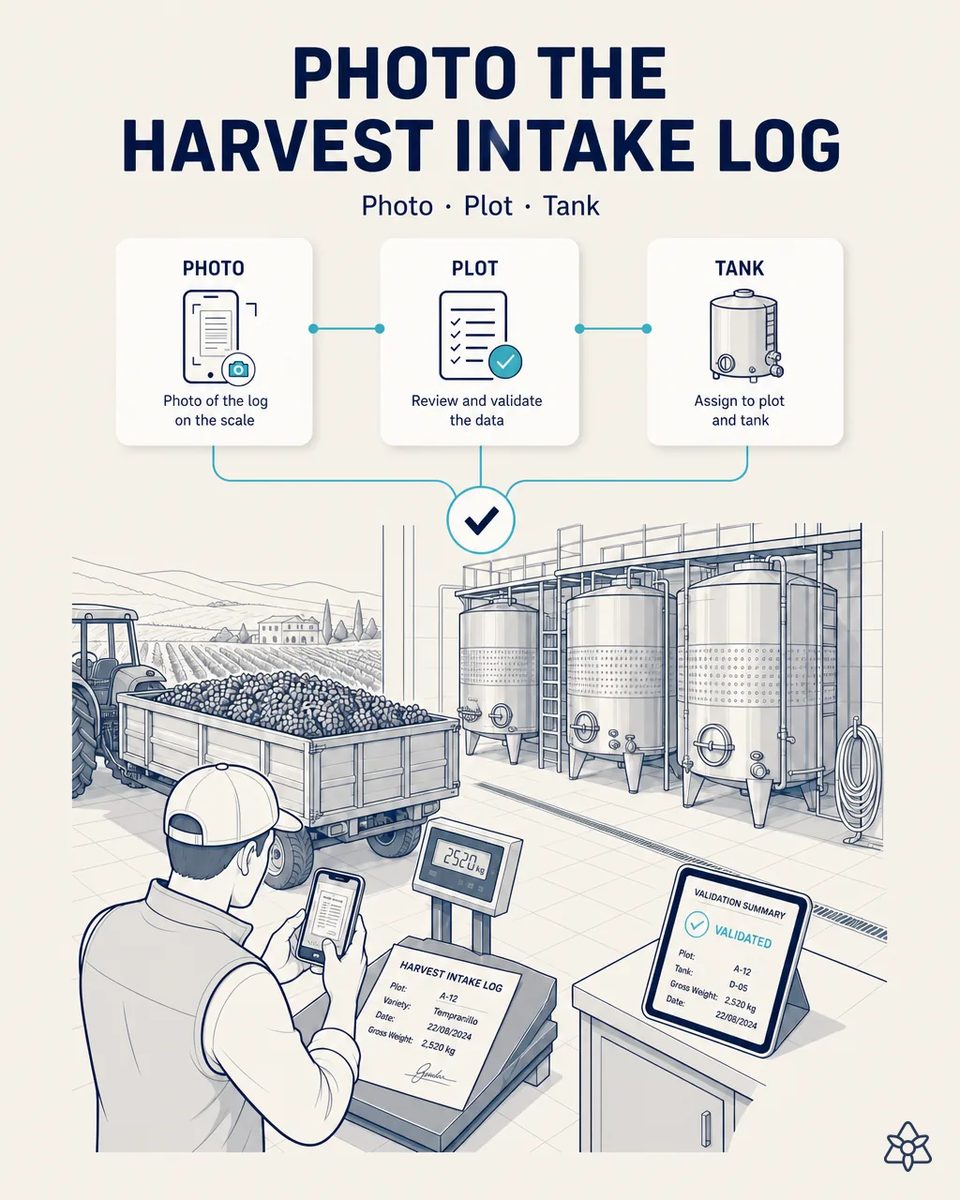
The document that decides the destination tank sleeps in a folder.
During harvest peak, dozens of loads arrive every day, each with its own handwritten log. The volume overwhelms manual transcription in real time — the tank's data stays blind for hours, right when decisions need to be fastest.
- Next to the scale, the cellar master writes the intake log by hand for every trailer: variety, plot, grower, gross weight, probable alcohol reading and the tank the grapes are sent to.
- That sheet decides where each load ends up, but it only becomes data when someone types it in at the end of the day — or the next morning, after a twelve-hour shift at the weighbridge.
- At harvest peak, dozens of loads arrive every day, each with its own handwritten log. Transcription cannot keep up, and the tank fills physically while it is still empty in the system.
- That blind window lands exactly when decisions need to be fastest: which tank still has room, which plot is coming in under-ripe, which variety needs a separate fermentation, which load should go to the reserva tanks.
Connect in photo mode — the intake log stays on paper, and it is in the system too.
Connect photo mode. The team photographs the log with a phone or tablet. A grounded LLM extracts structured fields (variety, plot, origin, weight, destination tank, timestamp) and stores them in central memory. Zero habit change during the tightest week of the year.
Nobody is asked to change anything during the tightest week of the year: the paper log stays, the photo is added. That is why this case is usually the first one a winery approves, and why it becomes the foundation every later case reads from — the batch starts existing at the weighbridge.
The intake log on paper versus the intake log captured
| Aspect | Today, at the scale | With iLEAN Connect |
|---|---|---|
| When the load exists in the system | End of the day, or the next morning | Zero latency, at the weighbridge |
| Tank occupancy during peak | Known by whoever is on the floor | Visible to the whole cellar team |
| Probable alcohol per plot | Handwritten, hard to compare | Comparable across plots and campaigns |
| Variety assigned to each tank | Depends on reading the handwriting | Structured field, tied to the batch |
| Transcription work | Hours per day during harvest | None |
| The cellar team's routine | — | Unchanged: one photo per log |
hours of lag during peak campaign → zero latency; tank with no digital record until the next day → traceability from the weighbridge itself.
Impact estimate per campaign — to be validated with your numbers.
The block below is an estimate to be validated against your plant's actual data. We put it forward so the committee has an order of magnitude; we refine it during the assessment.
- Estimated payback 4-9 months, depending on the number of grape loads per campaign.
- The return comes from transcription time recovered for the cellar team, right in the weeks when that team is most stretched.
- From hours of lag during peak campaign to zero latency between the scale and the central system.
- And traceability starts at the weighbridge itself, not the next day when the tank already holds the grapes and nobody remembers which trailer came first.
estimated payback of 4-9 months depending on load volume per campaign, from recovered transcription time for the cellar team. Estimate to validate.
And the fair question from the production manager
"What if it misreads the variety or the weight on a smudged log?" — reading fields from a sheet whose layout is known is an anchored task, where the best models drop below 1.5% error [1]. And the second net is physical: a weight outside what the scale can register, or a variety the plot has never grown, is flagged for a person to confirm before anything is stored.
[1] OpenAI paper "Why Language Models Hallucinate", 2025 — on the reliability of AI in anchored tasks.
What people ask about photographing the harvest intake log
Does it read handwriting with grape juice on the paper?
Yes. The harvest log is filled in at the scale, in the open, often with sticky hands, and it is rarely clean. Fields that come out with low confidence are flagged for confirmation instead of being guessed.
Which fields are extracted from each log?
Variety, plot, grower, gross weight, destination tank and timestamp, plus the probable alcohol reading when the log carries it. They are the fields that define the batch from the first minute, and the ones every later case reads from.
Do we need a dedicated device at the scale?
No. The phone of whoever fills in the log is enough, or a tablet if the winery already has one at the weighbridge. Nothing is installed on the scale itself. If the cellar master prefers to keep the phone in a pocket, a fixed tablet at the weighbridge works just as well.
What happens with loads that arrive at night?
Exactly the same as by day: the photo is taken, and the load exists in the system before the tank is closed, not when the office opens the next morning. Night picking is where the gap is usually longest today. It is also when the fewest people are around to remember which load went where.
Is this the same as the delivery note case?
No, they complement each other. The intake log is the winery's internal record that decides the destination tank; the delivery note is the grower's document that feeds the ERP intake module and its licenses.
More cases from this series
- The capital pain of any winery, solved in 4 rings4 coordinated rings (ERP, labeler, Edge, evidence pack) stop the line the moment a batch or vintage…
- The audit dossier, ready before the auditor shows upEvery critical change automatically generates a photo, log and sign-off. Agents organizes the evidence…
- Nothing enters the ERP without your confirmationNothing iLEAN captures reaches the ERP without a human confirming it with 2 taps on an industrial tablet.
- The fermentation curve, digitized without touching the equipmentAn external camera digitizes the fermentation temperature curve from a legacy control panel, without…
- From the grower's text message to action, in secondsiLEAN reads associated growers' alerts in silent copy and reschedules harvest before the trailer even…
- The grower's delivery note, from paper to ERP in secondsPhotograph the grower's weighbridge note and it goes straight to the ERP after one confirmation tap.…
Tell us how many hours it takes for a grape load to exist in your system during harvest.
We work on your plant's real data, not ours. Assessment with no commitment.
Request estimated ROI within 48h ‹ See all cases of wineries See food industry