The fermentation curve, digitized without touching the equipment
A winery's fermentation temperature control panel is often over a decade old and isolated from the network. Replacing it during harvest isn't an option. With an external camera on the panel, iLEAN digitizes the per-tank fermentation curve without touching the original system.
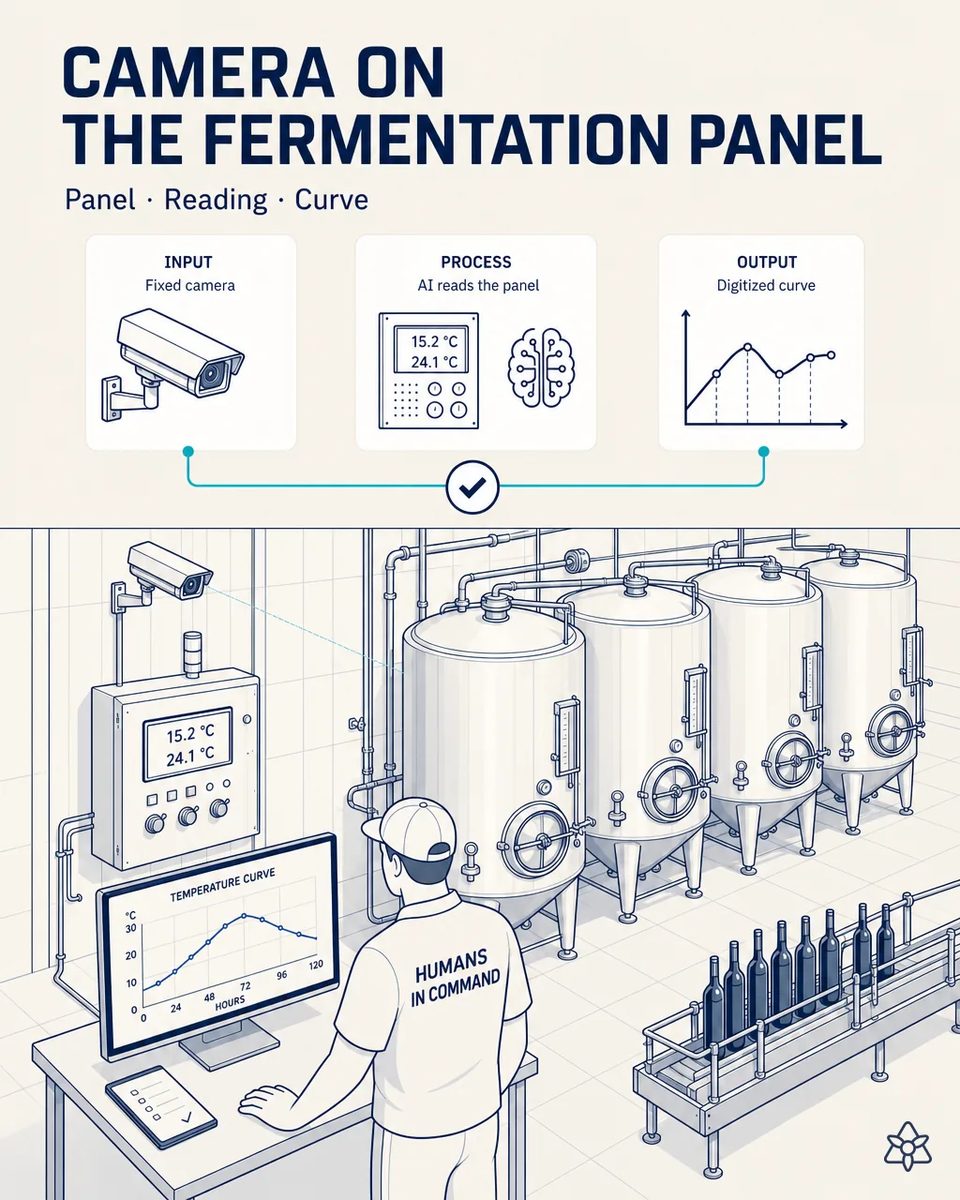
The fermentation curve dies every time the screen rotates to another tank.
Fermentation temperature control shapes the final wine's aroma profile and color. Today that data dies on screen the moment it rotates to another tank, with no record linked to the batch.
- Temperature during alcoholic fermentation shapes the aroma profile and color of the finished wine. It is one of the few levers the winemaker truly controls, tank by tank.
- Yet the panel that governs it is often more than ten years old and isolated from the network. It shows one tank, then the next, and keeps nothing.
- What survives is a reading written down twice a day on a sheet hanging from the tank — a couple of dots where there should be a continuous curve, and nothing at all from the night shift.
- So when a batch comes out with a different profile from the year before, no one can tell whether a temperature peak caused it, in which tank, or on which day of fermentation it happened.
Connect in photo mode on the panel — a camera in front of it, nothing inside it.
Connect photo mode on the panel. Fixed industrial camera, OCR plus a grounded LLM interprets each frame and structures the time-series curve per tank, cross-referenced with the harvest log (which batch is fermenting in which tank).
Replacing a fermentation control system during harvest is not an option, and it is rarely justified outside it. Reading it from the outside gives the winery the curve this campaign, and lets the replacement decision wait until there is a real reason rather than a missing record. Many wineries use that time to choose the right replacement calmly, with two campaigns of curves in hand.
The panel on its own versus the panel being read
| Aspect | Today | With iLEAN Connect |
|---|---|---|
| Temperature record per tank | Two handwritten readings a day | Continuous curve per tank |
| Link between curve and batch | None | Crossed with the harvest intake log |
| A temperature peak at night | Noticed only if someone was there | Recorded with time and tank |
| Explaining a profile change | Hypotheses | Root cause by batch and campaign in minutes |
| The control system | — | Untouched, nothing installed on it |
| Panel replacement | Pressure to bring it forward | Deferred until it is justified |
zero correlation between curve and final profile → root-cause analysis by batch and campaign in minutes.
Impact estimate — to be checked against your fermentation records.
The block below is an estimate to be validated against your plant's actual data. We put it forward so the committee has an order of magnitude; we refine it during the assessment.
- Estimated payback 5-10 months.
- Avoided premature replacement of the control panel: CAPEX that does not have to be spent this year just to get a record. The camera and its setup cost a fraction of a new control system.
- Better reproducibility of the wine's profile from one campaign to the next, because the curve that produced the good vintage is on record.
- And root-cause analysis by batch and campaign goes from impossible to a few minutes of querying.
estimated payback of 5-10 months, avoided premature replacement of the control panel (CAPEX avoided), improved profile reproducibility across campaigns. Estimate to validate.
And the fair question from the production manager
"Can a camera read a panel display reliably enough to trust the curve?" — the screen is fixed, the fields sit in known positions and fermentation temperatures move inside a narrow physical range, so it is an anchored task where the best models drop below 1.5% error [1]. Any frame whose value jumps outside what a tank can physically do in a few minutes is discarded rather than stored.
[1] OpenAI paper "Why Language Models Hallucinate", 2025 — on the reliability of AI in anchored tasks.
What people ask about reading the fermentation panel
Does anyone have to open or rewire the panel?
No. The camera points at the screen from outside; there is no connection to the control system, no software installed and no port opened. The panel keeps working exactly as it did. Its manufacturer's warranty and settings are not affected, because nothing on it is touched.
How does it know which tank the screen is showing?
The tank identifier is read from the display itself, and the curve is then crossed with the harvest intake log to know which batch is fermenting in that tank at that moment. When a tank is emptied and refilled, the curve starts a new batch automatically.
Does it also cover malolactic fermentation?
Yes, as long as the panel displays it. The curve keeps building after the alcoholic fermentation ends, which is useful when malolactic stalls in a cold cellar and nobody notices for days.
What if the cellar light changes through the day?
The camera is placed and set up for the panel's real lighting, and frames that cannot be read with confidence are discarded instead of producing false points on the curve. A missing minute is better than an invented one when the curve is used to explain a profile.
Can it warn about a tank running too hot?
Once the curve is digital, a threshold per tank or per variety can be set, so the winemaker hears about it before the next scheduled reading instead of at the next morning's round. The alert goes to whoever is on duty, not to a screen nobody is watching at night.
More cases from this series
- The capital pain of any winery, solved in 4 rings4 coordinated rings (ERP, labeler, Edge, evidence pack) stop the line the moment a batch or vintage…
- The audit dossier, ready before the auditor shows upEvery critical change automatically generates a photo, log and sign-off. Agents organizes the evidence…
- Nothing enters the ERP without your confirmationNothing iLEAN captures reaches the ERP without a human confirming it with 2 taps on an industrial tablet.
- From the grower's text message to action, in secondsiLEAN reads associated growers' alerts in silent copy and reschedules harvest before the trailer even…
- The grower's delivery note, from paper to ERP in secondsPhotograph the grower's weighbridge note and it goes straight to the ERP after one confirmation tap.…
- The harvest log, digitized at zero latencyPhotograph the harvest intake log with a phone and the batch is already live in the central system.…
Tell us how old your fermentation panel is and how its readings are kept today.
We work on your plant's real data, not ours. Assessment with no commitment.
Request estimated ROI within 48h ‹ See all cases of wineries See food industry