The grower's delivery note, from paper to ERP in seconds
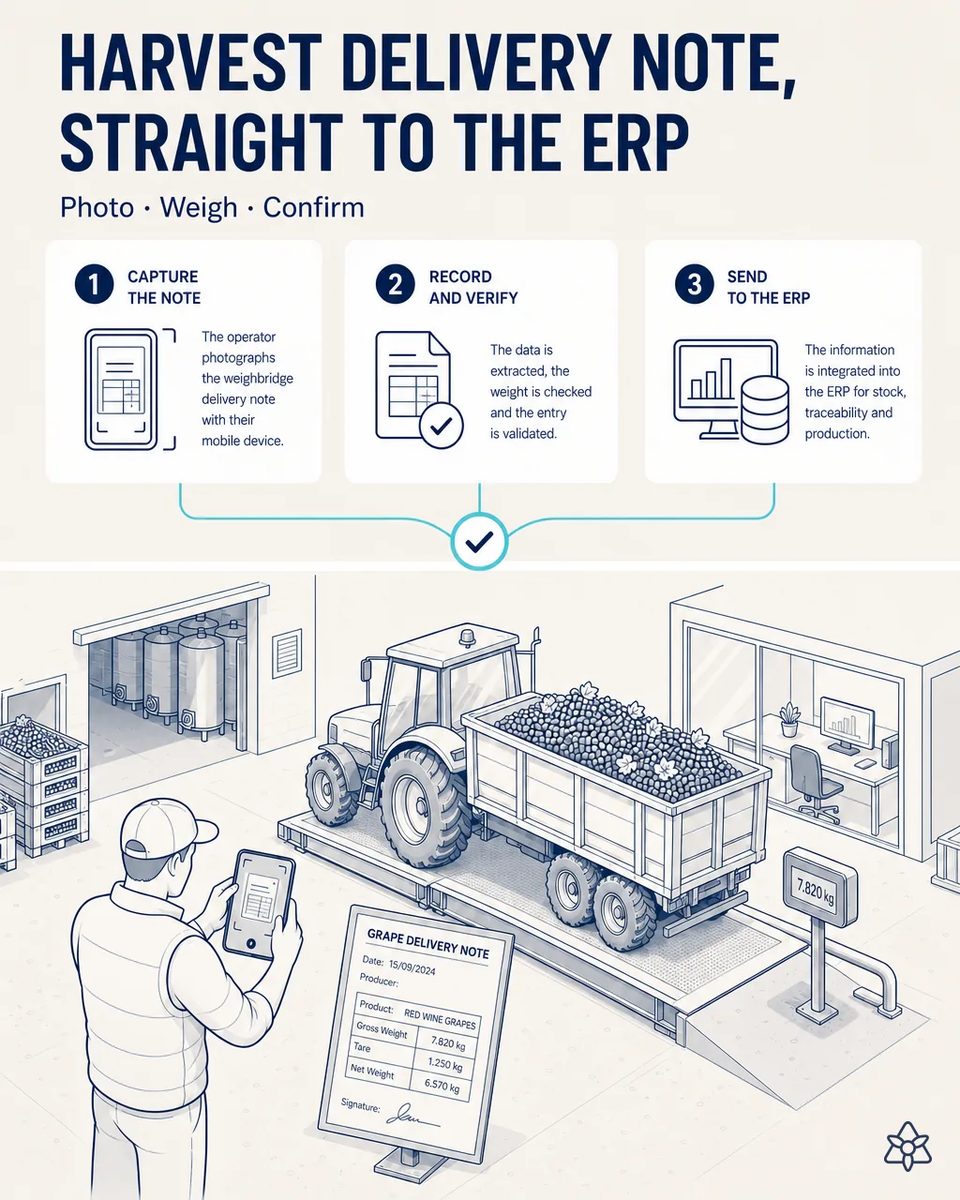
The grower's trailer arrives at the scale with a paper delivery note. Instead of typing into the ERP during harvest peak, a photo is enough to digitize it and sync it after validation.
Every trailer waits while someone types, and the errors surface weeks later.
every trailer waits at the scale while the supervisor types the load into the ERP. If they rush, plot or variety gets entered wrong — and that surfaces weeks later as a denomination-of- origin traceability problem.
- The grower's trailer reaches the scale with a paper delivery note: grower, plot, variety, gross weight, tare, net weight and signature.
- The supervisor types it into the ERP while the next trailer waits behind. Tractors with engines running, growers impatient to get back to the vineyard, and a queue that reaches the road. At peak campaign the queue grows faster than the typing.
- Typing in a hurry means a plot or a variety entered wrong, and nobody notices on the day because the grapes are already in the hopper.
- That error comes back weeks later as a denomination-of-origin traceability problem, when the grapes are already wine in a tank and the batch cannot be untangled. By then, nobody remembers which trailer brought the wrong plot.
Connect in photo mode towards the ERP — the grower's note as it comes, confirmed with one tap.
Connect photo mode. Vision AI recognizes the delivery note and extracts its tabular structure; for trailer/pallet labels, it reads barcode, QR or plain OCR. Validation with one tap.
The grower does not change their delivery note and the supervisor does not type. The only gesture left is checking a summary, which is exactly the moment where plot and variety errors are caught, before they turn into an origin traceability problem. And because the trailer leaves the scale sooner, the next grower does not lose half a morning waiting in line.
Typed intake versus photographed intake
| Aspect | Today | With iLEAN Connect |
|---|---|---|
| Trailer queue at peak | Growing | Flowing |
| Plot and variety errors | Hidden until the council asks | Caught on the summary |
| Grower delivery note format | Typed field by field | Read as it arrives |
| Trailer and pallet labels | Read by eye | Barcode, QR or plain text recognition |
| Supervisor's job at the scale | Typing | One confirmation tap |
| Intake and scale module licenses | Three | One, the supervisor who validates |
growing trailer queue at the scale during peak campaign → smooth flow; hidden plot/variety errors → zero.
Impact estimate at the scale — to be validated with your numbers.
The block below is an estimate to be validated against your plant's actual data. We put it forward so the committee has an order of magnitude; we refine it during the assessment.
- Estimated payback 3-8 months.
- CFO angle: a typical 50-70% reduction in ERP licenses for the intake and scale module, going from three licenses to one. The saving repeats every year the license contract is renewed.
- The trailer queue at the scale flows during peak campaign instead of growing with every load.
- And hidden plot and variety errors drop to zero, before they become an origin traceability issue in front of the regulatory council. Settlements with growers at the end of the campaign start from weights everyone already confirmed at the scale.
CFO angle — typical reduction of 50 to 70% in ERP licenses for the intake/scale module (from 3 licenses to 1), estimated payback of 3-8 months. Estimate to validate.
And the fair question from the production manager
"Every grower brings a different note, some handwritten, some printed by a cooperative." — the model recognizes the table structure of the delivery note without a template per grower, and reads trailer or pallet labels by barcode, QR or plain text. It is an anchored task, where the best models drop below 1.5% error [1], and the net weight is checked against the scale's own reading before the supervisor confirms. A note that does not match the scale is never confirmed by accident.
[1] OpenAI paper "Why Language Models Hallucinate", 2025 — on the reliability of AI in anchored tasks.
What people ask about the grower's delivery note at the scale
Do growers have to use a common delivery note?
No. Each one keeps their own, handwritten or printed by their cooperative. The model reads the structure as it comes, without a template per grower. New growers or new cooperatives are recognized from their first delivery note, without setup.
Does it check the weight against the scale?
Yes. Gross, tare and net from the note are compared with the weighbridge reading, and any difference is highlighted before confirmation, not discovered at the month's settlement. That alone avoids a good share of the disputes with growers at the end of the campaign.
What if the plot does not belong to that grower?
The summary flags it against the ERP's grower and plot register, so it is resolved at the scale with the grower present, instead of in front of the regulatory council. That is the error that is cheapest to fix on the day and most expensive to fix weeks later.
How is this different from the harvest intake log case?
The intake log is the winery's own sheet that decides the destination tank; this case is the grower's document that feeds the ERP intake module and its licenses.
Does it work with a phone, or do we need scanners?
A phone or tablet photo is enough. Existing scanners can be kept if they already work well at the weighbridge; nothing has to be thrown away. What changes is that nobody needs to type what the scanner or the photo already read.
More cases from this series
- The capital pain of any winery, solved in 4 rings4 coordinated rings (ERP, labeler, Edge, evidence pack) stop the line the moment a batch or vintage…
- The audit dossier, ready before the auditor shows upEvery critical change automatically generates a photo, log and sign-off. Agents organizes the evidence…
- Nothing enters the ERP without your confirmationNothing iLEAN captures reaches the ERP without a human confirming it with 2 taps on an industrial tablet.
- The fermentation curve, digitized without touching the equipmentAn external camera digitizes the fermentation temperature curve from a legacy control panel, without…
- From the grower's text message to action, in secondsiLEAN reads associated growers' alerts in silent copy and reschedules harvest before the trailer even…
- The harvest log, digitized at zero latencyPhotograph the harvest intake log with a phone and the batch is already live in the central system.…
Tell us how long a grape trailer waits at your scale during peak harvest.
We work on your plant's real data, not ours. Assessment with no commitment.
Request estimated ROI within 48h ‹ See all cases of wineries See food industry