The capital pain of any winery, solved in 4 rings
A batch, vintage or origin traceability incident threatens certification and distributor trust. iLEAN's flagship system coordinates 4 cross-checking rings so it never reaches the customer.
A wrong vintage on a bottle costs more than the wine inside it.
a batch/vintage/origin incident is the biggest reputational and certification risk in the wine sub-sector.
- A batch, vintage or origin incident is the biggest reputational and certification risk a winery faces, far above any single defect on the line.
- It rarely comes from one big failure. It comes from small ones in a row: a batch defined right, a label typed wrong, a bottle nobody read, a sign-off with no evidence.
- Each control on its own looks fine, and the bottle still leaves with the wrong vintage on it.
- When it is found, it is found at the distributor or the importer, and what is at stake is the certification and a relationship built over years.
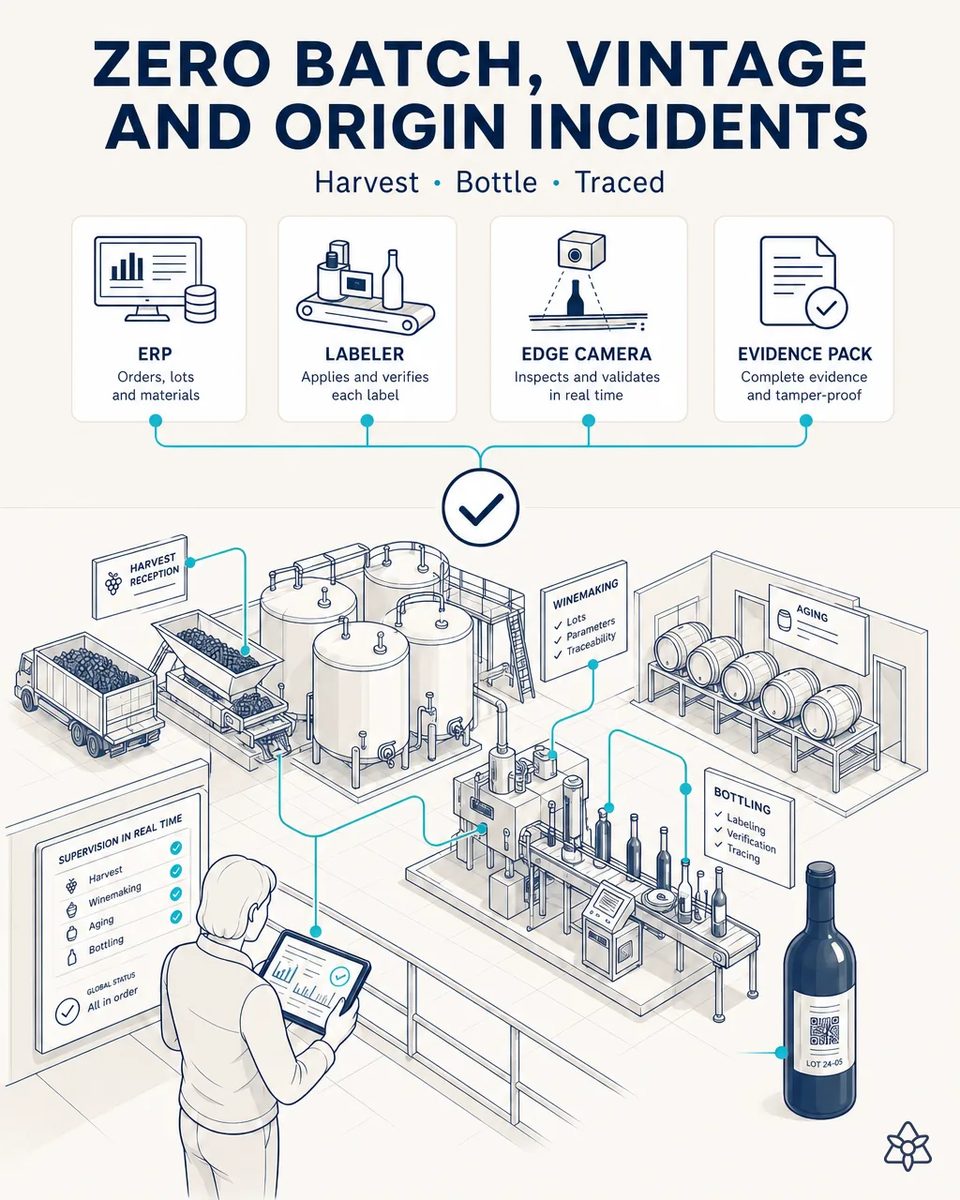
Four coordinated rings — all the previous cases, checking each other.
4 coordinated rings —
No single ring is new: the ERP, the labeler, the camera and the sign-off already exist in some form. What is new is that they check each other, and that the line stops the moment two of them disagree, before the case is closed. That is the difference between a control system and a coordinated one: the discrepancy is visible in the cross-check even when each ring, looked at alone, reports that everything is fine.
- the ERP defines batch and vintage in the active order,
- the labeler prints what the ERP publishes,
- the Edge camera reads what's printed on the bottle and matches it against the order,
- the evidence pack ties the previous three together with the winemaker's sign-off. JIDOKA AI halts the line on any mismatch; SMED AI keeps batch changeovers fast.
The four rings, and the incident each one stops
| Ring | What it does | What it stops |
|---|---|---|
| 1 · ERP | Defines batch and vintage in the active order | Bottling without a clear reference |
| 2 · Labeler | Prints exactly what the ERP publishes | Typing errors on vintage and back-label |
| 3 · Edge camera | Reads the printed bottle and matches it to the order | A label that differs from the order |
| 4 · Evidence pack | Ties the three together with the winemaker's sign-off | A batch released with no proof |
| Line stop by JIDOKA AI | Halts bottling on any mismatch | The case leaving with the discrepancy |
| Fast changeover by SMED AI | Keeps batch changeovers short | Control that slows bottling down |
latent incident risk every campaign → discrepancy caught right on the line, before the case leaves the winery.
Impact estimate — to be validated with the winemaker and general management.
The block below is an estimate to be validated against your plant's actual data. We put it forward so the committee has an order of magnitude; we refine it during the assessment.
- Estimated payback 6-12 months, measured against the first incident avoided. One incident avoided is usually enough to cover the whole system.
- Protection against a certification incident, the kind that can put a denomination of origin at stake.
- Protection of the multi-year distributor and importer relationship, which is harder to rebuild than any batch. Importers increasingly ask for that proof before renewing.
- And latent incident risk every campaign becomes a discrepancy caught on the line, before the case leaves the winery.
protection against a certification incident and protection of the multi-year distributor/importer relationship. Estimated payback of 6-12 months against the first incident avoided. Estimate to validate with the winemaker and general management.
And the fair question from the production manager
"Won't the line stop every hour for nothing?" — JIDOKA AI stops on a verifiable mismatch between sources, not on a hunch. Reading batch and vintage from a printed label and comparing it with the order is an anchored task, where the best models drop below 1.5% error [1]. When the doubt comes from the model rather than from the data, it goes to the winemaker instead of stopping the line.
[1] OpenAI paper "Why Language Models Hallucinate", 2025 — on the reliability of AI in anchored tasks.
What people ask about end-to-end batch traceability
Do we have to deploy all twelve cases to get this?
No. The rings are built layer by layer, and each case pays on its own. The labeler integration and the Edge camera already close most of the risk on the bottling line. The evidence pack and the line stop come afterwards, on top of what is already working.
What does crossing the rings add to each control?
It catches the chain of small errors that each control lets through on its own: the right batch with the wrong vintage, or the right label on the wrong order. No single control can see those, because each one only looks at its own piece.
What exactly happens when a mismatch appears?
JIDOKA AI halts the line, shows which ring disagrees and with what, and the winemaker decides. The case never leaves the winery with the discrepancy. The stop is recorded with its cause, so it feeds the evidence pack as well.
Does it slow down changeovers between batches?
No. SMED AI prepares the next batch's data before the change, so the control does not add minutes to the bottling run.
Does it cover wines from several denominations in the same winery?
Yes. Each order carries its denomination, vintage and back-label range, and the rings check them order by order. A change of denomination between two orders is treated like any other batch changeover.
More cases from this series
- The audit dossier, ready before the auditor shows upEvery critical change automatically generates a photo, log and sign-off. Agents organizes the evidence…
- Nothing enters the ERP without your confirmationNothing iLEAN captures reaches the ERP without a human confirming it with 2 taps on an industrial tablet.
- The fermentation curve, digitized without touching the equipmentAn external camera digitizes the fermentation temperature curve from a legacy control panel, without…
- From the grower's text message to action, in secondsiLEAN reads associated growers' alerts in silent copy and reschedules harvest before the trailer even…
- The grower's delivery note, from paper to ERP in secondsPhotograph the grower's weighbridge note and it goes straight to the ERP after one confirmation tap.…
- The harvest log, digitized at zero latencyPhotograph the harvest intake log with a phone and the batch is already live in the central system.…
Tell us what a vintage or batch error on a pallet would cost your winery.
We work on your plant's real data, not ours. Assessment with no commitment.
Request estimated ROI within 48h ‹ See all cases of wineries See food industry