Catch the defect before it reaches the customer
At packaging-line speed, the human eye tires and can miss a defect. With Edge, a camera over the line compares every pack against the expected pattern in milliseconds and rejects it before sealing.
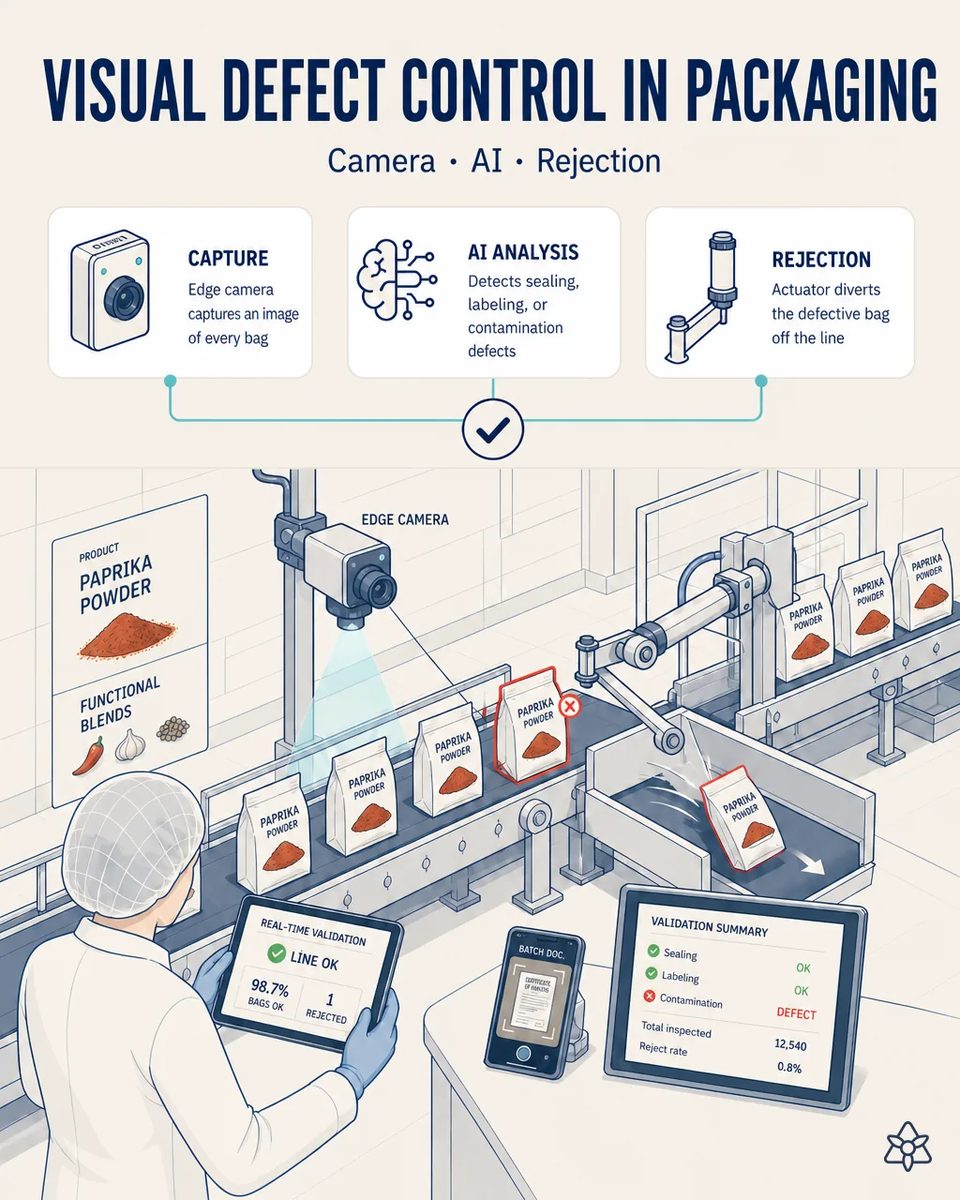
At line speed, the human eye loses to the borderline case.
an off-range color, a visible foreign body or a bad seal can reach the customer, triggering a complaint.
- An off-range color, a foreign body visible in a transparent pouch or a seal with powder trapped in it are the three defects that generate complaints in this sub-sector.
- All three are visible. The problem is that they are visible to somebody checking thousands of packs per shift, and fatigue lets exactly the borderline ones through.
- Color is the worst of the three, because it drifts slowly: the run starts inside the ASTA window and ends outside it, and nobody sees the change happen pack by pack. It is only obvious when two pouches from different ends of the run are put side by side, which happens at the customer.
- A trapped seal is not a cosmetic issue either: it is the entry route for moisture, and moisture in a spice pack means caking in the jar and a shelf life that does not reach its printed date.
Edge — every pack classified in milliseconds, before sealing.
Edge camera + CNN trained on the specific product, millisecond inference, automatic rejection.
Catching it on the line instead of at the customer changes what the defect costs: a rejected pouch is grams of product, while a complaint is a pallet returned, an investigation opened, a corrective action to write and a commercial conversation you did not want to have. The unit cost of the same defect differs by three orders of magnitude depending on where it is found.
Today's inspection versus Edge vision
| Aspect | Visual sampling | With iLEAN Edge |
|---|---|---|
| Coverage | A sample, and it depends on fatigue | Every pack, at cadence |
| Slow color drift | Nobody sees it happen | Detected as a trend mid-run |
| Foreign body in the pouch | Caught if someone is looking | Classified pack by pack |
| Powder trapped in the seal | Found by the customer | Rejected before sealing |
| Point of detection | The complaint | The line itself |
| Borderline cases | They slip through | Escalated to a person |
defects caught downstream → caught and rejected on the line itself.
Estimated impact — to validate with your own numbers.
The block below is an estimate to be validated against your plant's actual data. We put it forward so the committee has an order of magnitude; we refine it during the assessment.
- Estimated payback 4-9 months, depending on your packing volume and your current complaint rate.
- Estimated reduction of at least 30 % in complaints and returns on the covered formats.
- Color drift caught mid-run instead of at the end, which is the difference between adjusting and reprocessing.
- And the sealing defect that shortens shelf life stops leaving the plant inside the pallet.
≥30% reduction in complaints and returns, estimated payback of 4-9 months. *Estimate to validate*.
And the fair question from the production manager
"What if it rejects good product?" — the false positive is the real risk of any vision system, which is why the model is trained on good and bad packs of your own formats and with that line's lighting, not on a generic reference. Classifying a pack against a known reference is an anchored task, where the best models drop below 1.5% error [1]. And borderline packs are not simply rejected: they are escalated for a person to decide, and every decision feeds back into training.
[1] OpenAI paper "Why Language Models Hallucinate", 2025 — on the reliability of AI in anchored tasks.
What people ask about vision on the packaging line
Does it replace the metal detector or the X-ray?
No, and it should not be framed that way. Those cover what is inside the product and stay exactly as they are; the camera covers what is visible on the pack, which is the family of defects that actually generates complaints.
Can it really judge color?
It compares against the reference for that specific product under controlled lighting, which is what makes the comparison valid. It is a relative judgment on the line, not a lab measurement, and it does not replace your colorimeter or your ASTA release check.
Does it keep up with the bagger's cadence?
Yes: inference runs locally on the Edge device and resolves in milliseconds per pack. It does not depend on the plant network or on the cloud, so a network outage does not stop the line.
How many packs does it need to learn?
Fewer than people fear, because the defect catalog on a packaging line is short and repetitive. What matters is that they be real packs from your own formats, including the borderline ones nobody agrees on.
Does it handle several formats on the same camera?
Yes, switching the model according to the format running. That is the normal condition in a plant that packs jars, stick packs and bulk in the same week, and the switch follows the packing order rather than a manual selection.
More cases from this series
- Seamless traceability, from sack to packConnect, Edge, Agents, JIDOKA AI and SMED AI coordinated against untraced traceability risk in spice…
- Paperless batch startupHow a spice factory digitizes the production order and blend formula at batch startup with a simple…
- Validate the formula in seconds, no typingNo formula or allergen data enters the central system without human validation first, in 2 taps.
- The delivery note, to ERP in one tapPhoto the delivery note and raw-material sack labels: Connect validates and pushes to the ERP, no driver…
- The dryer that now talksAn external camera digitizes the moisture curve of a vintage dryer/mill without touching the original…
- A headset so plant knowledge never gets lostA spice factory's section lead talks to the AI while walking the floor; no plant knowledge gets lost.
Tell us what share of your complaints are color or sealing.
We work on your plant's real data, not ours. Assessment with no commitment.
Request estimated ROI within 48h ‹ See all cases of spices and seasonings See food industry