The delivery note, to ERP in one tap
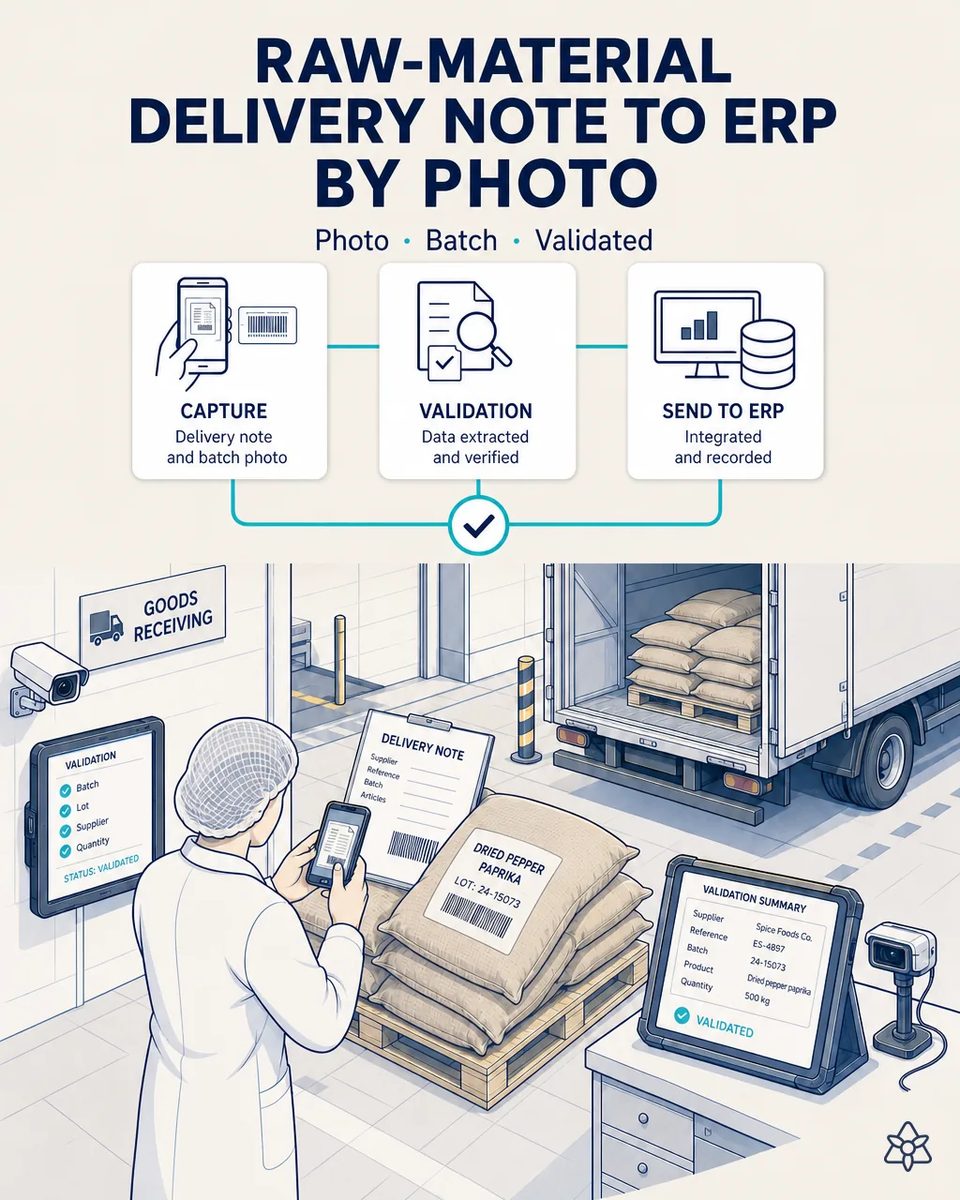
Every raw-material delivery brings a note and sacks labeled with an origin batch. With Connect, one photo of the note and another of the labels is enough for the system to recognize everything, and the receiving manager validates with one tap.
All of your traceability rests on typing under pressure.
today it means signing and typing line by line, or the driver waits racking up demurrage, or it's rushed and the origin batch ends up poorly traced.
- The truck arrives with sacks of dried peppers, cumin, turmeric or pepper: a twelve-to-twenty-line delivery note, a certificate of analysis per lot and pallets labeled with an origin lot and a harvest, sometimes in another language and another unit system.
- Both ways out are bad. Either the driver waits forty minutes racking up demurrage while somebody types line by line, or it gets typed in a hurry after the truck has gone and the origin lot ends up badly traced at the exact point where traceability begins.
- That reappears months later, when a customer asks which harvest and which grower a jar came from and the chain breaks at the first link, which is the one nobody thought was fragile.
- And the certificate of analysis ends up filed loose, unlinked to the lot, when it is precisely the document that proves aflatoxin and ethylene oxide compliance for that specific material.
Connect in photo mode — note, certificate and labels, with no supplier changes.
Connect photographs the delivery note + labels (GS1-128, QR, plain OCR). On-screen summary, one-tap validation, push to ERP via API.
The certificate of analysis stops being a filed sheet of paper and becomes linked to the origin lot from minute one. That is what turns grower-to-jar traceability into a lookup instead of a reconstruction, and it is the only ring of the chain that cannot be repaired afterwards: if the lot was typed wrong at the dock, every batch downstream inherits the error.
Today's intake versus captured intake
| Aspect | Today | With iLEAN Connect |
|---|---|---|
| Truck at the dock | 20-40 minutes | Validation in seconds |
| Certificate of analysis | Filed loose | Linked to the lot on arrival |
| Grower → jar traceability | Rebuilt under pressure | Complete and queryable |
| Badly traced origin lots | Surface months later | Do not occur |
| Driver demurrage | Recurring | Eliminated |
| Receiving-module licenses | Two or three | One, the validator |
20-40 minutes of manual entry → validation in seconds.
Estimated impact — to validate against your actual invoice.
The block below is an estimate to be validated against your plant's actual data. We put it forward so the committee has an order of magnitude; we refine it during the assessment.
- 💰 CFO angle: the receiving module typically needs two or three active licenses; with Connect only the receiving manager validates: 50-70 % reduction, recurring.
- From 20-40 minutes of manual entry per truck down to a validation in seconds, on every delivery and not only the quiet ones.
- Driver demurrage eliminated truck after truck, which is a recurring invoice that nobody budgets for and everybody pays.
- And a traceability chain that starts complete instead of starting rushed, which is what holds up when a harvest or a grower is questioned months afterwards.
50% to 70% savings on receiving-module ERP licenses + no more driver demurrage. *Estimate to validate*.
And the fair question from the production manager
"Does it recognize every supplier's delivery note?" — yes, and without asking any of them to change theirs: the model extracts the table structure with no per-supplier template. Labels are read by GS1-128 or QR where they carry one and by optical recognition where they do not. It is an anchored task, where the best models drop below 1.5% error [1], and the receiving manager validates before anything enters.
[1] OpenAI paper "Why Language Models Hallucinate", 2025 — on the reliability of AI in anchored tasks.
What people ask about digitizing raw-material intake
Is the certificate of analysis read as well?
Yes, and it is the part that adds most: aflatoxin and ethylene oxide values end up linked to the lot, so proving compliance stops being a search through a filing cabinet and becomes a field on the batch record.
What if the note and the sack labels disagree?
The discrepancy is highlighted in the summary before the receiving manager validates. Today nobody does that cross-check with a driver waiting at the dock, which is precisely why those mismatches survive into the traceability chain.
Does it work with imported raw material?
Yes, including notes and labels in another language and in another unit system. That is the ordinary case when the origin is outside the country, and it is the case where typing errors are most frequent.
Do we need a barcode scanner?
Not necessarily: a photo from the phone or the industrial tablet is enough, and plenty of sacks arrive with no readable symbology at all. If the plant already has scanners that work well, they integrate just the same.
Can we start with intake alone?
Yes, and it is a good place to start: the result is visible from the first truck, it does not depend on any other piece being deployed, and it is the foundation every other case rests on.
More cases from this series
- Seamless traceability, from sack to packConnect, Edge, Agents, JIDOKA AI and SMED AI coordinated against untraced traceability risk in spice…
- Paperless batch startupHow a spice factory digitizes the production order and blend formula at batch startup with a simple…
- Validate the formula in seconds, no typingNo formula or allergen data enters the central system without human validation first, in 2 taps.
- The dryer that now talksAn external camera digitizes the moisture curve of a vintage dryer/mill without touching the original…
- A headset so plant knowledge never gets lostA spice factory's section lead talks to the AI while walking the floor; no plant knowledge gets lost.
- The lab spreadsheet, straight to the ERPiLEAN reads the lab's quality spreadsheet and pushes it to the ERP, saving up to 80% on module licenses.
Tell us how long it takes today to book in a raw-material truck.
We work on your plant's real data, not ours. Assessment with no commitment.
Request estimated ROI within 48h ‹ See all cases of spices and seasonings See food industry