Paperless batch startup
In a spice factory, the mixer operator starts every batch with a paper production order and formula sheet. Those documents define the whole batch, yet today they go undigitized for hours. With iLEAN Connect, the operator takes two photos with their phone and the batch exists in the central system at zero lag.
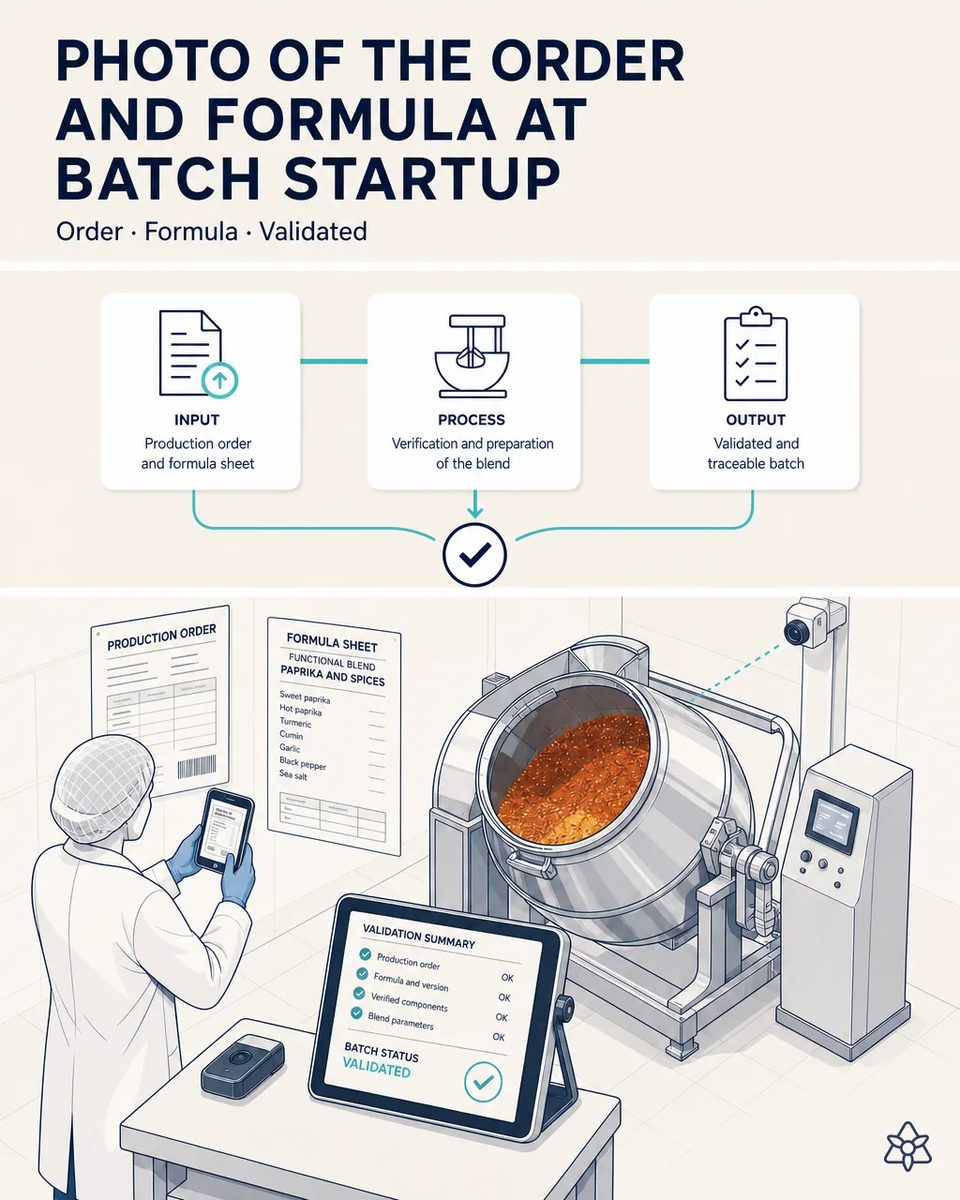
The two sheets that define the batch spend the shift on a clipboard.
the order is printed from ERP data and any last-minute adjustment gets handwritten. The formula sheet for customer-specific blends can carry variations not always logged. Both can sit undigitized for hours, recovered only when someone transcribes them at shift end.
- The production order prints from the ERP, and then reality corrects it by hand: a sack of sweet paprika swapped for another origin lot, a percentage adjusted because the incoming color came in low, a component substituted the morning it ran short.
- The formula sheet for customer-specific blends carries versions that are not always logged. Two blends with the same commercial name can differ in the allergen they declare, and the difference lives in pen on paper.
- Between the mixer starting and somebody transcribing the paperwork, hours pass — and over a weekend, days. Nobody designed it that way; it is simply that transcription is the last thing anyone does and the first thing that gets dropped when the plant is busy.
- During that gap the batch physically exists, is packed and may even ship, while existing in no system anyone can query. Which is exactly when a customer calls asking what went into it, or when quality needs to hold the batch before it leaves.
Connect in photo mode — the operator keeps filling in the same paperwork.
Connect photo mode. A grounded LLM extracts batch, formula, percentages and allergens straight from the photo. The data enters central memory without the operator changing their routine.
It is the shortest of the twelve to deploy and the one that creates least friction at the mixer, because it asks for no change of habit: the operator adds a photo to what they already did. Nothing is taken away, no new screen is introduced and no step is added to the changeover. That is usually why it is the first one approved, and why it is the one that survives the third month.
Batch startup on paper versus batch startup captured
| Aspect | Today, on paper | With iLEAN Connect |
|---|---|---|
| Capture latency | Hours, and days over a weekend | Zero lag |
| Formula version used | Whatever was on the sheet | Recorded with the batch |
| Declared allergens | In pen, in the margin | Structured field, tied to the batch |
| Origin lots consumed | Reconstructed afterwards | Linked at startup |
| Answering a customer query | Hunt through the clipboard | One lookup by batch |
| Operator's routine | — | Unchanged: two photos |
hours of latency until transcription → zero lag. Scattered paper → instant web lookup by batch and formula.
Estimated impact — to validate with your own numbers.
The block below is an estimate to be validated against your plant's actual data. We put it forward so the committee has an order of magnitude; we refine it during the assessment.
- Estimated payback 4-9 months, depending on how many batches you start per day.
- Transcription time recovered by production and by the quality team, which is where it is scarcest and where it is currently spent on typing rather than on control.
- From hours of latency — days over a weekend — down to zero lag, on every batch and not only on the ones somebody remembers.
- And the formula version actually blended stops being a memory exercise when a customer complaint lands weeks later.
estimated payback of 4 to 9 months depending on daily batch volume. *Estimate to validate*.
And the fair question from the production manager
"What if it misreads a percentage in the formula?" — reading fields from a document with a known structure is an anchored task, where the best models drop below 1.5% error [1]. And there is a second net: the summary goes to the tablet next to the mixer and the blending manager confirms or corrects it before anything crosses into the central system.
[1] OpenAI paper "Why Language Models Hallucinate", 2025 — on the reliability of AI in anchored tasks.
What people ask about digitizing batch startup
Do we have to change the production order or the formula sheet?
No. Both keep the format the ERP prints and the layout the blending team is used to. Vision reads the document as it is, including the handwritten corrections in the margin, and no operator is asked to fill in anything new.
Does it pick up the handwritten adjustment on the printed order?
That is the part with the most value, because that is where what actually went into the mixer is written. It is extracted like any other field, and a low-confidence value is flagged for a person to confirm rather than silently accepted.
Does it record the allergens the blend declares?
Yes, as a structured field tied to the batch, taken from the formula version actually used. That is what lets you answer, months later, whether a given batch carried mustard, celery or sesame without opening a single folder.
Does it need ERP or MES integration on day one?
No. The case works from the first batch against iLEAN's central memory, and the push to the ERP is connected afterwards, once the value is demonstrated on the floor. That is deliberate: it keeps the first month free of an integration project.
What about batches started on a weekend shift?
That is where the gap is widest today, because nobody transcribes anything until Monday. With capture, a Sunday batch exists in the system from the first minute exactly like a Tuesday one, tied to the equipment it ran on.
More cases from this series
- Seamless traceability, from sack to packConnect, Edge, Agents, JIDOKA AI and SMED AI coordinated against untraced traceability risk in spice…
- Validate the formula in seconds, no typingNo formula or allergen data enters the central system without human validation first, in 2 taps.
- The delivery note, to ERP in one tapPhoto the delivery note and raw-material sack labels: Connect validates and pushes to the ERP, no driver…
- The dryer that now talksAn external camera digitizes the moisture curve of a vintage dryer/mill without touching the original…
- A headset so plant knowledge never gets lostA spice factory's section lead talks to the AI while walking the floor; no plant knowledge gets lost.
- The lab spreadsheet, straight to the ERPiLEAN reads the lab's quality spreadsheet and pushes it to the ERP, saving up to 80% on module licenses.
Tell us how long a blend batch takes to exist in your system today.
We work on your plant's real data, not ours. Assessment with no commitment.
Request estimated ROI within 48h ‹ See all cases of spices and seasonings See food industry