A headset so plant knowledge never gets lost
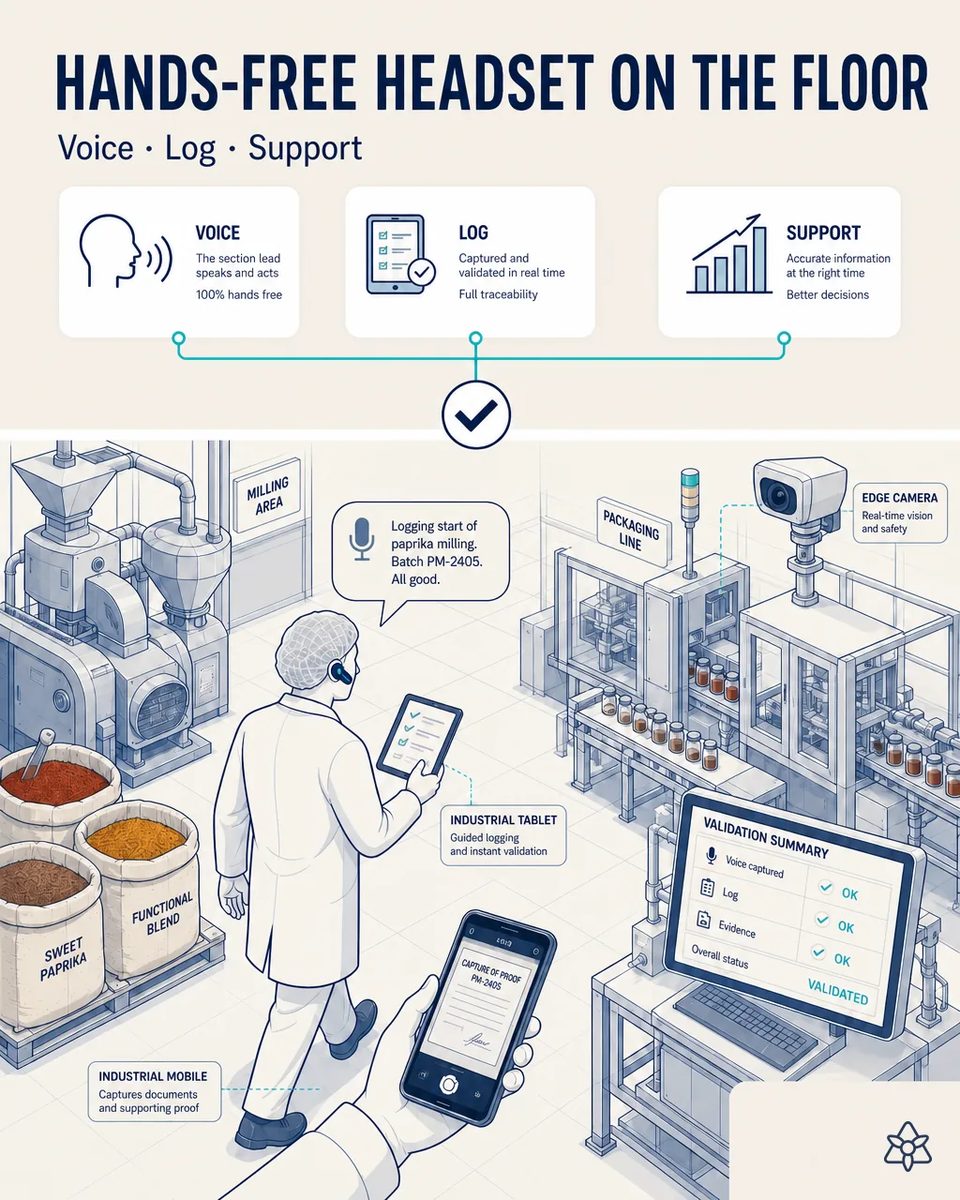
The section lead walks the milling, blending and packaging areas every day, hands always busy. What they notice disappears at shift end if no one logs it. With Connect in voice mode, they log it while walking.
Recurring problems are never spotted as recurring.
the tacit knowledge of whoever walks the floor daily never gets recorded because there's no easy way to capture it without stopping.
- The section lead knows more about the plant than any system: which mill has been running hot since the last origin change, which sifter blinds up with turmeric and not with cumin, which sachet former drifts after two hours.
- Nobody asks them anything because they cannot type with gloves on in a dusty area, and they record nothing because recording means walking back to the office, washing up and opening a system.
- What survives is a five-minute verbal handover and, at best, a line in a notebook that nobody reads again. Everything else evaporates at the door.
- The cumulative effect is worse than it looks: the same problem gets solved again every time, by a different person, with no memory of the three previous attempts. The plant pays for the same diagnosis four times a year.
Connect in voice mode — iLEAN listens to the section lead, not to the line.
Bluetooth headset + Connect voice mode, recognition grounded in plant-specific vocabulary, automatic alert to quality or maintenance when needed.
Humans in command taken literally: it records what the section lead chooses to tell it, when they choose to. There is no open microphone and no background capture. That distinction is not cosmetic — it is what keeps the case alive in month six instead of being read on the floor as control of people, which is how these deployments die.
Today's shift versus the captured shift
| Aspect | Today | With iLEAN Connect |
|---|---|---|
| Floor knowledge | Lost at shift end | Accumulated, queryable memory |
| Shift handover | Five verbal minutes | A written summary, ready |
| A repeat sifter blinding | Invisible: solved again each time | Detected as a pattern with dates |
| Section lead's effort | Walk back to the office | Speak while walking |
| Training a new blender | Depends who is beside them | Backed by the history |
| Ordinary conversation on the floor | — | Not recorded |
knowledge lost at shift end → searchable history by line and date.
Estimated impact — to validate with your own numbers.
The block below is an estimate to be validated against your plant's actual data. We put it forward so the committee has an order of magnitude; we refine it during the assessment.
- No standalone payback: this is an enabling piece. It is not sold on months, and presenting it that way would be dishonest.
- What it changes is the number of recurring incidents that get diagnosed instead of being solved from scratch every time by whoever happens to be on shift.
- It feeds the batch history that the evidence pack and the flagship organize: without a voice log, the dossier has holes exactly where the floor knows most and writes least.
- And onboarding a new section lead or blender stops depending on who happens to be standing next to them that week, which in a lean team is the difference between three months and one.
reduction in undiagnosed recurring issues. *Estimate to validate*.
And the fair question from the production manager
"Is this here to keep track of my team?" — no: iLEAN listens to the section lead, not to the operators, and only to what they choose to dictate. There is no continuous listening and no location tracking. On the transcription side it is an anchored task with plant-specific vocabulary, where the best models drop below 1.5% error [1], and anything unclear is left for the person to confirm rather than guessed.
[1] OpenAI paper "Why Language Models Hallucinate", 2025 — on the reliability of AI in anchored tasks.
What people ask about capturing the shift by voice
Does it work with the noise of a milling area?
That is the design condition. The headset is compatible with hearing protection and with a hairnet, and recognition is prepared for industrial noise and for trade vocabulary rather than for an office.
Does it understand our product names?
It is grounded in your own vocabulary: your blend names, your origin codes, the nicknames your team uses for each mill and sifter. A generic model is what fails here, not the microphone.
Does it have to be said in a particular way?
No. They speak the way they would tell a colleague, and iLEAN structures it afterwards: area, equipment, symptom, criticality and shift. Asking for a fixed phrasing would guarantee nobody uses it after the second week.
How does it tell that something is recurring?
Records are tied to the line and the asset. When the same symptom shows up for the third time on the same sifter, it stops being a shift anecdote and becomes a pattern with dates behind it, which is what justifies a maintenance action.
Does it produce the handover on its own?
Yes, from what was dictated during the shift, already structured. It is the first thing people notice, because today that handover depends entirely on the memory of whoever is walking out of the door.
More cases from this series
- Seamless traceability, from sack to packConnect, Edge, Agents, JIDOKA AI and SMED AI coordinated against untraced traceability risk in spice…
- Paperless batch startupHow a spice factory digitizes the production order and blend formula at batch startup with a simple…
- Validate the formula in seconds, no typingNo formula or allergen data enters the central system without human validation first, in 2 taps.
- The delivery note, to ERP in one tapPhoto the delivery note and raw-material sack labels: Connect validates and pushes to the ERP, no driver…
- The dryer that now talksAn external camera digitizes the moisture curve of a vintage dryer/mill without touching the original…
- The lab spreadsheet, straight to the ERPiLEAN reads the lab's quality spreadsheet and pushes it to the ERP, saving up to 80% on module licenses.
Tell us how many times this year you solved the same milling problem from scratch.
We work on your plant's real data, not ours. Assessment with no commitment.
Request estimated ROI within 48h ‹ See all cases of spices and seasonings See food industry