Validate the formula in seconds, no typing
The exact composition of a blend and its allergens is the plant's most sensitive data point. A tablet next to the mixer shows the summary iLEAN just captured; the manager confirms with 2 taps before it crosses into the central system.
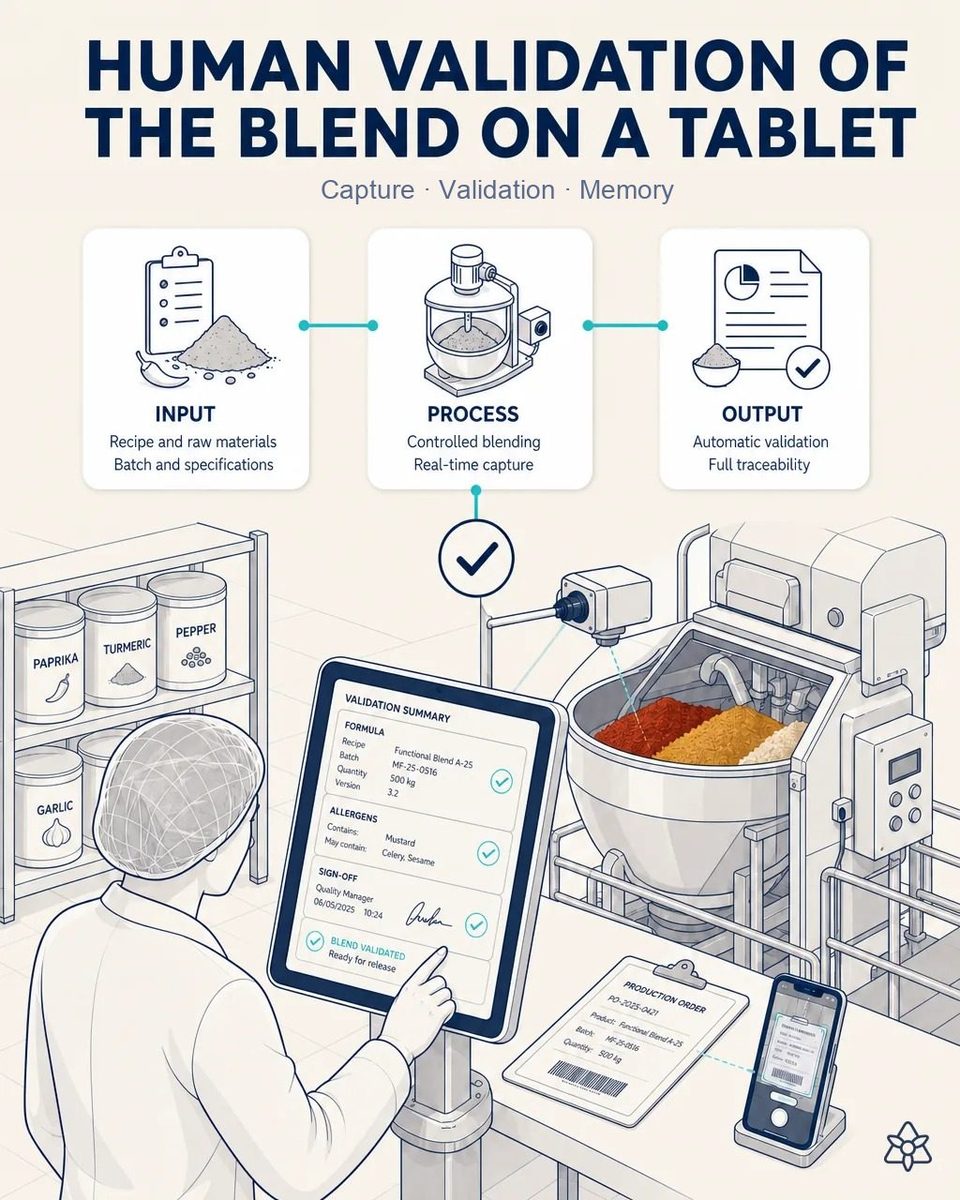
The most sensitive data in the plant enters without anyone signing it.
a formula or allergen error isn't caught today until the customer complains, weeks later.
- The exact composition of a blend and the allergens it declares are the two data points that can force a recall. Everything else in the plant is a quality question; these two are a legal one, and they are handled today with the same clipboard as everything else.
- Today they are written on the formula sheet and typed later, often by somebody who was not at the mixer and did not see which sack went in or which version of the recipe was on the clipboard.
- A wrong allergen on a label is not a complaint, it is a product withdrawal, and it surfaces weeks later when the customer's own audit catches it, by which time the product is on a supermarket shelf.
- When the certification body asks who approved that formula version and on what basis, the answer has to be a name and a timestamp, not a checkbox in a spreadsheet that anyone could have ticked.
Connect with early human verification — two taps at the mixer.
industrial tablet with a visual summary of what was captured (photo, voice or spreadsheet); confirmation in seconds, no retyping.
It is the piece that guarantees the central memory is not contaminated and that every formula has a responsible person by name. Without it the other eleven do not get approved: nobody signs off on AI writing an allergen declaration unsupervised, and they are right not to. The gate is what makes the rest of the architecture defensible.
Today's formula entry versus the signed formula
| Aspect | Today | With iLEAN |
|---|---|---|
| When the data enters | Hours later, by transcription | In seconds, at the mixer |
| Who appears as the author | Whoever typed it | Whoever was at the mixer |
| What the sign-off proves | That somebody signed | Which formula and allergens they saw |
| Allergen error | Found when the customer calls | Caught before the batch runs |
| Manager's time | Walk to a terminal | Two taps on the tablet |
| Who writes to the system | A person, typing | A person, confirming |
unverified data entering blind → a seconds-long human gate before ERP/MES.
Estimated impact — to validate with your own numbers.
The block below is an estimate to be validated against your plant's actual data. We put it forward so the committee has an order of magnitude; we refine it during the assessment.
- No standalone payback: this is an enabling piece. Its value is risk, not productivity, and it is presented as such.
- What it removes is the undetected formula or allergen error, whose cost is not a line on a budget but a product withdrawal and the commercial relationship that goes with it.
- It is also the gate that makes the rest approvable, because it is what keeps unverified data out of the central memory that every other case writes into.
- And every correction the manager makes is stored with its author: the system learns exactly where its extraction fails on your formulas, and the audit trail shows who caught what.
reduction in undetected formula/allergen errors. *Estimate to validate*.
And the fair question from the production manager
"If a person signs at the end, what is the AI actually saving?" — the work is not in deciding, it is in assembling. Today somebody would have to find the batch, read the sheet and type the components. Here it arrives assembled and they confirm or correct. Extraction itself is an anchored task where the best models drop below 1.5% error [1], and nothing crosses without the sign-off.
[1] OpenAI paper "Why Language Models Hallucinate", 2025 — on the reliability of AI in anchored tasks.
What people ask about validating the blend
How long does it take the person signing?
Seconds. The summary arrives with formula, version, quantity and declared allergens already assembled, and it is resolved with two taps from the mixer itself, with gloves on and without walking anywhere.
Can the AI approve a formula on its own?
No, and it is not a configurable option: it is the architecture. Formula and allergen data cross into the system only after human confirmation, and there is no setting that turns that off.
What exactly gets recorded?
Which summary was shown, who confirmed it, when, and what they corrected if anything. That is the record a certification body asks for, and it is also the record that protects the person who signed.
Does it work with voice and spreadsheet capture too?
Yes. Whatever the source — a photo of the sheet, a dictated note or the lab file — the summary is the same and the gate is the same. There is one door into the central memory, not three.
Is it mandatory before deploying the others?
In practice yes. It is the piece that makes the rest approvable, because it is what guarantees no unverified allergen declaration ever reaches a label or a specification sheet.
More cases from this series
- Seamless traceability, from sack to packConnect, Edge, Agents, JIDOKA AI and SMED AI coordinated against untraced traceability risk in spice…
- Paperless batch startupHow a spice factory digitizes the production order and blend formula at batch startup with a simple…
- The delivery note, to ERP in one tapPhoto the delivery note and raw-material sack labels: Connect validates and pushes to the ERP, no driver…
- The dryer that now talksAn external camera digitizes the moisture curve of a vintage dryer/mill without touching the original…
- A headset so plant knowledge never gets lostA spice factory's section lead talks to the AI while walking the floor; no plant knowledge gets lost.
- The lab spreadsheet, straight to the ERPiLEAN reads the lab's quality spreadsheet and pushes it to the ERP, saving up to 80% on module licenses.
Tell us who appears today as the author of your allergen declarations.
We work on your plant's real data, not ours. Assessment with no commitment.
Request estimated ROI within 48h ‹ See all cases of spices and seasonings See food industry