The lab spreadsheet, straight to the ERP
The quality manager fills a spreadsheet every batch with moisture, color and heat level in a shared folder. With Connect, that file is read on save and, after validation, pushed automatically to the ERP.
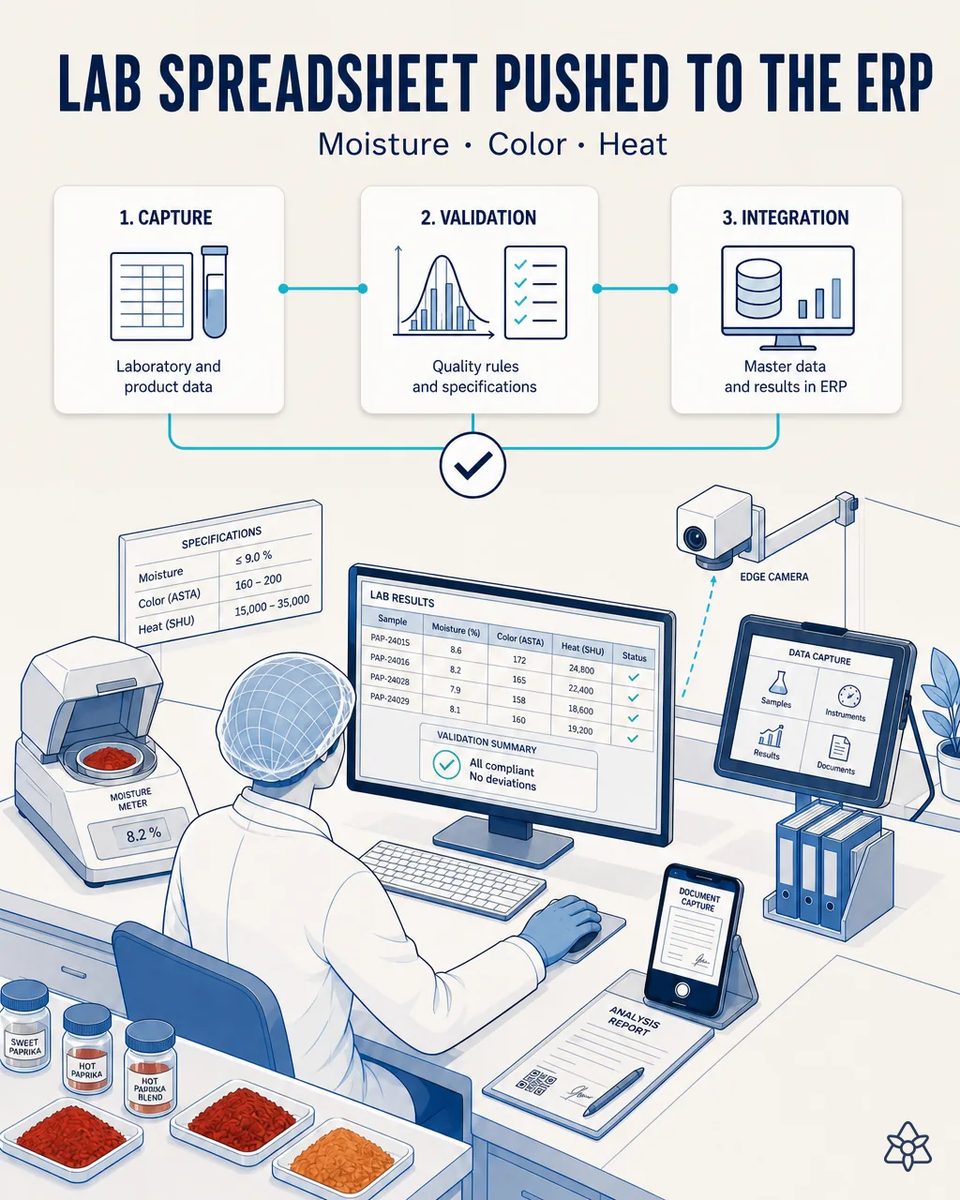
Two parallel worlds and a technician copying cells between them.
the spreadsheet is the real source of truth, but the ERP demands manual re-entry, days behind the real data.
- The spreadsheet holds the live data: moisture per batch, ASTA color, heat, granulometry after sifting, and the aflatoxin and ethylene oxide results that come back from the external lab days later. It is the file everyone actually trusts.
- The ERP holds a transcribed, incomplete and out-of-date version of the same numbers. The practical gap runs from days to weeks, and it is the ERP that the commercial team quotes from when a customer asks for a specification.
- Transcription errors surface at the worst possible moment: preparing a certificate of analysis for a customer, or answering a complaint about color drift with a figure that turns out not to match the spreadsheet.
- And several lab and quality people log into the ERP purely to type these numbers in, each one consuming a named quality-module license that the plant pays for every year.
Connect in inward listening mode — it watches the file, not the person.
Connect "inward listening" — watches the shared folder, parses with a grounded LLM, pushes to the ERP after human validation. License savings: if several lab staff currently log into the ERP just to enter this data, each consumes a quality-module license; with Connect, only the validator needs one.
The certificate of analysis the customer asks for stops being rebuilt: it is in the system, up to date, on the day they ask. That turns an afternoon's work into a lookup, and it removes the version problem entirely — there is no longer a spreadsheet figure and an ERP figure that disagree about the same batch, with nobody able to say which one is right.
Today's lab versus the connected lab
| Aspect | Today | With iLEAN Connect |
|---|---|---|
| Gap between real data and ERP | From days to weeks | Same shift |
| Manual transcription | Every batch, every day | Zero |
| Certificate of analysis | Rebuilt by hand | Assembled from live data |
| Copying errors | Surface with the customer | Eliminated |
| Spreadsheet format | Has to be respected | Tolerated as it is, even as it changes |
| Quality-module licenses | Four or five | One, the validator |
manual transcription and days of lag → lab data in the ERP the same shift.
Estimated impact — to validate against your actual invoice.
The block below is an estimate to be validated against your plant's actual data. We put it forward so the committee has an order of magnitude; we refine it during the assessment.
- 💰 CFO angle: the ERP bills per named user. If four or five lab and quality people log in purely to enter results, that is four or five licenses: 50-80 % reduction, recurring every year.
- Transcription time recovered from the scarcest team in the plant, which is the quality team that also has to run the audits.
- From a days-to-weeks gap down to lab data available in the ERP within the same shift it was measured, on every batch.
- And ASTA color, heat and moisture history becomes a trend you can act on mid-campaign instead of a folder you consult after a customer has already complained.
50% to 80% savings on quality-module ERP licenses, recurring every year. *Estimate to validate*.
And the fair question from the production manager
"Several people have been changing that sheet for years — does it hold up?" — that is the anticipated case: parsing does not depend on fixed positions, it interprets columns, units, merged cells and margin notes without asking anyone to standardize anything. It is an anchored task, where the best models drop below 1.5% error [1], and the quality manager validates before the push.
[1] OpenAI paper "Why Language Models Hallucinate", 2025 — on the reliability of AI in anchored tasks.
What people ask about connecting the lab spreadsheet
Do we have to standardize the spreadsheet first?
No, and it is better not to. Asking the lab to change the file it has used for years is the fastest route to nobody using the system. iLEAN reads the one that exists, with its merged cells and its margin notes.
Does it include results that come back from an external lab?
Yes: aflatoxins and ethylene oxide enter when the report is filed, the same way. What changes is not the turnaround of the analysis, it is the time until the result is available to everyone who needs it.
Can licenses really be reduced?
It depends on your contract, which is why it is framed as an estimate to validate against last year's invoice. The logic is simple: anyone logging in purely to type stops needing to, and only the validator keeps a seat.
Does it help with the certificate of analysis?
It is one of the biggest time savers, because today that document is assembled by hand, against the clock, every time a customer asks for it, and it is assembled from the very data the spreadsheet already holds.
Does it watch the folder or the person?
The folder. The file is read when it is saved; there is no record of who opens what, how long they spend in it or when they log off.
More cases from this series
- Seamless traceability, from sack to packConnect, Edge, Agents, JIDOKA AI and SMED AI coordinated against untraced traceability risk in spice…
- Paperless batch startupHow a spice factory digitizes the production order and blend formula at batch startup with a simple…
- Validate the formula in seconds, no typingNo formula or allergen data enters the central system without human validation first, in 2 taps.
- The delivery note, to ERP in one tapPhoto the delivery note and raw-material sack labels: Connect validates and pushes to the ERP, no driver…
- The dryer that now talksAn external camera digitizes the moisture curve of a vintage dryer/mill without touching the original…
- A headset so plant knowledge never gets lostA spice factory's section lead talks to the AI while walking the floor; no plant knowledge gets lost.
Tell us how many people log into your ERP purely to enter lab results.
We work on your plant's real data, not ours. Assessment with no commitment.
Request estimated ROI within 48h ‹ See all cases of spices and seasonings See food industry