The dryer that now talks
A plant's paprika dryer or mill is often over a decade old, with a proprietary controller isolated from the network. Its screen shows the process's most critical variable — moisture — but that data dies with every screen change. With Connect, an external camera digitizes it without touching the machine.
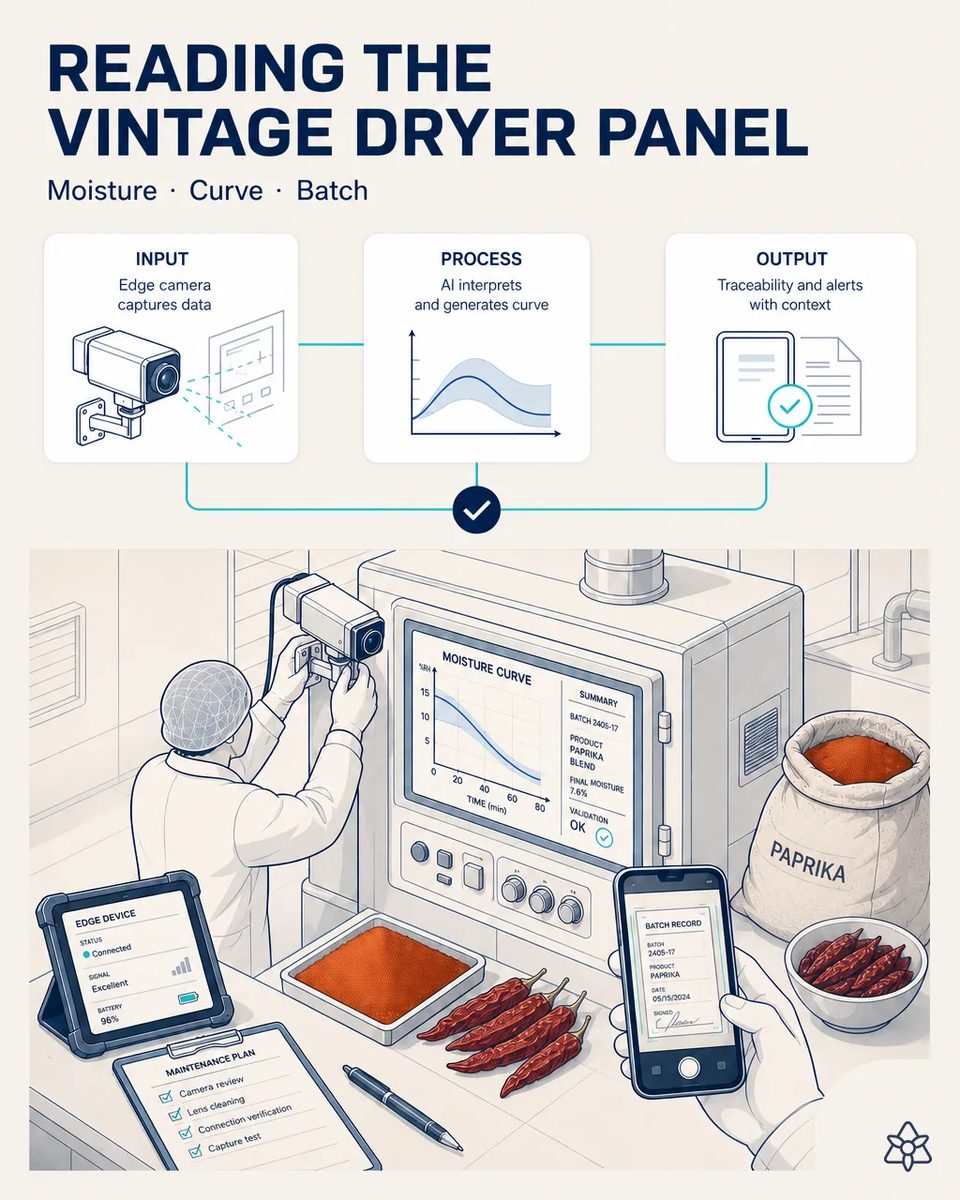
The variable that decides the product leaves no trace.
replacing the dryer would cost hundreds of thousands of euros and weeks of downtime. Meanwhile, quality can't correlate moisture with issues because the data is never logged.
- Moisture decides almost everything downstream: whether the mill clogs, whether the powder cakes in the sachet, whether the product holds its best-before date, whether mold risk appears in the jar three months later.
- The dryer or the mill that governs it is often more than a decade old, with a proprietary controller the manufacturer keeps off the plant network by design. Replacing it costs hundreds of thousands of euros and weeks of downtime the season will not allow.
- Its screen shows the curve in real time, and that curve dies with every screen change. What survives is a final figure written into the logbook, if anyone writes it, and a figure is not a curve.
- So when a customer complaint arrives, quality cannot correlate the incident with what happened in the dryer, because the data was never logged in the first place. The analysis stops before it starts.
Connect in photo mode on the panel — solved from outside, not from inside.
Connect photo mode on the panel + OCR with a grounded LLM. Each reading is structured and cross-referenced with the batch being processed at that moment.
It does not integrate with the controller, does not open ports and installs nothing on a machine that has been running for a decade. The camera is mounted, aimed and calibrated, and the equipment never learns it is being read. On the machine the whole plant depends on, that is the difference between an approvable case and a project maintenance never authorizes.
Today's dryer versus the dryer being read
| Aspect | Today | With iLEAN Connect |
|---|---|---|
| The moisture curve | Dies with the screen change | Digitized batch by batch |
| What survives a drying run | A final figure in the logbook | The whole curve, tied to the origin lot |
| Moisture-to-incident correlation | Impossible | Root cause in minutes |
| Caking in the sachet | Diagnosed by guesswork | Traced back to its drying run |
| The controller's software | — | Untouched, no revalidation |
| Replacement capex | On the plan | Deferrable |
zero moisture↔issue correlation → root-cause analysis by batch in minutes.
Estimated impact — to validate with your own numbers.
The block below is an estimate to be validated against your plant's actual data. We put it forward so the committee has an order of magnitude; we refine it during the assessment.
- Estimated payback 5-10 months, with the avoided capex of replacing the dryer on top.
- Root-cause analysis by batch in minutes instead of a correlation nobody in the plant is currently able to make at all.
- Drying drift detected as a trend over successive runs, before it turns into an out-of-spec batch or a caking complaint three months later.
- And the equipment keeps running exactly as it is: no weeks of downtime in the middle of the campaign and no hundreds of thousands of euros brought forward in the investment plan.
estimated payback of 5 to 10 months, also avoiding equipment replacement CAPEX. *Estimate to validate*.
And the fair question from the production manager
"Does a camera pointed at a screen hold up in front of an auditor?" — here the task is anchored: a fixed panel, fields in known positions and physically bounded ranges, where the best models drop below 1.5% error [1]. And the system discards any frame whose moisture value falls outside the possible range instead of accepting it, which is exactly what would invalidate the series for a certification body.
[1] OpenAI paper "Why Language Models Hallucinate", 2025 — on the reliability of AI in anchored tasks.
What people ask about reading the dryer panel
Does the equipment have to be modified or revalidated?
No, and that is the point. Nothing is installed on the machine and no port is opened, so its controller and its validation are untouched. The manufacturer's position on network access becomes irrelevant, because nobody is asking for network access.
Does it capture the whole curve or just the final value?
The whole curve: setpoint, temperature, elapsed time and the moisture trend through the run. You already have the final figure; what is missing is how it got there, and that is where the explanation of a bad batch lives.
Can it be tied to the origin lot being dried?
Yes, by crossing each reading with the batch running at that moment. That is what turns a number on a screen into evidence you can put in front of a customer, or in front of a certification body asking about a specific harvest.
Does it work on the mill panel too?
The pattern is identical for any isolated panel: mill, sifter or the sampling drawer's own display. You start with the dryer because moisture is the variable with the longest reach downstream, but the second camera is usually cheaper than the first.
What if the screen is dirty or badly lit?
It is the normal condition in a milling area, and it is designed for. The mount and the lighting are set at commissioning, and a frame that cannot be read with confidence is discarded rather than guessed.
More cases from this series
- Seamless traceability, from sack to packConnect, Edge, Agents, JIDOKA AI and SMED AI coordinated against untraced traceability risk in spice…
- Paperless batch startupHow a spice factory digitizes the production order and blend formula at batch startup with a simple…
- Validate the formula in seconds, no typingNo formula or allergen data enters the central system without human validation first, in 2 taps.
- The delivery note, to ERP in one tapPhoto the delivery note and raw-material sack labels: Connect validates and pushes to the ERP, no driver…
- A headset so plant knowledge never gets lostA spice factory's section lead talks to the AI while walking the floor; no plant knowledge gets lost.
- The lab spreadsheet, straight to the ERPiLEAN reads the lab's quality spreadsheet and pushes it to the ERP, saving up to 80% on module licenses.
Tell us whether you can correlate a complaint with its drying curve today.
We work on your plant's real data, not ours. Assessment with no commitment.
Request estimated ROI within 48h ‹ See all cases of spices and seasonings See food industry