Seamless traceability, from sack to pack
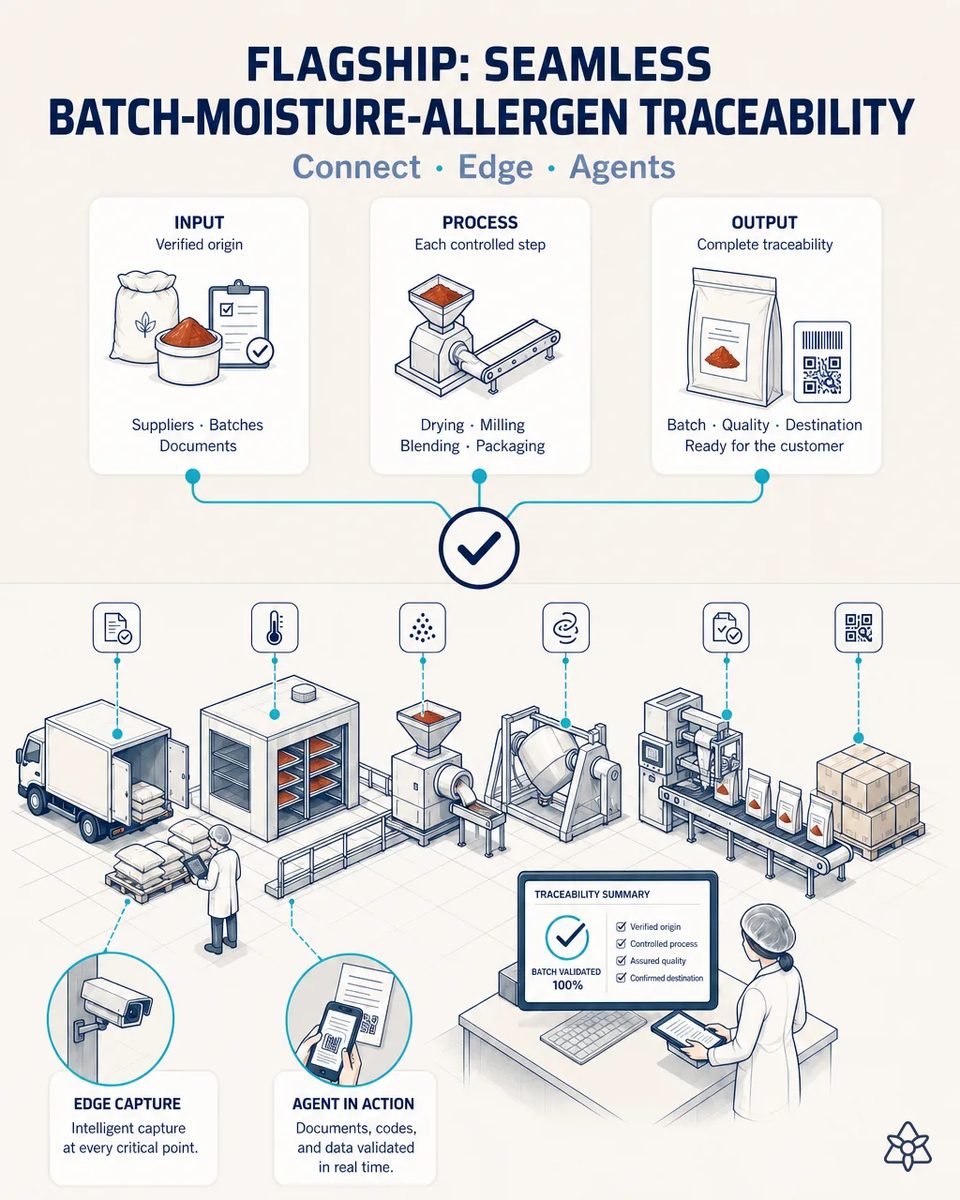
The pain that defines a spice factory this size is sustaining full traceability, with a small team, under demanding certifications. The complete system coordinates every piece covered in the previous cases against that risk.
A recall is almost never caused by a single failure.
any gap — moisture, allergen, untraced cleaning — can escalate into a product recall or an audit non-conformity, with a team too small to watch every point by hand.
- It is the concatenation: an origin lot typed in a hurry at the dock, a drying run whose moisture nobody logged, a changeover signed without evidence and a formula version that was never recorded.
- Each link on its own looks acceptable, and each one passes its own control. Together they produce the batch you cannot defend when the question comes.
- That is why isolated controls are not enough: they have to cross-check each other, because what gives a gap away is two independent sources ceasing to agree about the same batch.
- And the team that would have to hold every point by hand is the same lean quality team that also runs the audits, the specification sheets, the customer complaints and the supplier approvals.
Four rings that cross-check — it is all of the above, orchestrated.
Connect captures every signal; Edge visually monitors critical points; Agents coordinates the auditable dossier; JIDOKA AI blocks startup on anomalies; SMED AI speeds up formula changeovers between batches.
No single ring solves the problem: each one already exists today in some form and the gap still appears. The strength is in the cross-check, because a traceability chain is only as good as its weakest link, and this is what makes the weak link announce itself instead of waiting to be discovered by a customer.
The four rings, and what each one closes
| Ring | Which cases it draws on | What it closes |
|---|---|---|
| 1 · Origin | Intake (7) + supplier alert (3) | Which grower, harvest and lot the batch is made of |
| 2 · Process | Batch startup (1) + dryer panel (2) + lab (6) | Formula, moisture, color and heat, batch by batch |
| 3 · Allergen | Blend validation (5) + allergen cleaning (10) | What the batch declares and what the equipment held before |
| 4 · Evidence | Encoder (8) + packaging (9) + evidence pack (11) | What was printed, what shipped and the dossier behind it |
| Cross-check | JIDOKA AI over all four | Startup blocked when two sources disagree |
| Changeovers | SMED AI between batches | Formula changes without the evidence gap |
traceability rebuilt by hand under pressure → live traceability, queryable by batch at any moment.
Estimated impact — to validate with your own numbers.
The block below is an estimate to be validated against your plant's actual data. We put it forward so the committee has an order of magnitude; we refine it during the assessment.
- No standalone payback figure is claimed for the whole system: each layer pays on its own, and the combined number depends on which order you deploy them in.
- Non-conformity and recall risk reduced by an order of magnitude, which is the pain that defines a plant of this size.
- Traceability queryable by batch at any moment, instead of a reconstruction exercise under pressure.
- And the quality team freed from transcription work, which is the capacity you actually needed to certify the next standard.
non-conformity/recall risk reduced by an order of magnitude, quality team freed from transcription work. *Estimate to validate*.
And the fair question from the production manager
"Do we have to deploy all twelve cases to get this?" — no, and framing it that way is the way never to start. The rings are built in layers and each case pays on its own from the first month. With intake and batch startup you already have ring 1 and half of ring 2, which is where most of the missing traceability sits. Within each ring the underlying tasks stay anchored, where the best models drop below 1.5% error [1], with a person on the gate.
[1] OpenAI paper "Why Language Models Hallucinate", 2025 — on the reliability of AI in anchored tasks.
What people ask about the complete system
Where do you start?
With the case that has fewest dependencies and the shortest deployment, which in this matrix is raw-material intake or batch startup. What matters is that each layer pays on its own, so the decision to continue is taken on results and not on faith.
What does the cross-check give that each control does not?
Exactly what escapes today: the concatenation. An origin lot typed in a hurry passes its own control, an unlogged drying run passes its own, and the batch that carries both is the one you cannot defend when somebody asks.
What happens when a ring flags a discrepancy?
JIDOKA AI stops on a verifiable disagreement between sources, not on model uncertainty. When the doubt is the model's, the case is escalated to a person instead of blocking the plant on a maybe.
Does it replace the ERP we already have?
No. Ring 1 rests precisely on the order and the goods receipt being the truth. iLEAN cross-checks the systems against each other and against what actually happened on the floor, which is the comparison nobody can make today.
Can the return be estimated before committing?
Yes: with your batch volume, your complaint history and the hours your last audit took to prepare, the return per layer is estimated before you decide the deployment order. That estimate is the first meeting, not the last.
More cases from this series
- Paperless batch startupHow a spice factory digitizes the production order and blend formula at batch startup with a simple…
- Validate the formula in seconds, no typingNo formula or allergen data enters the central system without human validation first, in 2 taps.
- The delivery note, to ERP in one tapPhoto the delivery note and raw-material sack labels: Connect validates and pushes to the ERP, no driver…
- The dryer that now talksAn external camera digitizes the moisture curve of a vintage dryer/mill without touching the original…
- A headset so plant knowledge never gets lostA spice factory's section lead talks to the AI while walking the floor; no plant knowledge gets lost.
- The lab spreadsheet, straight to the ERPiLEAN reads the lab's quality spreadsheet and pushes it to the ERP, saving up to 80% on module licenses.
Tell us how long your last traceability exercise took from sack to pack.
We work on your plant's real data, not ours. Assessment with no commitment.
Request estimated ROI within 48h ‹ See all cases of spices and seasonings See food industry