A coating defect is only visible while the piece goes past
At the real speed of a croquette line the human eye cannot look at every piece, and the ones that get through are always the same: incomplete breading, a piece burst in the pre-fryer, a misshapen one, one outside weight tolerance. Once frozen they are indistinguishable. Edge places an overhead camera at the breading outfeed, infers in milliseconds and rejects before the tunnel.
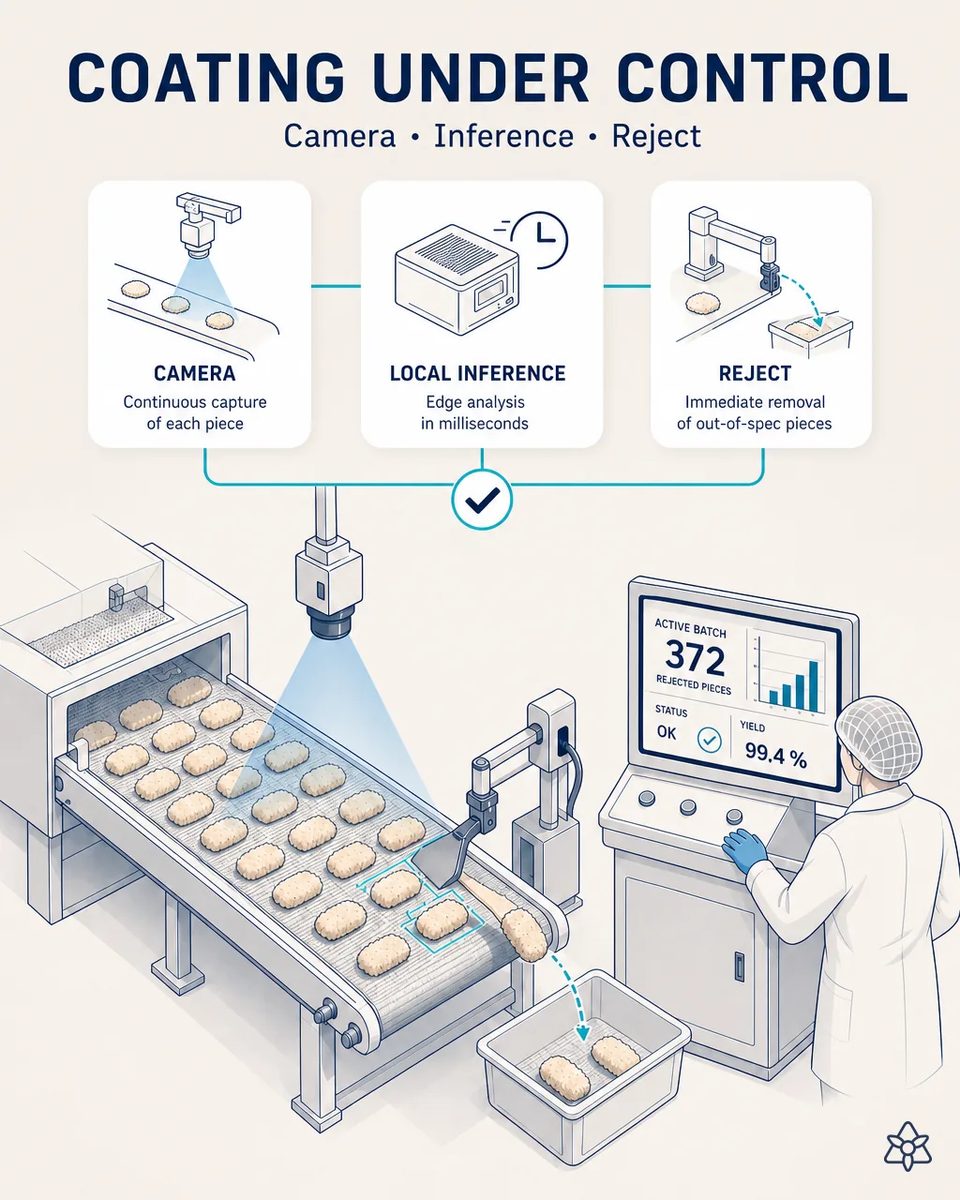
A coating defect is visible for one second, and then it freezes.
A coating defect is superficial and visible, but only if somebody is looking at that piece at that exact instant. Sampling-based inspection leaves gaps by definition. And this product has a cruel particularity: once the piece enters the tunnel and freezes, it becomes indistinguishable from the rest. It is packed, palletized and distributed. The defect is discovered when the croquette opens up in the restaurant's fryer, and the complaint arrives with a photograph. Every defective piece that gets through also consumes tunnel freezing capacity and packaging, both of which are lost too.
- Incomplete breading, a piece burst in the pre-fryer, a misshapen one, one outside weight tolerance: all superficial, all visible — but only if somebody is looking at that piece at that exact instant. At the real speed of a croquette line, sampling leaves gaps by definition.
- This product has a cruel particularity: once the piece enters the tunnel and freezes, it becomes indistinguishable from the rest. It is packed, palletized and distributed.
- The defect is discovered when the croquette opens up in the restaurant's fryer, and the complaint arrives with a photograph and the distributor's name on it.
- Every defective piece that gets through also consumes tunnel freezing capacity and packaging, both of which are lost too.
Edge — AI vision executed locally, piece by piece, before the tunnel infeed.
Edge — AI vision executed locally.
Rejecting before the tunnel instead of after the customer does two things at once: the scrap is never frozen and never packed, and every rejection is logged against the batch. That second effect — a defect history by reference and line — is the one that ends up changing how the breading machine is run, because for the first time the plant can see that bare pieces appear above a certain belt speed on one format and not on another. The supervisor's observation from case 4 gets a number behind it.
- An overhead camera on the breading outfeed belt, before the tunnel infeed.
- A neural network trained on good and bad pieces of the plant's real formats — croquette, large croquette, mini croquette, filled pepper, bite-size — rather than a generic model.
- Inference in milliseconds per piece on a local GPU: no image is sent to the cloud, so neither latency, bandwidth nor connectivity is a limit.
- The defective piece is rejected before the tunnel.
- Every rejection is logged against the batch and feeds the defect history by reference and line.
Today's inspection versus Edge vision
| Aspect | Sampling inspection | With iLEAN Edge |
|---|---|---|
| Coverage | A small percentage of pieces | 100% of pieces |
| Where the defect is found | In the restaurant's fryer | On the breading outfeed |
| A burst or bare piece | Frozen, packed and shipped | Rejected before the tunnel |
| Tunnel capacity and packaging | Spent on scrap | Spent on good product only |
| Defect history | None | By reference, line and batch |
| Images sent to the cloud | — | None: inference on a local GPU |
Impact estimate — to be validated with your numbers.
The block below is an estimate to be validated against your plant's actual data. We put it forward so the committee has an order of magnitude; we refine it during the assessment.
- Estimated payback 5-12 months, depending on the current scrap ratio.
- The saving is made of scrap never frozen, packaging never used and complaints never received.
- From sampling a small percentage to inspecting every piece, at line speed, without slowing the breading line.
- And a defect history that shows, for the first time, which reference and which line speed produce the bare pieces.
estimated payback of 5 to 12 months depending on the current scrap ratio. The saving is made of scrap never frozen, packaging never used and complaints never received. *Estimate to be validated*.
And the fair question from the production manager
“What if it rejects good croquettes?” — the false positive is the real risk of any vision system, which is why the network is trained on good and bad pieces of your own formats — croquette, large croquette, mini, filled pepper, bite-size — under that belt's lighting, not on a generic model. Classifying a piece against a trained reference is an anchored task, where the best models drop below 1.5% error [1]. Borderline pieces are not simply rejected: they are escalated for a person to decide, and every decision feeds back into training.
[1] OpenAI paper "Why Language Models Hallucinate", 2025 — on the reliability of AI in anchored tasks.
What people ask about coating vision
Does it keep up with the speed of the breading line?
Yes: inference runs on a local GPU in milliseconds per piece. It does not depend on the plant network, on bandwidth or on the cloud, so line speed is not a limit and no image of your product ever leaves the plant.
How many pieces do we need to train it?
Fewer than feared, because the defect catalog of a breaded piece is short and repetitive: bare patches, burst, misshapen, out of tolerance. What matters is that they are real pieces from your formats, photographed on your belt under your lighting, which is what a vision trial with your own product provides.
Does it work for several formats on the same line?
Yes, switching the model according to the active reference from the work order. A croquette line that runs mini and large formats in the same shift is the normal case.
What happens to the rejected piece?
It is diverted before the tunnel infeed and logged against the batch. It never consumes freezing capacity or packaging, and the count feeds the defect history. Whether the diverted piece is reworked or discarded stays a decision of the kitchen.
Does it replace the quality technician?
No. It replaces the sampling that could never cover every piece. The technician gets a history by reference and line instead of a complaint with a photograph.
More cases from this series
- Non-conformities come from the gaps, not from the processEvery changeover and batch builds its dossier with photos, records and signatures, organized by…
- Four rings that verify each other, from recipe to palletFour verification rings cross-checking each other, from recipe to pallet, so the discrepancy is caught…
- The last machine to touch the product should not depend on typingLot, expiry and allergens travel from the work order to the coder by API, including in export market…
- The plant's most expensive asset is also its most silentAn external camera digitizes the freezing curve of a blast tunnel without touching the machine or…
- Traceability is born on the dock, and it is born in a hurryPhotograph the delivery note, the lot labels and the thermometer: goods receipt enters the ERP after one…
- The person who knows the plant best is the one who can log the leastThe supervisor dictates while walking with both hands busy: iLEAN listens, ties it to the active batch…
Tell us what percentage of your output is inspected piece by piece today.
We work on your plant's real data, not ours. Assessment with no commitment.
Request estimated ROI within 48h ‹ See all cases of precooked frozen foods See food industry