Four rings that verify each other, from recipe to pallet
The capital pain of a precooked frozen food factory is zero incidents from allergens or mislabeling across a catalog of dozens of references sharing lines. One single incident costs the recall, the distributor penalty, collection across hundreds of points of sale and, in the worst case, the contract. The iLEAN system coordinates the previous eleven pieces into four rings that verify each other.
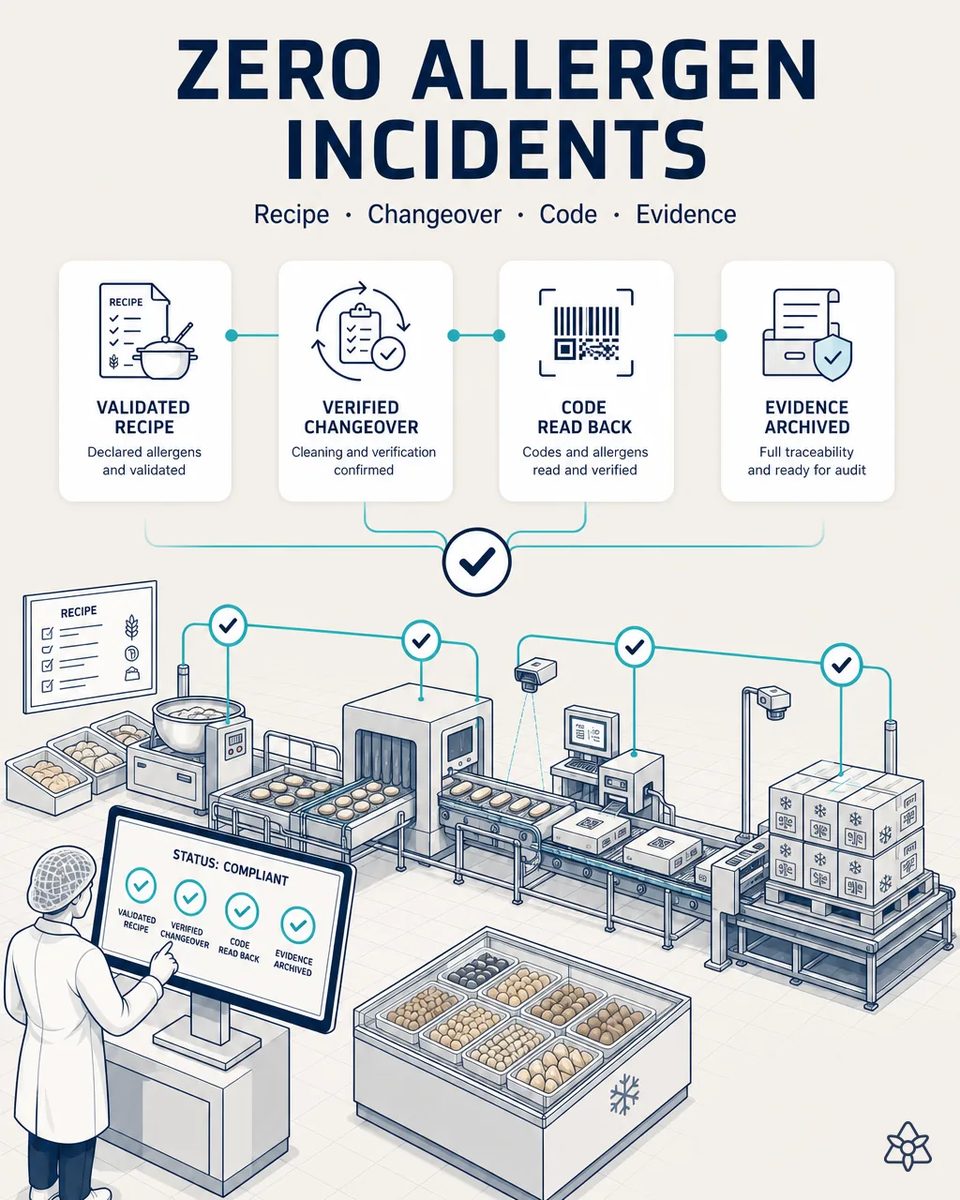
An allergen or mislabeling incident is never a single failure.
What makes this pain critical is the combination of four conditions: a broad catalog, shared lines, a dense allergen matrix (milk, gluten, egg, fish, crustaceans, molluscs) and multi-language labeling for export. Each one on its own is manageable without drama. All four together turn every working day into dozens of critical transitions, and only one has to fail: a run contaminated with crustacean, an export case carrying the allergen declaration of the previous recipe. And the cost that never appears on the recall invoice is the highest one: the relationship with the distributor, worth considerably more than the incident.
- What makes this pain critical is the combination of four conditions: a broad catalog, shared lines, a dense allergen matrix — milk, gluten, egg, fish, crustaceans, molluscs — and multi-language labeling for export.
- Each one on its own is manageable without drama. All four together turn every working day into dozens of critical transitions, and only one has to fail: a run contaminated with crustacean, an export case carrying the allergen declaration of the previous recipe.
- One incident costs the recall, the distributor penalty, collection across hundreds of points of sale and, in the worst case, the contract.
- And the cost that never appears on the recall invoice is the highest one: the relationship with the distributor, worth considerably more than the incident.
Agents coordinating four rings that cross-check — it is all of the above, orchestrated.
Four rings, each with its own case behind it:
No single ring solves the problem: each one already exists today in some form and the incident still gets through. The strength is in the cross-check, because what gives a bad transition away is four independent sources ceasing to agree — and when they disagree, JIDOKA AI stops the line before palletizing.
- Ring 1 · The recipe (Connect, cases 1 and 5): the active order and its recipe sheet define what is produced, from which raw materials and which allergens it declares. Captured by photo and validated by a human on the tablet.
- Ring 2 · The changeover (Edge + JIDOKA AI, case 10): the line does not start the new reference until the cameras confirm the critical points are clean and quality signs on that evidence. SMED AI accelerates the changeover sequence so that rigour does not penalize productivity.
- Ring 3 · The mark on the product (cases 8 and 9): the coder prints lot, expiry and allergens straight from the order, with no typing; and the line camera reads back what is printed and cross-checks it against the active order. If they do not match, JIDOKA AI stops the line before palletizing. Two independent systems checking each other.
- Ring 4 · The evidence (Agents, case 11): every batch leaves with its dossier — recipe, cleaning evidence, tunnel curve, laboratory controls, photograph of the code and signatures — organized by standard and available with no human work.
The four rings, and what each one closes
| Ring | Which cases it draws on | What it closes |
|---|---|---|
| 1 · The recipe | Batch start (1) + line-side sign-off (5) | What is produced, from which lots, declaring which allergens |
| 2 · The changeover | Allergen changeover (10) | The line does not start until every critical point clears on evidence |
| 3 · The mark on the product | Coder (8) + coating vision (9) | Printed lot, expiry and allergens read back against the active order |
| 4 · The evidence | Evidence pack (11) | Every batch leaves with its dossier, organized by standard |
| When two rings disagree | JIDOKA AI | The line stops before palletizing |
| When the customer calls | Agents | The batch dossier, in minutes |
Impact estimate — to be validated with quality and management.
The block below is an estimate to be validated against your plant's actual data. We put it forward so the committee has an order of magnitude; we refine it during the assessment.
- Estimated payback 6-12 months, measured against the first incident avoided.
- The direct cost of that incident runs into tens or hundreds of thousands across recall, penalty and collection from hundreds of points of sale, without counting the distributor relationship.
- The discrepancy is caught on the line instead of at the customer, and an alert is answered with the batch dossier in minutes instead of after days of reconstruction.
- And SMED AI accelerates the changeover sequence, so the rigor of ring 2 does not penalize productivity.
the return is measured against the first incident avoided, whose direct cost runs into tens or hundreds of thousands, without counting the distributor relationship. Estimated payback of 6 to 12 months. *Estimate to be validated with quality and management*.
And the fair question from the production manager
“Do we have to deploy all twelve cases to get this?” — no, and framing it that way would be the way never to start. The rings are built in layers and each case pays on its own. With the batch start, the line-side tablet and the coder you already have ring 1 and half of ring 3, which is where mislabeling is decided. Each ring rests on anchored tasks where the best models drop below 1.5% error [1]; what the cross-check adds is that a failure in one ring is caught by another before the pallet leaves.
[1] OpenAI paper "Why Language Models Hallucinate", 2025 — on the reliability of AI in anchored tasks.
What people ask about the complete system
Where do you start?
With the case that has fewest dependencies and the shortest deployment, which in this matrix is the paperless batch start together with the line-side tablet. What matters is that each layer pays on its own.
What does the cross-check give that each control does not?
Exactly what escapes today: a changeover that was signed, a coder that printed what the last run left, a batch that passed both. Two independent sources disagreeing is the signal no single control produces.
What if a ring flags a false discrepancy?
JIDOKA AI stops on a verifiable discrepancy between sources — the printed allergen list against the active order, for example — not on model uncertainty. When the doubt is the model's, it is escalated to a person.
Does it replace our ERP or our recipe master?
No. Ring 1 rests precisely on the order and the recipe master being the truth. iLEAN cross-checks the systems against each other and against what actually happens in the kitchen.
Can the return be estimated before committing?
Yes: with your number of critical transitions per day, your allergen matrix, the cost of the last recall or distributor penalty and the export markets you label for, the return per ring is estimated before deciding the order. That is what the design session for the four rings on your line is for.
More cases from this series
- Non-conformities come from the gaps, not from the processEvery changeover and batch builds its dossier with photos, records and signatures, organized by…
- The last machine to touch the product should not depend on typingLot, expiry and allergens travel from the work order to the coder by API, including in export market…
- The plant's most expensive asset is also its most silentAn external camera digitizes the freezing curve of a blast tunnel without touching the machine or…
- Traceability is born on the dock, and it is born in a hurryPhotograph the delivery note, the lot labels and the thermometer: goods receipt enters the ERP after one…
- The person who knows the plant best is the one who can log the leastThe supervisor dictates while walking with both hands busy: iLEAN listens, ties it to the active batch…
- The good data lives in a spreadsheet the ERP never seesThe laboratory control sheet flows into the ERP after human sign-off, with up to 80% fewer licenses on…
Tell us how many critical transitions your plant runs per day.
We work on your plant's real data, not ours. Assessment with no commitment.
Request estimated ROI within 48h ‹ See all cases of precooked frozen foods See food industry