The good data lives in a spreadsheet the ERP never sees
In a precooked food factory with its own laboratory, the live data — average piece weight, core temperature, filling percentage, béchamel viscosity, microbiology, pre-fryer oil control — is filled in every shift on a spreadsheet in a shared folder. It reaches the ERP weeks later, transcribed by hand. Connect reads the sheet when it is saved and, after sign-off, writes it into the ERP by API.
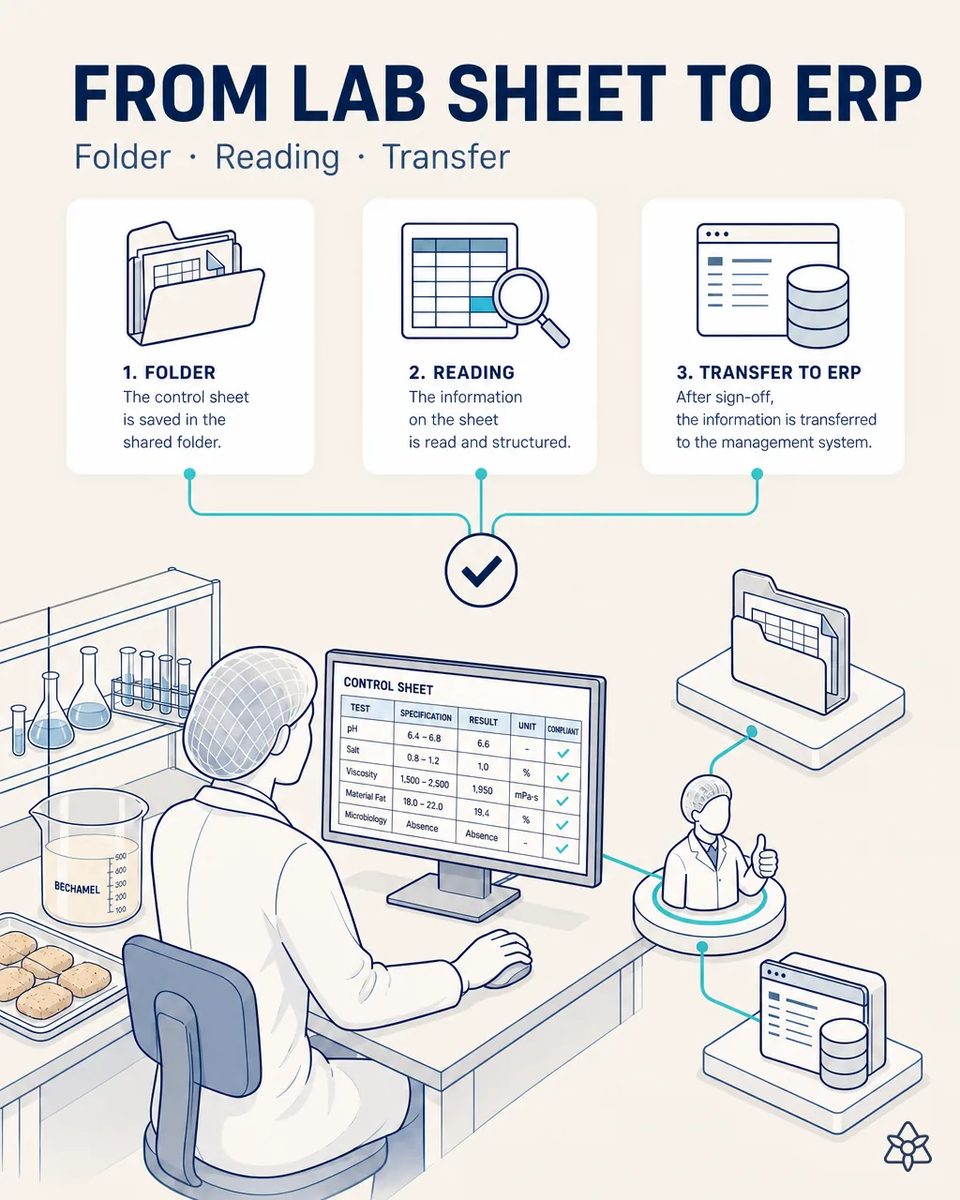
The good data lives in a spreadsheet the ERP only sees weeks later.
Two parallel worlds exist. The laboratory spreadsheet, in a shared folder, where the real process data sits. And the ERP, where the official data sits, arriving weeks late because somebody has to copy it across. That transcription costs in the order of half a working day a month, and along the way decimals get lost and batches get swapped. Not because the laboratory works badly, but because between the real figure and the official figure there is a person copying by hand. The discrepancy always surfaces at the worst possible moment: when the auditor cross-checks the quality record against the batch produced and the two sources do not match.
- The laboratory spreadsheet holds the live data: average piece weight, core temperature at the tunnel outfeed, filling percentage, béchamel viscosity, microbiology, the pre-fryer oil control. It is filled in every shift, in a shared folder, by whoever is on duty.
- The ERP holds the official data, which arrives weeks late because somebody copies it across. Between the real figure and the official figure there is a person copying by hand.
- That transcription costs in the order of half a working day a month, and along the way decimals get lost and batches get swapped.
- The discrepancy surfaces at the worst moment: when the auditor cross-checks the quality record against the batch produced and the two sources do not match.
Connect in inward listening mode — the folder, not the people.
Connect in "inward listening" mode.
The laboratory keeps working exactly as it does today, in the same sheet, each analyst in their own way. Only the transcription disappears — and with it the licenses that existed purely so that four or five people could type control data into the quality module. The batch-by-batch cross-reference that the auditor does by hand today happens automatically, because every row is written to the ERP already tied to its batch.
- The system observes the shared folder — the folder, not the people — and reads the delta when the file is saved.
- A grounded model interprets the sheet's structure even though every analyst fills it in their own way.
- The result is shown to the manager for sign-off on the validation screen.
- After sign-off it is written into the ERP by API, tied to the corresponding batch. The laboratory keeps working exactly as it does today; only the transcription disappears.
Today's laboratory versus the connected laboratory
| Aspect | Today | With iLEAN Connect |
|---|---|---|
| Gap between the sheet and the ERP | Weeks | Second zero |
| Manual transcription | Half a working day a month | Zero |
| Quality record versus batch | They never quite meet | Cross-referenced batch by batch |
| Lost decimals and swapped batches | Found by the auditor | Eliminated |
| Sheet format | Has to be respected | Read as it is, even as it changes |
| Quality module licenses | Four or five, to enter data | One, the person who validates |
Impact estimate — to be validated against your actual ERP invoice.
The block below is an estimate to be validated against your plant's actual data. We put it forward so the committee has an order of magnitude; we refine it during the assessment.
- Estimated payback 4-9 months.
- 💰 CFO angle: the ERP is billed per active user. If four or five people from the laboratory and quality log in purely to enter control data, that is four or five licenses of the quality module. With Connect only the person who validates goes in: typical reduction of 50-80% in that module's licenses, recurring every year.
- Half a working day a month of laboratory time recovered.
- And quality records that meet the batch on the day the auditor asks, not weeks later.
estimated payback of 4 to 9 months. CFO angle: the ERP is billed per active user; if four or five people from the laboratory and quality log in purely to enter control data, that is four or five licenses of the quality module. With Connect only the person who validates goes in: typical reduction of 50-80% in that module's licenses, with a recurring annual saving. *Estimate to be validated against the real ERP invoice*.
And the fair question from the production manager
“Every analyst fills in that sheet differently — does it hold up?” — that is the anticipated case: parsing does not depend on fixed cell positions. The model interprets columns, units, merged cells and margin notes without asking anyone to standardize the sheet. It is an anchored task, where the best models drop below 1.5% error [1], and the quality manager signs off on the validation screen before anything is written to the ERP.
[1] OpenAI paper "Why Language Models Hallucinate", 2025 — on the reliability of AI in anchored tasks.
What people ask about connecting the lab spreadsheet
Do we have to standardize the sheet?
No, and it is better not to. Asking the laboratory to change its sheet is the fast route to the system going unused. iLEAN reads the one that exists, with its merged cells and its notes in the margin.
Does it watch the folder or the analysts?
The folder. The file is read when it is saved and only the delta is processed; there is no tracking of who opens what or how long they spend on it.
Does it cover microbiology results that take days?
Yes. A result entered on day three enters the ERP on day three, tied to the batch it belongs to. What changes is not the duration of the test but the wait until the data is official — which, for a batch that is already in the distributor's cold store, is the difference between a hold and a recall.
Can licenses really be reduced?
It depends on your contract, which is why it is framed as an estimate to validate against last year's invoice. The logic is simple: anyone who logs in purely to type stops needing to.
What if a value is out of specification?
It is flagged on the validation screen before the push, so the quality manager sees the deviation on the day, not when the auditor cross-checks it against the batch. A béchamel viscosity out of range or a core temperature under target becomes a decision that afternoon.
More cases from this series
- Non-conformities come from the gaps, not from the processEvery changeover and batch builds its dossier with photos, records and signatures, organized by…
- Four rings that verify each other, from recipe to palletFour verification rings cross-checking each other, from recipe to pallet, so the discrepancy is caught…
- The last machine to touch the product should not depend on typingLot, expiry and allergens travel from the work order to the coder by API, including in export market…
- The plant's most expensive asset is also its most silentAn external camera digitizes the freezing curve of a blast tunnel without touching the machine or…
- Traceability is born on the dock, and it is born in a hurryPhotograph the delivery note, the lot labels and the thermometer: goods receipt enters the ERP after one…
- The person who knows the plant best is the one who can log the leastThe supervisor dictates while walking with both hands busy: iLEAN listens, ties it to the active batch…
Tell us how many people log into your ERP today purely to enter laboratory controls.
We work on your plant's real data, not ours. Assessment with no commitment.
Request estimated ROI within 48h ‹ See all cases of precooked frozen foods See food industry