Traceability is born on the dock, and it is born in a hurry
The truck arrives with fresh milk, butter, fish or cured ham. The receiving manager holds a delivery note with a dozen lines, pallets with lot and expiry labels, the unloading thermometer and the lot certificates. And they have to sign and also type it all into the ERP. With Connect they take photos: the system extracts, summarizes, the manager validates with one tap and it enters the ERP.
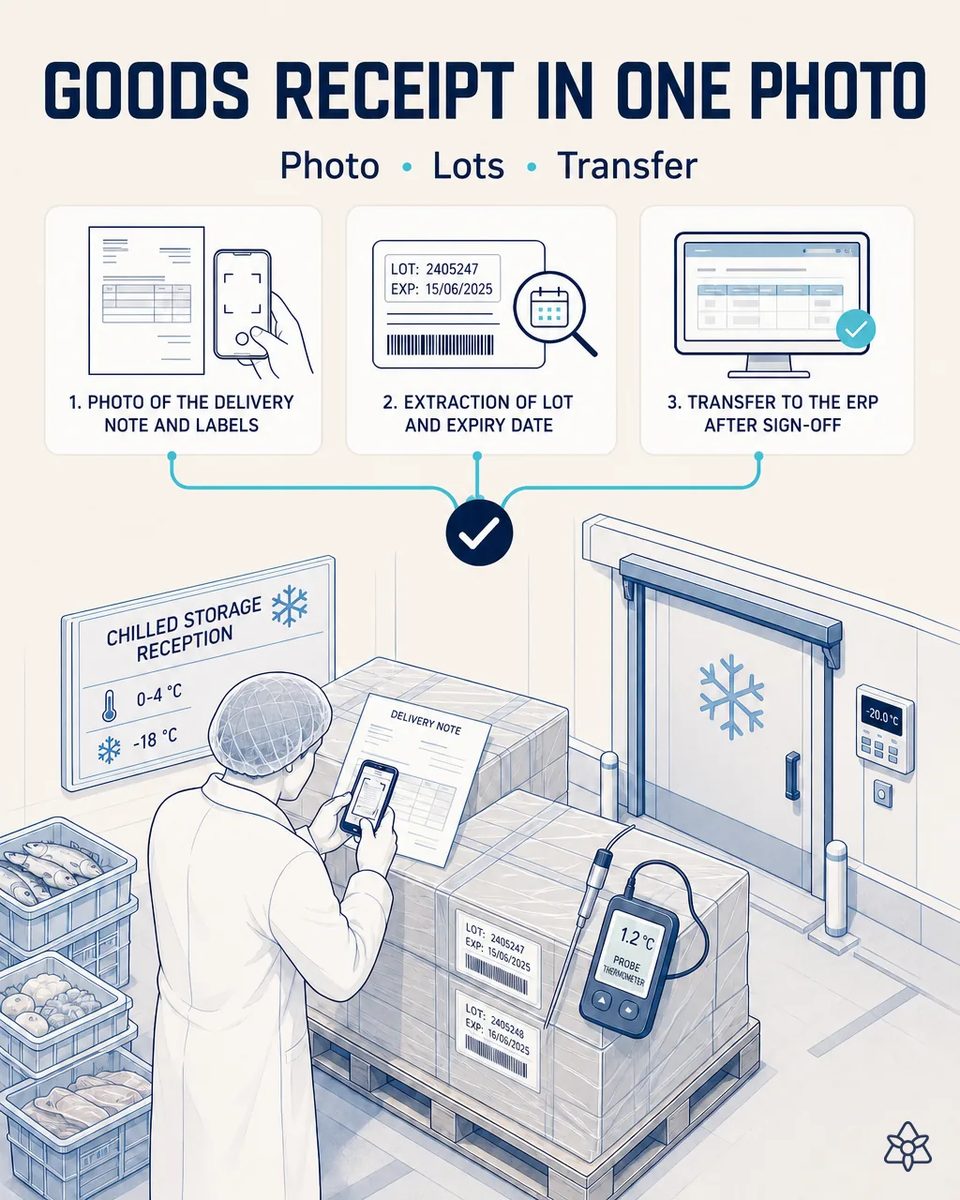
All the plant's traceability is born on the dock, and it is born in a hurry.
Goods-in is where all the plant's traceability is born, and it is also where the greatest hurry is. There are only two ways out and both are bad: either the carrier waits half an hour charging demurrage, or it gets typed in a rush. When it is typed in a rush, the lots end up badly traced. And that does not show that day: it shows weeks later, on exactly the day a lot has to be traced backwards. The real cost appears on the day of a supplier alert: if there are gaps in goods-in traceability, the precautionary recall is drawn wider than necessary, because it cannot be narrowed down.
- The truck arrives with fresh milk, butter, fish or cured ham. The receiving manager holds a delivery note with a dozen lines, pallets with lot and expiry labels, the unloading thermometer and the lot certificates. And they have to sign and also type it all into the ERP.
- There are only two ways out and both are bad: either the carrier waits half an hour charging demurrage, or it gets typed in a rush and the lots end up badly traced.
- A badly traced lot does not show that day. It shows weeks later, on exactly the day a lot has to be traced backwards.
- And on the day of a supplier alert, if there are gaps in goods-in traceability, the precautionary recall is drawn wider than necessary, because it cannot be narrowed down.
Connect in photo mode with ERP write-back — delivery note, labels and thermometer, no supplier changes.
Connect in "photo of the analog" mode with ERP write-back.
The lot and expiry recorded are the ones printed on the original label, with its photo behind them as evidence. That is what turns backward traceability into a query instead of a hand reconstruction, and what lets a recall be scoped to the lot that was actually affected. The receiving manager stops being a typist under pressure and goes back to being the person who checks the cold chain and signs.
- Photos of the delivery note, the pallet labels and the thermometer display.
- Vision recognizes each supplier's delivery note format without asking anyone to change theirs and extracts the table structure.
- On labels it reads barcodes, two-dimensional codes or plain text by OCR, depending on what each pallet carries.
- Everything is summarized on the tablet and the manager validates with one tap.
- The write-back to the ERP happens by API, and the recorded lot and expiry are the ones printed on the original label, with its photo behind them as evidence.
Today's receipt versus the captured receipt
| Aspect | Today | With iLEAN Connect |
|---|---|---|
| Truck at the dock | 30-45 minutes | A few minutes |
| Lot and expiry recorded | Typed in a rush | Read from the original label |
| Unloading temperature | Written on the note, maybe | Read from the thermometer display |
| Backward traceability | Rebuilt by hand | Complete from unloading |
| Scope of a precautionary recall | Wider than necessary | Narrowed to the real lot |
| Goods receipt licenses | Two or three | One, the manager who validates |
Impact estimate — to be validated with your numbers.
The block below is an estimate to be validated against your plant's actual data. We put it forward so the committee has an order of magnitude; we refine it during the assessment.
- Estimated payback 3-8 months.
- 💰 CFO angle: the goods receipt and warehouse module typically requires two or three active licenses (manager, backup and supervisor); with Connect only the manager validates, without entering the ERP. Typical reduction of 50-70% in that module's licenses, plus not contracting the vendor's bulk capture module.
- From 30-45 minutes of truck downtime to a few minutes, truck after truck, with the carrier's demurrage gone.
- And a precautionary recall that can be narrowed to the real lot, which is where the cost of a supplier alert is actually decided.
estimated payback of 3 to 8 months. CFO angle: the goods receipt and warehouse module typically requires two or three active licenses (manager, backup and supervisor); with Connect only the manager validates, without entering the ERP. Typical reduction of 50-70% in that module's licenses, plus the saving of not contracting the vendor's bulk capture module. *Estimate to be validated*.
And the fair question from the production manager
“Does it recognize every supplier's delivery note?” — yes, and without asking any of them to change theirs: the model extracts the table structure with no per-supplier template. On labels it reads barcodes and two-dimensional codes where they exist and plain text by OCR where they do not. It is an anchored task, where the best models drop below 1.5% error [1], and the receiving manager validates on the tablet before anything enters the ERP.
[1] OpenAI paper "Why Language Models Hallucinate", 2025 — on the reliability of AI in anchored tasks.
What people ask about digitizing goods receipt
Does it read the thermometer as well as the paper?
Yes. A photo of the display at unloading is enough, and the temperature is recorded against that delivery with the photo as evidence. Today that figure is written on the note, if at all, and it is exactly the figure the auditor asks for when a fresh dairy or fish lot is questioned.
What if the delivery note and the pallet labels disagree?
The discrepancy is highlighted in the summary before the manager validates. Today nobody makes that cross-check with a truck waiting at the dock.
Does it work for fish, dairy and cured meats alike?
Yes. What differs between them is the format of the note and the label, and the model reads the structure without a per-supplier template. The cold chain reading is the same.
Do we need a barcode scanner?
Not necessarily: a photo from a phone or industrial tablet is enough. If the dock already has scanners that work well, they integrate just the same.
Can we start with goods receipt alone?
Yes, and it is a good starting point: the result is visible from the first truck and it does not depend on the other pieces being deployed. The lots it records are the ones the batch start of case 1 later refers to, so the two cases reinforce each other when both are in.
More cases from this series
- Non-conformities come from the gaps, not from the processEvery changeover and batch builds its dossier with photos, records and signatures, organized by…
- Four rings that verify each other, from recipe to palletFour verification rings cross-checking each other, from recipe to pallet, so the discrepancy is caught…
- The last machine to touch the product should not depend on typingLot, expiry and allergens travel from the work order to the coder by API, including in export market…
- The plant's most expensive asset is also its most silentAn external camera digitizes the freezing curve of a blast tunnel without touching the machine or…
- The person who knows the plant best is the one who can log the leastThe supervisor dictates while walking with both hands busy: iLEAN listens, ties it to the active batch…
- The good data lives in a spreadsheet the ERP never seesThe laboratory control sheet flows into the ERP after human sign-off, with up to 80% fewer licenses on…
Tell us how long a raw material truck sits idle at your dock today.
We work on your plant's real data, not ours. Assessment with no commitment.
Request estimated ROI within 48h ‹ See all cases of precooked frozen foods See food industry