Non-conformities come from the gaps, not from the process
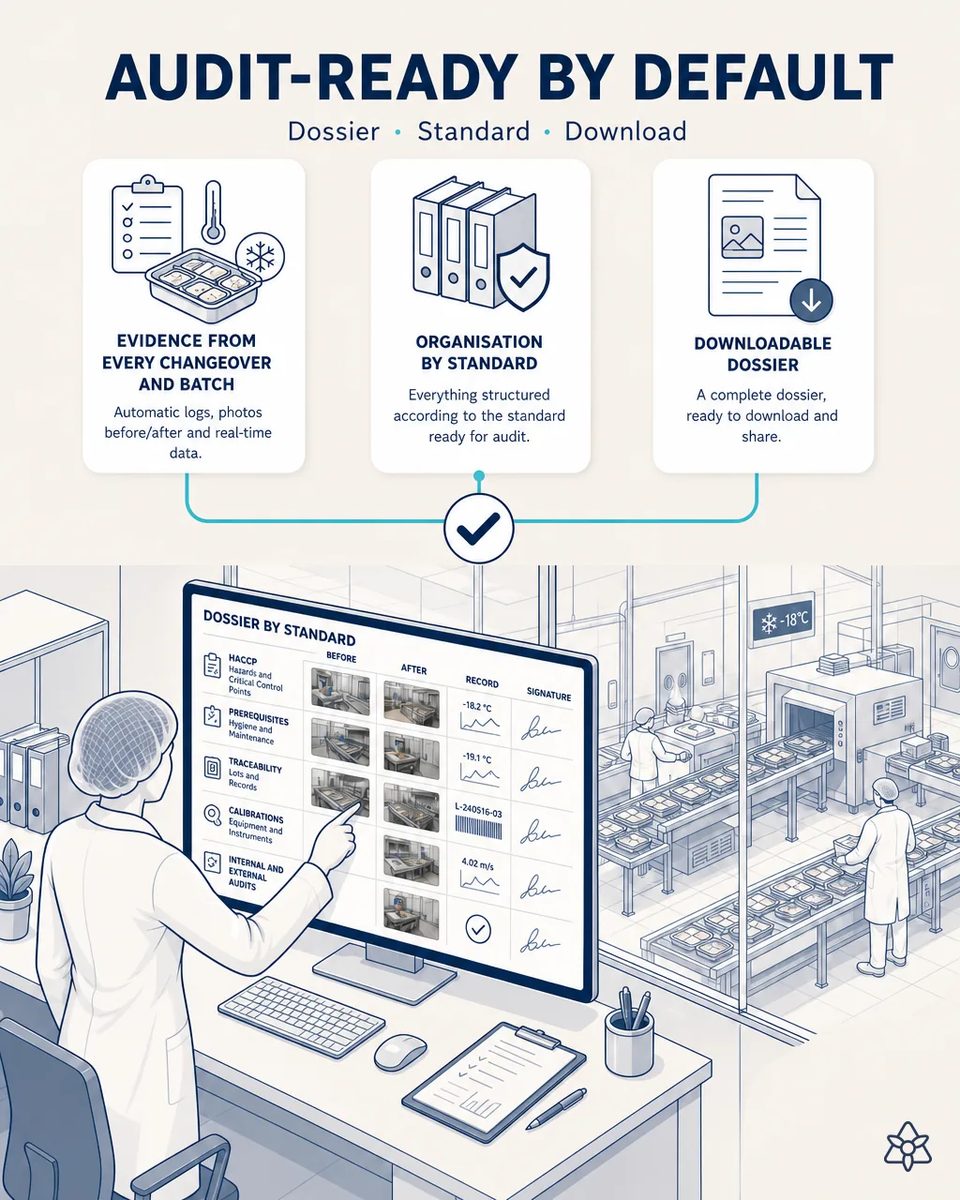
On audit day — certification, retail distributor or export customer — somebody in quality has spent weeks reconstructing cleaning records, tunnel temperatures, laboratory controls and delivery notes. With Agents, every critical changeover and every batch generates its dossier automatically and the system reorders it to fit what each standard asks for.
Non-conformities come from the paper that cannot be found, not from the process.
A precooked food plant with exports and retail faces several audits a year, each with its own format and vocabulary. All the evidence exists, but every piece is somewhere different: a folder, a spreadsheet, a filing cabinet, somebody's inbox. And here is what hurts most about that work: non-conformities rarely come from the process being wrong. They come from not finding the paper that proves it was right. The auditor asks for the evidence, the plant produces folders, and the documentary gap becomes a finding. On top of that, every traceability query from an export customer opens the same process in miniature: days of searching to answer one specific question.
- A precooked food plant with exports and retail faces several audits a year — certification, retail distributor, export customer — each with its own format and vocabulary.
- All the evidence exists, but every piece is somewhere different: cleaning records in a folder, tunnel temperatures on a form, laboratory controls in a spreadsheet, delivery notes in a filing cabinet, a supplier certificate in somebody's inbox.
- Non-conformities rarely come from the process being wrong. They come from not finding the paper that proves it was right. The auditor asks, the plant produces folders, and the documentary gap becomes a finding.
- And every traceability query from an export customer opens the same process in miniature: days of searching to answer one specific question about one batch.
Agents on top of what Connect and Edge already capture — the evidence organizes itself.
Agents on top of the evidence Connect and Edge already capture.
Every critical changeover and every batch aggregate their own dossier the moment they happen: changeover images, tunnel curve, laboratory controls, goods-in temperatures, signatures with timestamps. Anything rebuilt afterwards inherits the gaps of whatever nobody wrote down, and it is precisely in the rebuilding that findings appear. The plant does not produce more evidence than today; it stops losing the evidence it already produces.
- Every critical changeover and every batch automatically aggregates its before/after photos of critical points (case 10), the tunnel curve (case 2), laboratory controls (case 6), goods-in temperatures (case 7) and signatures with their timestamps.
- Agents maps each piece of evidence against each standard's requirements and composes the dossier for a period or a batch on demand.
- It spots what is missing before the auditor does, while there is still time to resolve it.
- The auditor logs in and downloads without anyone on the floor collecting anything.
Today's preparation versus the permanent dossier
| Aspect | Today | With iLEAN Agents |
|---|---|---|
| Audit preparation | Weeks in quality | Virtually zero |
| For each auditing customer | Repeated in full, in their format | Same evidence, another view |
| Where the evidence is | Folder, spreadsheet, cabinet, inbox | One dossier per batch |
| A documentary gap | Found by the auditor | Spotted while there is time to resolve it |
| A traceability query from an export customer | Days | Minutes |
| The auditor's access | Folders on a table | Logs in and downloads |
Impact estimate — to be validated with your numbers.
The block below is an estimate to be validated against your plant's actual data. We put it forward so the committee has an order of magnitude; we refine it during the assessment.
- Estimated payback 6-12 months, depending on the number of audits per year and the current preparation load.
- Continuous protection of the certifications that retail and export contracts depend on, which is the value that never appears in a time study.
- From weeks of preparation per audit to virtually zero, and the same evidence serving the certification body, the retail distributor and the export customer.
- And a traceability query answered in minutes, which is what an export customer remembers when the next contract comes up.
estimated payback of 6 to 12 months depending on the number of audits per year and the current preparation load, plus continuous protection of the certifications that retail and export contracts depend on. *Estimate to be validated*.
And the fair question from the production manager
“Isn't this just another document manager?” — the difference is direction. A document manager stores what somebody decides to upload, after the fact, and inherits the same gaps. Here the dossier closes the instant the changeover or the batch happens, from evidence captured at the line. Mapping each piece of evidence against a standard's requirement list is an anchored task, where the best models drop below 1.5% error [1], and the quality manager reviews what the system flags as missing before the auditor ever asks.
[1] OpenAI paper "Why Language Models Hallucinate", 2025 — on the reliability of AI in anchored tasks.
What people ask about the audit evidence pack
Does it serve the certification audit and the retail customers at once?
Yes, and that is the point: the evidence is the same, what changes is the requirement list it is indexed against. That is exactly the work repeated in full for each auditor today, and the reason quality spends weeks a year rebuilding the same cleaning records in three different formats.
What goes into a batch's dossier?
The before and after images of critical points from the allergen changeover, the tunnel curve, the laboratory controls, the goods-in temperatures of the raw materials used, and every signature with its timestamp.
Does it warn about a gap before the audit?
Yes, and it is the function with the most value: it detects that evidence for a critical event is missing when it should have been generated, while there is still time to resolve it.
Does the auditor get into our systems?
No. They access a view scoped to the period and the standard of their audit, filter and download. Nobody on the floor collects anything, and the quality manager sits with the auditor instead of running to the filing cabinet.
Does it work with an IFS- or BRCGS-type scheme?
Yes. Each scheme is a requirement list the evidence is mapped against. If your retail customer has its own addendum, it is one more list.
More cases from this series
- Four rings that verify each other, from recipe to palletFour verification rings cross-checking each other, from recipe to pallet, so the discrepancy is caught…
- The last machine to touch the product should not depend on typingLot, expiry and allergens travel from the work order to the coder by API, including in export market…
- The plant's most expensive asset is also its most silentAn external camera digitizes the freezing curve of a blast tunnel without touching the machine or…
- Traceability is born on the dock, and it is born in a hurryPhotograph the delivery note, the lot labels and the thermometer: goods receipt enters the ERP after one…
- The person who knows the plant best is the one who can log the leastThe supervisor dictates while walking with both hands busy: iLEAN listens, ties it to the active batch…
- The good data lives in a spreadsheet the ERP never seesThe laboratory control sheet flows into the ERP after human sign-off, with up to 80% fewer licenses on…
Tell us how many weeks a year your quality team spends preparing audits.
We work on your plant's real data, not ours. Assessment with no commitment.
Request estimated ROI within 48h ‹ See all cases of precooked frozen foods See food industry