The last machine to touch the product should not depend on typing
The coder that prints lot, expiry and allergens on every case is the last thing to touch the product before it leaves the plant. It is usually modern, usually has an API and is usually isolated, so on every reference change somebody types the lot into its panel. With Connect the coder is stitched to the ERP: the data travels from the active order, in the destination market's language, with no typing in between.
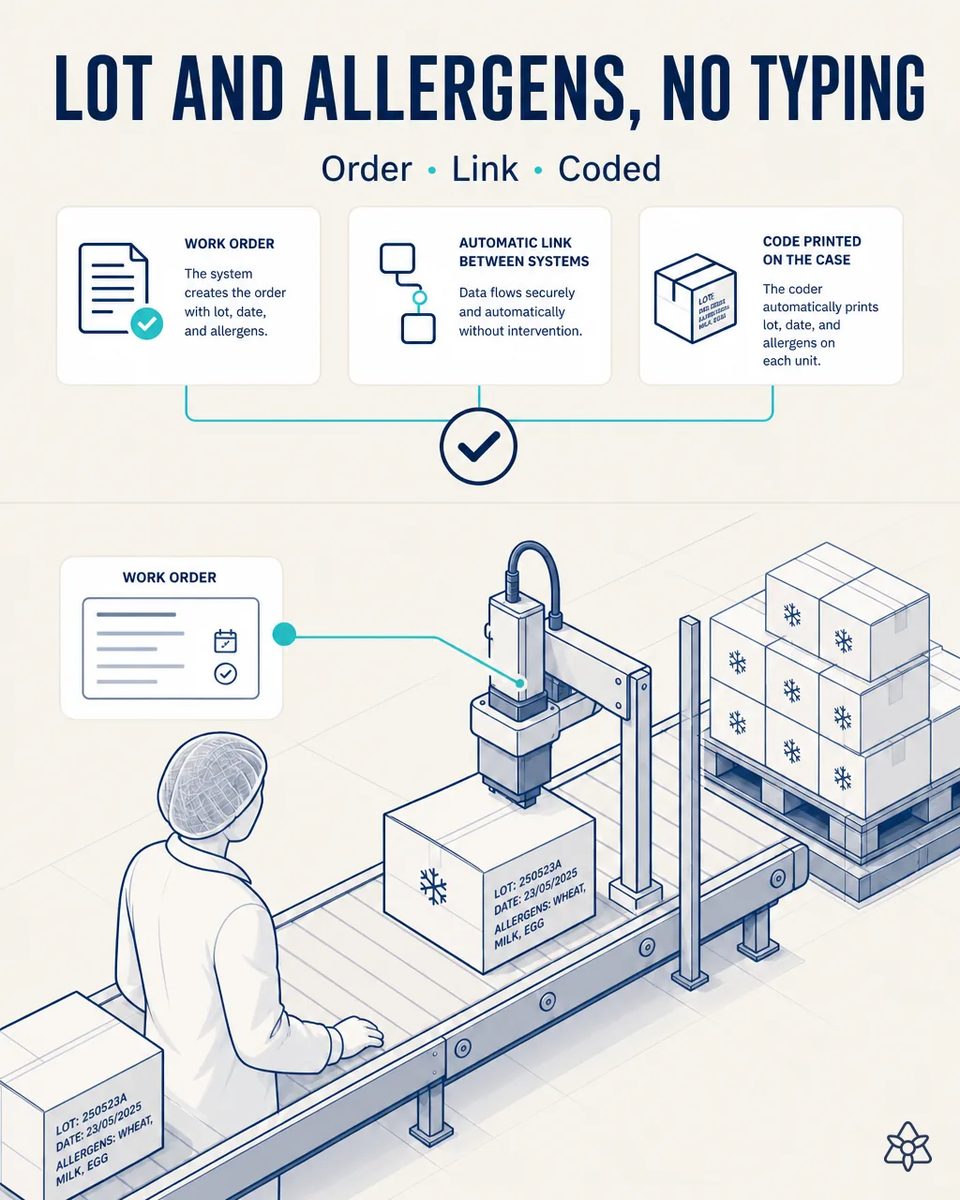
The last machine to touch the product is fed by hand on every reference change.
With a catalog of dozens of references, frequent format changes (bulk IQF, one-kilo cases, half-kilo packs), two own brands and private label production, coding changes run into dozens per week. One mistyped digit in a lot, an expiry calculated from the wrong date, or an allergen list belonging to the previous recipe. Each one of those three, on its own, is grounds for a recall. And as soon as exports are involved, that risk multiplies by every market, every labeling language and every template somebody maintains by hand.
- The coder that prints lot, expiry and allergens on every case is usually modern, usually has an API and is usually isolated. So on every reference change somebody types the lot into its panel, with the same data already sitting in the ERP.
- With a catalog of dozens of references, frequent format changes — bulk IQF, one-kilo cases, half-kilo packs — two own brands and private label production, coding changes run into dozens per week.
- One mistyped digit in a lot, an expiry calculated from the wrong date, an allergen list belonging to the previous recipe. Each of those three, on its own, is grounds for a recall.
- And as soon as exports are involved, that risk multiplies by every market, every labeling language and every template somebody maintains by hand.
Connect stitches the ERP and the coder together by API, replacing neither.
Connect stitching two modern systems together by API, replacing neither.
The allergen declaration printed on the case comes from the recipe master of the active order, not from whatever was on the coder from the previous run. That single change removes the costliest incident in the sub-sector, and it does so without replacing a machine that already works. For a plant that labels for several export markets, it also means the wording of each market is maintained once, in the master, instead of once per template on the coder.
- When the ERP marks the start of the order, it publishes to the coder the reference, the lot, the dates calculated from that product family's shelf life and the allergen declaration of that recipe.
- Language and format are resolved by destination market, from the recipe master.
- A lot change becomes a tap in the ERP rather than typing on a machine panel.
- Case 12 adds the read-back ring: a camera checks that what is printed matches the active order.
The isolated coder versus the stitched coder
| Aspect | Today | With iLEAN Connect |
|---|---|---|
| Lot and expiry | Typed on the coder panel | Published from the active order |
| Allergen declaration | Whatever the last run left | The recipe master's, per order |
| Export market language | A template maintained by hand | Resolved by destination market |
| A lot change | Typing on a machine panel | A tap in the ERP |
| Coding errors of human origin | Several a month | Zero |
| Either system | — | Neither is replaced |
Impact estimate — to be validated with your numbers.
The block below is an estimate to be validated against your plant's actual data. We put it forward so the committee has an order of magnitude; we refine it during the assessment.
- Estimated payback 3-6 months, one of the fastest in the matrix.
- A drastic reduction in mislabeling recall risk — the costliest incident in the sub-sector, because it hits allergen safety and the distributor relationship at the same time.
- Multi-language labeling for export stops depending on templates somebody maintains by hand.
- And the dozens of weekly coding changes stop being dozens of chances to type the wrong digit.
fast payback, 3 to 6 months, and a drastic reduction in mislabeling recall risk — the costliest incident in the sub-sector. *Estimate to be validated*.
And the fair question from the production manager
“Isn't a classic integration cleaner?” — it is the day the project reaches the top of the IT list, and that is the problem: the coder is the classic modern island that stays isolated because there was never time. This stitching leans on the API the coder already has, asks for no shutdown window and replaces nothing. There is no reading model involved: the data travels as data, so the note [1] that applies to captured documents does not even come into play here — and case 12 adds the read-back camera as the second net.
[1] OpenAI paper "Why Language Models Hallucinate", 2025 — on the reliability of AI in anchored tasks.
What people ask about connecting the coder
Do we have to replace the coder or the ERP?
Neither. Connect uses the API the coder already exposes and what the ERP publishes when the order starts. It is a link between two systems that already work, and it needs no shutdown window on the packing line to go in.
Where does the expiry date come from?
From the shelf life of that product family in the recipe master, calculated from the production date of the active order. Nobody does the arithmetic on the coder panel.
How does it handle export markets in different languages?
Language and format are resolved by destination market from the recipe master. The same lot printed for two markets carries the right allergen wording for each.
What about private label runs?
Private label is just another set of formats in the master: brand, case size, language. The order carries which one is active, and the coder receives it like any other, so a retail customer's own case never leaves with the wording of your own brand.
Does anything check what was actually printed?
That is the read-back ring of case 12: a camera reads the printed code and cross-checks it against the active order, and the line stops if they do not match. This case removes the typing; that one verifies the print.
More cases from this series
- Non-conformities come from the gaps, not from the processEvery changeover and batch builds its dossier with photos, records and signatures, organized by…
- Four rings that verify each other, from recipe to palletFour verification rings cross-checking each other, from recipe to pallet, so the discrepancy is caught…
- The plant's most expensive asset is also its most silentAn external camera digitizes the freezing curve of a blast tunnel without touching the machine or…
- Traceability is born on the dock, and it is born in a hurryPhotograph the delivery note, the lot labels and the thermometer: goods receipt enters the ERP after one…
- The person who knows the plant best is the one who can log the leastThe supervisor dictates while walking with both hands busy: iLEAN listens, ties it to the active batch…
- The good data lives in a spreadsheet the ERP never seesThe laboratory control sheet flows into the ERP after human sign-off, with up to 80% fewer licenses on…
Tell us how many times a week a lot is typed by hand on your coder.
We work on your plant's real data, not ours. Assessment with no commitment.
Request estimated ROI within 48h ‹ See all cases of precooked frozen foods See food industry