The person who knows the plant best is the one who can log the least
The floor supervisor spends the shift walking between the béchamel kettle, the forming machine, the breading line and the mouth of the tunnel, almost always with both hands busy. Nobody asks them to log anything because they cannot type, and everything they know dies at the end of the shift. With Connect in voice mode they dictate while walking: iLEAN structures it, ties it to the active batch and returns support through the same earpiece.
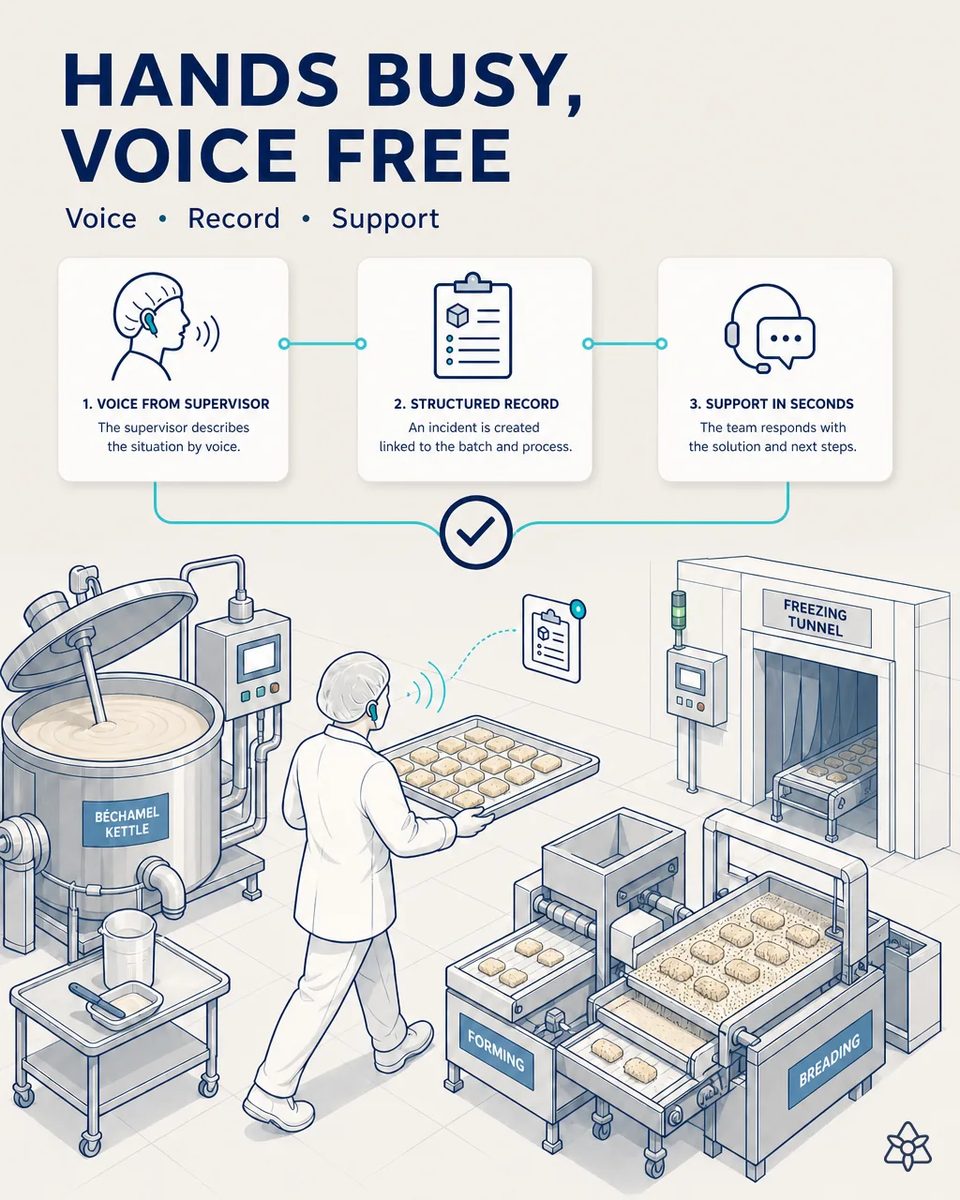
The person who knows the kitchen best is the one who cannot stop to write.
The operational knowledge of a production workshop lives in the heads of two or three people with many years in the house. That the béchamel of one recipe runs thinner since the supplier changed. That the breading machine leaves bare pieces above a certain speed. That the new operator on the former needs support this week. None of that enters any system, and not for lack of willingness: asking that person to stop at a computer is asking them to stop doing their job. The result is that continuous improvement meetings run on memory rather than on history. And any improvement plan carries that limitation from day one.
- The operational knowledge of the kitchen lives in the heads of two or three people with many years in the house: that the béchamel of one recipe runs thinner since the dairy changed, that the breading machine leaves bare pieces above a certain speed, that the new operator on the forming machine needs support this week.
- None of that enters any system, and not for lack of willingness. The supervisor walks the shift with both hands busy — a tray, a probe, a bag of breadcrumbs — and asking them to stop at a computer is asking them to stop doing their job.
- Continuous improvement meetings run on memory rather than on history, and any improvement plan carries that limitation from day one.
- When one of those people is on leave or retires, the recipe knowledge that was never written down leaves with them.
Connect in voice mode — iLEAN listens to the supervisor, not to the operators.
Connect in voice mode.
Humans in command taken literally: the earpiece records what the supervisor chooses to dictate, when they choose to, and answers through the same earpiece. That distinction is what keeps the case alive in month six instead of being perceived as monitoring.
- A Bluetooth earpiece with its own wake word.
- The supervisor dictates in their own words, with no format, without quoting batch numbers.
- The model structures the dictation as an incident, process observation or request, and ties it automatically to the active batch, line and shift.
- It returns confirmation and support through the same earpiece, so the conversation runs both ways without them taking their hands off production.
- Everything captured passes through early human validation before entering the master.
Today's shift versus the captured shift
| Aspect | Today | With iLEAN Connect |
|---|---|---|
| What the supervisor observes | Lost at the end of the shift | A structured record tied to the batch |
| A béchamel that runs thin since the supplier change | An anecdote in a meeting | An incident with a recipe and a date |
| Support for a new operator | Whoever is next to them | A request logged on the forming machine |
| Supervisor's effort | Stop at a computer | Speak while walking |
| Improvement meeting | Based on memory | Based on the incident history by reference and line |
| Ordinary kitchen conversation | — | Not recorded |
Impact estimate — to be validated with your numbers.
The block below is an estimate to be validated against your plant's actual data. We put it forward so the committee has an order of magnitude; we refine it during the assessment.
- No standalone payback, and the case analysis says so plainly: this is an enabling piece whose return is indirect.
- Without this capture, continuous improvement keeps depending on two people's memory, and every other case in the matrix inherits that gap.
- What it enables is measurable elsewhere: recipe deviations caught earlier, a defect history by line that the coating vision case can lean on, onboarding that stops depending on who happens to be next to the new operator.
- The estimate is agreed with the production manager, against the incidents they know are repeated every month and never written down.
this is not a direct payback case and it is worth saying so plainly: the return is indirect and enabling. Without this capture, continuous improvement keeps depending on two people's memory. *Estimate to be validated with the production manager*.
And the fair question from the production manager
“Is this for monitoring my team?” — no: iLEAN listens to the supervisor, not to the operators, and only to what they choose to dictate after the wake word. There is no continuous listening and no tracking of where anyone is. On the technical side, turning a dictation into an incident, observation or request tied to the active batch is an anchored task, where the best models drop below 1.5% error [1], and every record passes through the line-side tablet before entering the master.
[1] OpenAI paper "Why Language Models Hallucinate", 2025 — on the reliability of AI in anchored tasks.
What people ask about capturing the kitchen by voice
Does it work with the noise of the kettles and the tunnel fans?
That is the design condition. The earpiece is specified for industrial noise and hairnets, and recognition is prepared for kitchen vocabulary: béchamel, breading, former, pre-fryer, tunnel.
Does the supervisor have to say the batch number?
No. They speak naturally, the way they would tell a colleague. iLEAN ties the dictation to the active batch, line and shift on its own.
What does the supervisor get back?
Confirmation of what was logged and, when they ask, support: the recipe parameter, the previous incident on that former, the person to call. The conversation runs both ways through the same earpiece.
How does it help a new operator on the forming machine?
The request for support is logged on that machine and that shift, so the history shows where new people struggle and what the experienced supervisor did about it. That is what turns onboarding into a plan.
Why does this case carry no payback of its own?
Because its value shows up in the other cases: fewer repeated incidents, a real history for the improvement meeting, knowledge that survives a retirement. It is enabling, and so do we; the estimate is agreed with the production manager rather than sold as a number.
More cases from this series
- Non-conformities come from the gaps, not from the processEvery changeover and batch builds its dossier with photos, records and signatures, organized by…
- Four rings that verify each other, from recipe to palletFour verification rings cross-checking each other, from recipe to pallet, so the discrepancy is caught…
- The last machine to touch the product should not depend on typingLot, expiry and allergens travel from the work order to the coder by API, including in export market…
- The plant's most expensive asset is also its most silentAn external camera digitizes the freezing curve of a blast tunnel without touching the machine or…
- Traceability is born on the dock, and it is born in a hurryPhotograph the delivery note, the lot labels and the thermometer: goods receipt enters the ERP after one…
- The good data lives in a spreadsheet the ERP never seesThe laboratory control sheet flows into the ERP after human sign-off, with up to 80% fewer licenses on…
Tell us how much kitchen knowledge is lost at every shift change.
We work on your plant's real data, not ours. Assessment with no commitment.
Request estimated ROI within 48h ‹ See all cases of precooked frozen foods See food industry