Zero recalls and zero rejections at destination: the five verification rings
The capital pain of any exporting rawhide chew factory is always the same: a container rejected or recalled at destination. It has three entry doors — food safety, out-of-range residual moisture and wrong private label labeling — and in private label a single failure drags several client brands down at once. The flagship system coordinates the previous eleven pieces into five verification rings.
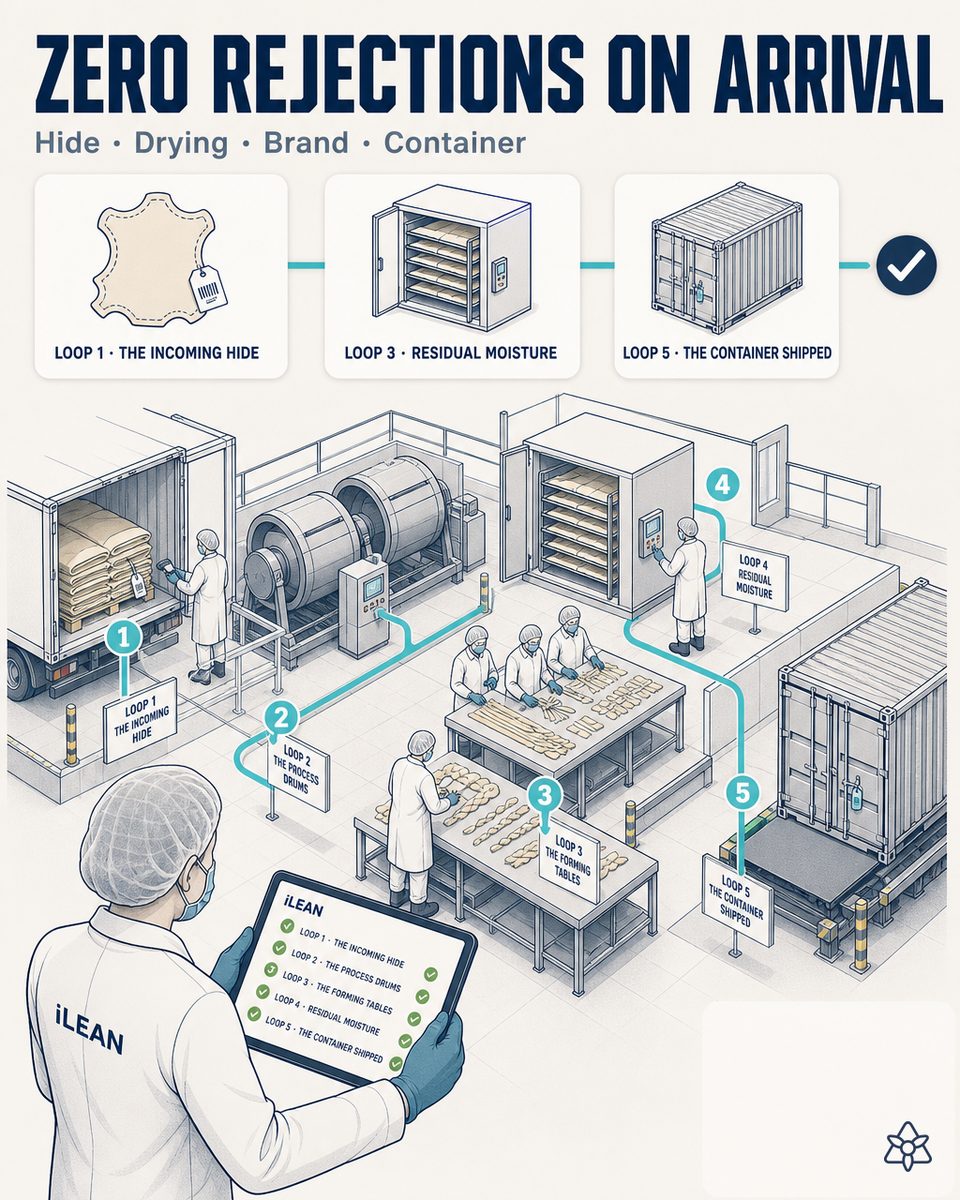
It is not an efficiency pain: it is a business continuity pain.
A recall at destination costs the product, the recovery operation across hundreds of points of sale and the chain's penalty. But the truly expensive part is the brand owner's trust. The three doors are well known in the sub-sector:
- Food safety — whether a pathogen or the residue of a process chemical not approved in the destination country, a door that depends not on hygiene but on the documentary control of what comes in.
- Out-of-range residual moisture — which turns into mold weeks later, already in the distributor's warehouse or on the shelf. It is not visible at shipping.
- Wrong private label labeling — where a single failure drags several client brands down at once, because the plant produces for all of them on the same line.
In a sector where supplier reputation is built over decades, the recall's direct economic impact is the small part of the bill.
The five rings — from the hide coming in to the container going out.
The flagship adds no new pieces: it coordinates the previous eleven. Each ring closes one of the paths through which the risk escapes today, and the whole is designed so no batch reaches the container without passing through all of them.
A batch without its ring 3 closed cannot pass to shipping. And if on the line something does not add up between what the system publishes and what the camera reads, JIDOKA AI stops the line before the product reaches the pallet.
The five rings, each with its pieces:
- Ring 1 · Inbound — every hide and chemical batch enters identified by photo and by code, with its certificate checked against the substances admitted in the destination country. Nothing enters silently.
- Ring 2 · Process and drying — the order and the load sheet exist at second zero, and each load's drying curve is digitized by reading the panel. Moisture and time stop being memory and become per-batch data.
- Ring 3 · Laboratory — residual moisture, water activity, chemical residuals and microbiology enter against the batch as soon as the laboratory saves them and quality validates. A batch without its ring 3 closed cannot pass to shipping.
- Ring 4 · Line — the coder prints what the system publishes, the Edge camera reads what was printed and checks it against the active order, and the between-brand clearance is verified before startup. If something does not add up, JIDOKA AI stops the line before the pallet.
- Ring 5 · Container — every container leaves with its evidence pack closed: the four previous rings plus the loading and sealing photos, ready for the auditor, for customs and for the brand owner.
- And SMED AI accelerates the changes between brands so all this coordination does not cost capacity — critical in a plant working a single shift with no overtime to compensate.
Risk spread across four moments vs. five coordinated rings
| Aspect | Without coordination | With the iLEAN flagship |
|---|---|---|
| Where the problem is detected | At the customer, weeks later and untraceable | On the line, at second zero and with evidence |
| Response to an alert | Days of reconstruction | A per-batch query |
| A chemical not approved at destination | Discovered at customs | Checked at the dock, ring 1 |
| Out-of-range residual moisture | Seen as mold on the shelf | Blocks the shipment, ring 3 |
| Private label labeling | One failure drags several brands | Published from the ERP and camera-verified, ring 4 |
| The container's evidence | Reconstructed if requested | Closed at sealing, ring 5 |
Impact estimate for your plant — to be validated with your own numbers.
The block below is an estimate to be validated against your plant's actual data. We put it forward so the committee has an order of magnitude; we refine it during the assessment.
- Exporting rawhide chew factory producing for several private labels, with the three risk doors open and no coordination between the checks.
- Phased deployment: start with the shortest-payback Connect cases, raise rings 1 to 3 and close with the line and the container.
- The economic case is not built on efficiency but on avoided risk: the direct cost of a single export recall is of another order of magnitude than the complete project, and losing a private label contract is multi-year.
- Estimated payback between 6 and 12 months against the first avoided incident. Estimate to be validated with the rejection and recall history and their average cost.
- And an operational constraint the design takes into account: in a plant working a single shift, the coordination cannot cost capacity because there is no overtime to compensate with. Hence SMED AI is part of the flagship and not an add-on.
And the fair question from general management
"Isn't this too much project to start with?" — you do not start here. The flagship is the destination, not the first step: you get there in phases, starting with the shortest-payback Connect cases, which finance the next ones. And on the reliability of the whole: everything the AI does in these five rings is an anchored task — reading a known data point, checking against a list, comparing against a reference state, cross-checking two records — where the best models brought the error below 1.5% [1], with a person signing every critical decision.
[1] OpenAI paper "Why Language Models Hallucinate", 2025 — on the reliability of AI in anchored tasks.
What people ask about the zero-recalls-at-destination flagship
What exactly are the three risk doors?
Food safety — a pathogen, or the residue of a process chemical not approved in the destination country, a path depending not on hygiene but on the documentary control of what comes in. Out-of-range residual moisture, invisible at shipping and turning into mold weeks later, already in the distributor's warehouse or on the shelf. And wrong private label labeling, where a single failure drags several client brands down at once because all are produced on the same line. Each flagship ring closes one of those paths, and the five together close all three.
What does it mean that a batch cannot pass to shipping without ring 3?
That the laboratory's validation is a blocking condition, not a formality. Residual moisture, water activity, chemical residuals and microbiology must be recorded against that batch and validated by quality before the batch is eligible for shipping. Today that works by trust and by procedure; in the flagship it is a system check. It is the point where the second door closes — moisture — which is precisely the one giving no signal at the moment of loading the container.
What does JIDOKA AI stop and what does it not?
It stops the line when what the Edge camera reads on the product does not match what the system published to the coder from the active order — that is, when there is an identification discrepancy in ring 4. And it does so before the product reaches the pallet, the last point where stopping is still cheap. What it does not do is stop on its own processes where the decision has cost and nuance: there it proposes and a person signs. The distinction is the usual one: the automatic covers the verifiable, the expensive is decided by someone.
Why is the labeling failure so serious in private label?
Because a single failure drags several client brands down at once. The plant produces for several brand owners on the same line, so an artwork or batch mix-up does not only affect the wrong order: it puts the whole operation's control in question before all the customers at once. And in a sector where supplier reputation is built over decades, that loss of trust is the big part of the bill — the direct cost of the recalled product is the small one.
How is the economic case built?
On avoided risk, not efficiency — and it is worth framing it that way in committee so it does not compete with productivity projects playing another league. The direct cost of a single export recall is of another order of magnitude than the complete project, and losing a private label contract is multi-year. The figure that best sizes the case is not an external estimate: it is the plant's own rejection and recall history and their average cost. With that figure on the table, the 6-to-12-month payback against the first avoided incident checks itself.
More cases from this series
- The audit stops being a two-week projectPhotos, signatures and measurements organize themselves by certifying standard. The auditor downloads…
- The changes arriving by email stop being read lateiLEAN reads the client brands’ email and messaging, cross-references it with live orders and returns the…
- The last piece before the customer stops depending on typingBatch, expiry and the right brand’s artwork travel from the ERP to the coder with no typing. Zero…
- The drying chamber starts to talk without anyone touching itAn external camera reads the drying chamber’s isolated panel: temperature and humidity curve per load,…
- Backward traceability starts at the dock: receiving by photoA photo of the delivery note and the pallet labels: batches enter the ERP in minutes and the chemical’s…
- The laboratory stops transcribing: from Excel to the ERP at second zeroResidual moisture, water activity and microbiology enter the ERP as soon as the laboratory saves the…
How many rejections at destination have you had and what did each cost?
We work on your operation's real data, not ours. With that figure the case signs itself. Assessment with no commitment.
With that figure the case signs itself — let's talk ‹ See all 12 rawhide petfood cases See food industry