The laboratory stops transcribing: from Excel to the ERP at second zero
In a rawhide plant, the laboratory is who really knows whether a batch can ship: it measures residual moisture and water activity after drying, checks pH and process chemistry residuals, and waits for the microbiological results. All of that lives in a spreadsheet the ERP does not see. iLEAN Connect reads the file as soon as it is saved and, after validation, feeds it into the ERP against the right batch.
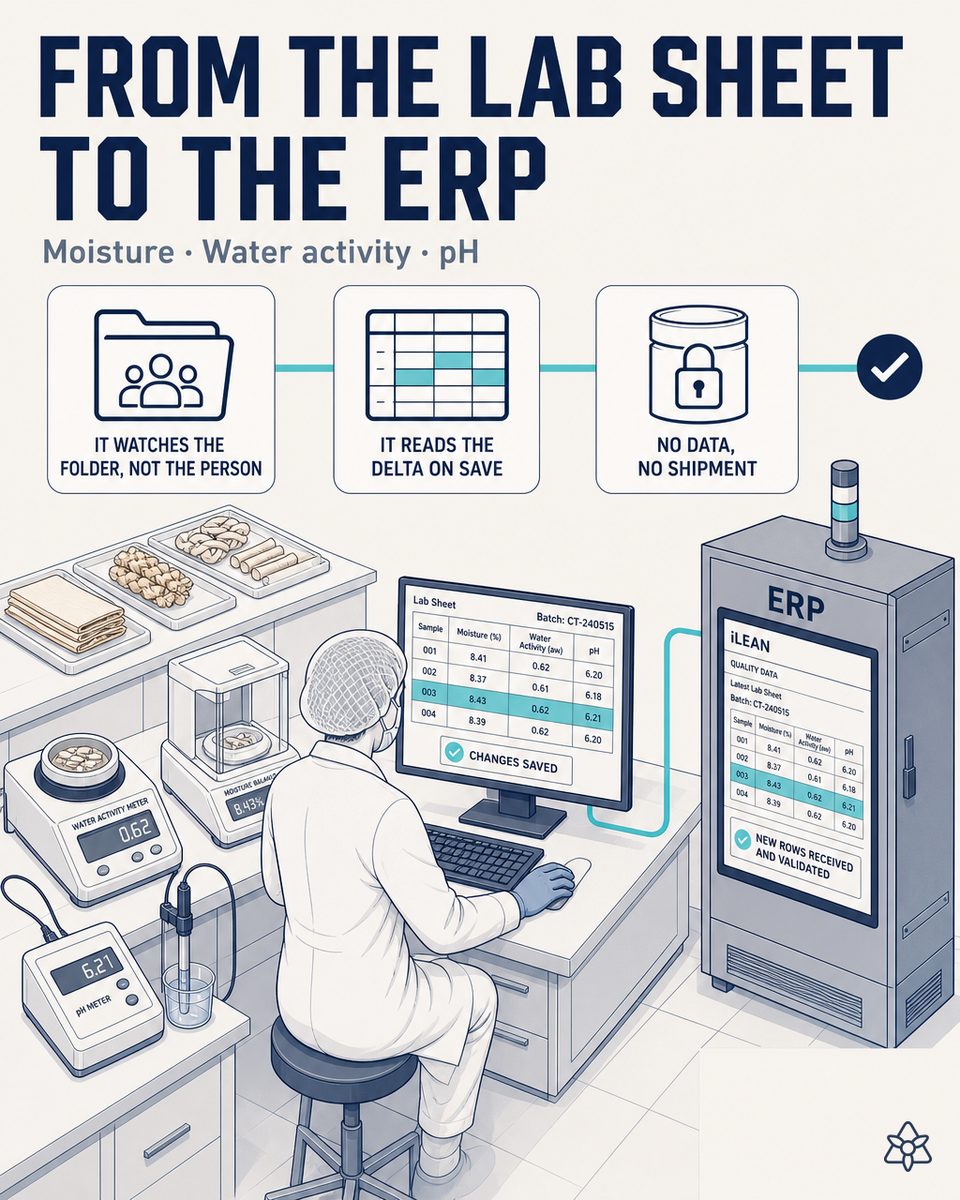
Two parallel worlds — and with several plants, the problem multiplies.
There is the real Excel, holding the living data that decides whether the container leaves. And there is the official ERP, with data transcribed weeks behind by someone who spends days a month copying between windows and who, inevitably, makes mistakes:
- One sheet per site, and none quite like another — the same parameter with a different name, a different unit, a different column. Comparing two plants' behavior becomes a manual exercise.
- Days per month of pure transcription — plus the copying errors it introduces, right into the data that decides whether a container ships.
- And the auditor arrives and asks for the cross-reference — between the laboratory result and the manufactured batch. That cross-reference exists, but it must be built by hand every time.
Add the cost that appears on no process sheet: for that typing to be possible, several people at each plant need access to the ERP's quality module — not because they manage quality in the system, but because it is the only way to enter their own results.
Connect in inward-listening mode — it watches the folder, not the people.
The laboratory's sheet does not need to disappear or change format. The data that already exists in it needs to reach the ERP without anyone typing it again — and, in a multi-plant operation, to arrive homogeneous too.
iLEAN watches the shared folder and reads the file as soon as it is saved. It parses it with an anchored model and normalizes the criteria between plants: same field, same name, same units. It presents it to the quality manager for validation and, after it, feeds it into the ERP through an interface against the right batch.
How Connect operates on the laboratory's sheet:
- The folder is watched, not the people — worth stating precisely. Nothing is installed on the technician's computer and their activity is not logged: only the moment the file is saved is detected.
- Anchored to each plant's real sheet — with its own names, units and columns, without asking anyone to redo them.
- Normalization between plants — same field, same name, same units. It is what turns four different sheets into comparable data, which is where the return lives in a multi-plant operation.
- The quality manager's validation — before anything reaches the ERP. A single person validates what several used to type at each site.
- A feed against the right batch — through an interface, so the laboratory-to-batch cross-reference the auditor asks for stops being built by hand.
Disconnected Excel and ERP vs. automatic feed with Connect
| Aspect | Manual transcription per plant | With iLEAN Connect |
|---|---|---|
| Real data ↔ ERP data lag | Weeks | Second zero |
| Manual transcription | Days per month, at each plant | Zero |
| Format between plants | A different one per site | Homogeneous, comparable data |
| Laboratory ↔ batch cross-reference for audits | Built by hand every time | Automatic, batch by batch |
| Quality and laboratory module licenses | Several per plant, multiplied | 1: the validating manager's |
| The laboratory's habit | Their sheet — plus the ERP | Their sheet |
Impact estimate for your plant — to be validated with your own numbers.
The block below is an estimate to be validated against your plant's actual data. We put it forward so the committee has an order of magnitude; we refine it during the assessment.
- Rawhide chew operation with a laboratory at each plant, its own spreadsheets and an ERP billed per active user.
- Connect pilot on the laboratory folder with an ERP feed after validation. Without changing the sheets or the habit. First value expected within a few weeks.
- Direct financial angle — the ERP is billed per active user. If at each plant there are laboratory and quality people entering only to enter results, that is licenses multiplied per site. With Connect only the validating manager needs a license: typical reduction of 50-80% in quality and laboratory module licenses, recurring every year.
- Estimated payback between 4 and 9 months plus that recurring saving. Estimate to be validated with the ERP's annual invoice.
- A lever that only appears in multi-plant: with the criteria normalized, comparing two sites' behavior stops being a manual exercise — which is the starting point of any standardization.
And the fair question from the finance manager
"What if the model misreads a cell and an out-of-range moisture enters as good?" — hallucination is a problem of free generation, not of anchored tasks. Here the AI reads cells from a known sheet and maps them to known fields, with plausible ranges: the best models brought the error below 1.5% [1]. And that remainder does not reach the ERP: Connect holds the feed until the quality manager validates, and an out-of-range value gets flagged instead of slipping through — which in residual moisture is exactly the data point that decides whether a container leaves.
[1] OpenAI paper "Why Language Models Hallucinate", 2025 — on the reliability of AI in anchored tasks.
What people ask about feeding the laboratory's sheet into the ERP
Do all the plants' sheets have to be unified?
No, and that is precisely the point. Each plant keeps its sheet as it is — with its parameter names, its units and its columns — because asking them all to redo them would be a project in itself, with its resistance and its timeline. What Connect does is normalize at reading time: it parses each sheet anchored to its real structure and returns the data with the same field, the same name and the same units for all. The homogenization happens in the system, not in people's daily work.
Does Connect log the laboratory technician?
No, and it is worth stating precisely: it watches the folder, not the people. It detects when the file has been saved and reads what is new. No software is installed on the technician's computer, their activity is not logged and their performance is not measured. It is an important distinction to frame well with the team, because the goal is exactly the opposite of monitoring: it is taking off their hands the days per month they spend copying results between windows today.
How is the license saving calculated?
The ERP is billed per active user, so the calculation is direct: count how many laboratory and quality people enter the module today only to enter results, and multiply it by the number of plants. That is the key in a multi-site operation: it is not four licenses, it is four per plant. With Connect the data enters through an interface and only the validating manager keeps a license, which means a typical reduction of 50-80% in that module, recurring every year. The exact amount is calculated against the ERP's real annual invoice.
What does the audit gain from this?
The cross-reference that today is built by hand. When the auditor asks to relate the laboratory result with the manufactured batch, that cross-reference exists but must be assembled every time: find that plant's sheet, locate the batch's row, check the dates add up. With the feed against the right batch, the relation exists from the moment the technician saved the file. The query becomes immediate and, moreover, it can be put next to that same load's drying curve — which is what really explains an out-of-range residual moisture.
Why does residual moisture matter so much?
Because it is the parameter that decides whether the container can ship. If it comes out above range, mold appears weeks later in the distributor's warehouse, already at destination, and that is a rejection or a recall. If it comes out below, sellable weight is lost. That data point is measured by the laboratory and today lives in a sheet the ERP does not see for weeks, so the shipping decision is taken with information the official system does not have. Closing that lag is not an administrative improvement: it is putting the data that rules where the decision is taken.
More cases from this series
- The audit stops being a two-week projectPhotos, signatures and measurements organize themselves by certifying standard. The auditor downloads…
- The changes arriving by email stop being read lateiLEAN reads the client brands’ email and messaging, cross-references it with live orders and returns the…
- The last piece before the customer stops depending on typingBatch, expiry and the right brand’s artwork travel from the ERP to the coder with no typing. Zero…
- The drying chamber starts to talk without anyone touching itAn external camera reads the drying chamber’s isolated panel: temperature and humidity curve per load,…
- Backward traceability starts at the dock: receiving by photoA photo of the delivery note and the pallet labels: batches enter the ERP in minutes and the chemical’s…
- The batch exists at second zero: production order and drying load without paperThe production order and the drying load sheet, captured by photo: the batch exists in the system at…
Bring us your annual ERP invoice and we will calculate the exact saving on quality module licenses.
We work on your operation's real data, not ours. Assessment with no commitment.
Calculate my quality module license savings ‹ See all 12 rawhide petfood cases See food industry