The last piece before the customer stops depending on typing
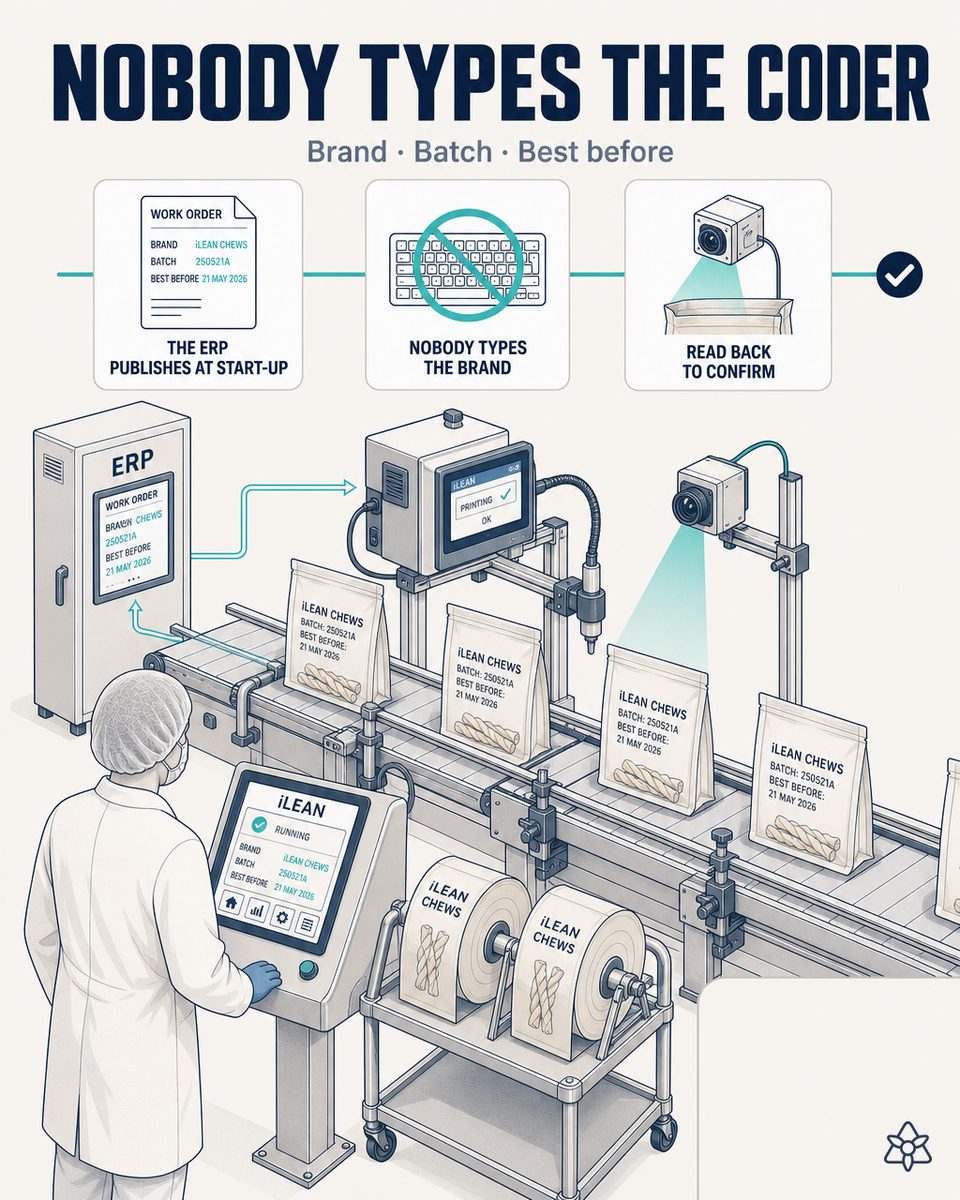
The coder is the last physical piece touching the product before it leaves for the customer, and in a plant manufacturing for several brands it is also the most dangerous: what it prints is not internal data, it is another company's brand identity. With iLEAN it is stitched to the ERP and the batch, the dates and the correct artwork travel on their own from the active order.
Integrating it properly never becomes the quarter's priority.
The coder is usually relatively modern equipment, between five and fifteen years old, already exposing a programming interface. But it is isolated from the ERP — and from there comes a chain of consequences:
- On every order change someone types the batch and the date and selects the artwork at the panel. One misplaced finger, or the wrong brand's artwork selected in a hurry, and half a production run leaves with the wrong identification.
- In private label that is not an internal error — it is not fixed in the warehouse: it is one customer's product carrying another's identity, and a direct candidate for customs rejection or a recall at destination.
- And the artwork master is usually a folder of documents with versions resembling each other, where the current one is whichever someone remembered to open.
It is the most frustrating gap of all: the equipment already knows how to talk, so does the ERP, and what is missing is an integration that never climbs high enough on the priority list — while the risk repeats on every order change.
Connect stitching two modern systems, replacing neither.
When both ends already have a way to communicate, stitching is not a project: it is closing a specific gap. And here the gap sits exactly at the last piece before the customer.
When the ERP marks the order's startup, it automatically publishes to the coder the batch, the production date and the expiry date — and also the destination brand's artwork identifier, taken from the master linked to the commercial reference. The order change becomes one tap in the ERP, not a key sequence at the panel.
How Connect operates on the coder:
- Automatic publication on order startup — batch, production date and expiry date travel together from the ERP, without anyone transcribing them.
- The artwork, linked to the commercial reference — not selected by hand from a folder: the identifier comes from the master associated with that reference, so the current version stops being "the one someone remembered to open".
- The order change is one tap in the ERP — not a key sequence at the equipment's panel, done in a hurry between two productions.
- Without replacing any system — the two that already exist are stitched through an interface. Neither the coder nor the ERP changes configuration.
- A double ring over the same information — the line clearance's Edge camera later reads what was printed and checks it against the active order: what was published and what was actually printed check each other.
An isolated coder vs. a coder stitched to the ERP
| Aspect | Manual typing on every change | With iLEAN Connect via interface |
|---|---|---|
| Origin of the batch and dates | A copy typed at the panel | The ERP's active order |
| Artwork selection | By hand, from a folder of similar versions | An identifier linked to the commercial reference |
| Coding errors | Several a month, some with rework | Zero of human origin |
| Risk in private label | One customer's product with another's identity | Eliminated at the origin |
| The artwork master | A document folder, current version by memory | The current version linked to the reference |
| Check of what was printed | None | Checked by the Edge camera against the order |
Impact estimate for your plant — to be validated with your own numbers.
The block below is an estimate to be validated against your plant's actual data. We put it forward so the committee has an order of magnitude; we refine it during the assessment.
- Rawhide chew plant producing for several third-party brands, with a modern coder isolated from the ERP and several order changes per shift.
- Connect pilot stitching the ERP and the coder through an interface. Without replacing equipment. First value expected within a few weeks.
- Fast payback, estimated between 3 and 6 months, and a drastic reduction of the rejection or recall risk from wrong identification. Estimate to be validated.
- It requires confirming beforehand that the installed model exposes a programming interface. If not, an adapter is needed that raises the initial CAPEX without breaking the case — but it is worth knowing before committing to a deadline.
- The asymmetric lever: half a production run with another brand's identity detected at customs or at destination costs, between rejection and commercial conversation, far more than the whole pilot.
And the fair question from the operations director
"What if the AI invents a batch or selects the wrong artwork?" — it cannot: here the AI does not generate data, it transports it anchored. The batch and the dates come from the ERP's active order and the artwork from the master linked to the commercial reference. It is an anchored task, where the best models brought the error below 1.5% [1]. And there is a second ring: the Edge camera reads what was printed and checks it against the active order, so what was published and what was actually printed check each other.
[1] OpenAI paper "Why Language Models Hallucinate", 2025 — on the reliability of AI in anchored tasks.
What people ask about stitching the coder to the ERP
If the coder already has an interface, why isn't it integrated?
Because integrating it properly never becomes the quarter's priority. It is a small project falling between the ERP's scope and the equipment vendor's, so it gets postponed — and meanwhile it is covered by a person typing, which is the solution always available. The equipment is usually between five and fifteen years old and has exposed its interface from day one; the gap is not technical, it is one of priority. Connect exists precisely to close it without opening a full integration project.
Why is a coding error more serious in private label?
Because what the coder prints is not internal data: it is another company's brand identity. If in own-brand production a badly coded batch is fixed in the warehouse, in private label the result is one customer's product carrying another customer's identity. That is not fixed by relabeling: it is a direct candidate for customs rejection or a recall at destination, with the commercial conversation that drags along with the brand owner. And the plant works for several at once, so the risk repeats on every order change.
What is the problem with the artwork master?
That it is usually a folder of documents with versions resembling each other, where the current one is whichever someone remembered to open. In an operation producing for several brands, each with its artwork revisions, that folder accumulates variants distinguished by details. Selecting by hand at the panel, in a hurry between two productions, is an invitation to error. By publishing the artwork identifier linked to the commercial reference, the correct version stops depending on the memory of whoever is on the line that shift.
Does the coder have to be changed?
In principle no: work goes against the programming interface the equipment already exposes, and nothing is replaced or reprogrammed. That said, there is a requirement worth confirming before committing to deadlines: that the installed model actually exposes it. Some older machines do not and demand an intermediate adapter, which raises the initial CAPEX without breaking the case but changes the calculation. That is why the first thing we ask for is the specific model: we check it before giving a payback.
What does the Edge camera add on top of this?
A second ring over the same information. Connect publishes batch, dates and artwork from the active order; the line clearance's Edge camera later reads what was actually printed and checks it against that same order. The difference matters: one guarantees the correct data was sent, the other that the equipment applied it. If for any reason what was printed does not match what was published — a machine failure, a residue from the previous order — it is detected on the line and not in the container.
More cases from this series
- The audit stops being a two-week projectPhotos, signatures and measurements organize themselves by certifying standard. The auditor downloads…
- The changes arriving by email stop being read lateiLEAN reads the client brands’ email and messaging, cross-references it with live orders and returns the…
- The drying chamber starts to talk without anyone touching itAn external camera reads the drying chamber’s isolated panel: temperature and humidity curve per load,…
- Backward traceability starts at the dock: receiving by photoA photo of the delivery note and the pallet labels: batches enter the ERP in minutes and the chemical’s…
- The laboratory stops transcribing: from Excel to the ERP at second zeroResidual moisture, water activity and microbiology enter the ERP as soon as the laboratory saves the…
- The batch exists at second zero: production order and drying load without paperThe production order and the drying load sheet, captured by photo: the batch exists in the system at…
Tell us your coder's model and we will confirm whether it can be stitched to the ERP without an adapter.
We work on your plant's real data, not ours. Assessment with no commitment.
Confirm whether it can be stitched to the ERP without an adapter ‹ See all 12 rawhide petfood cases See food industry