The audit stops being a two-week project
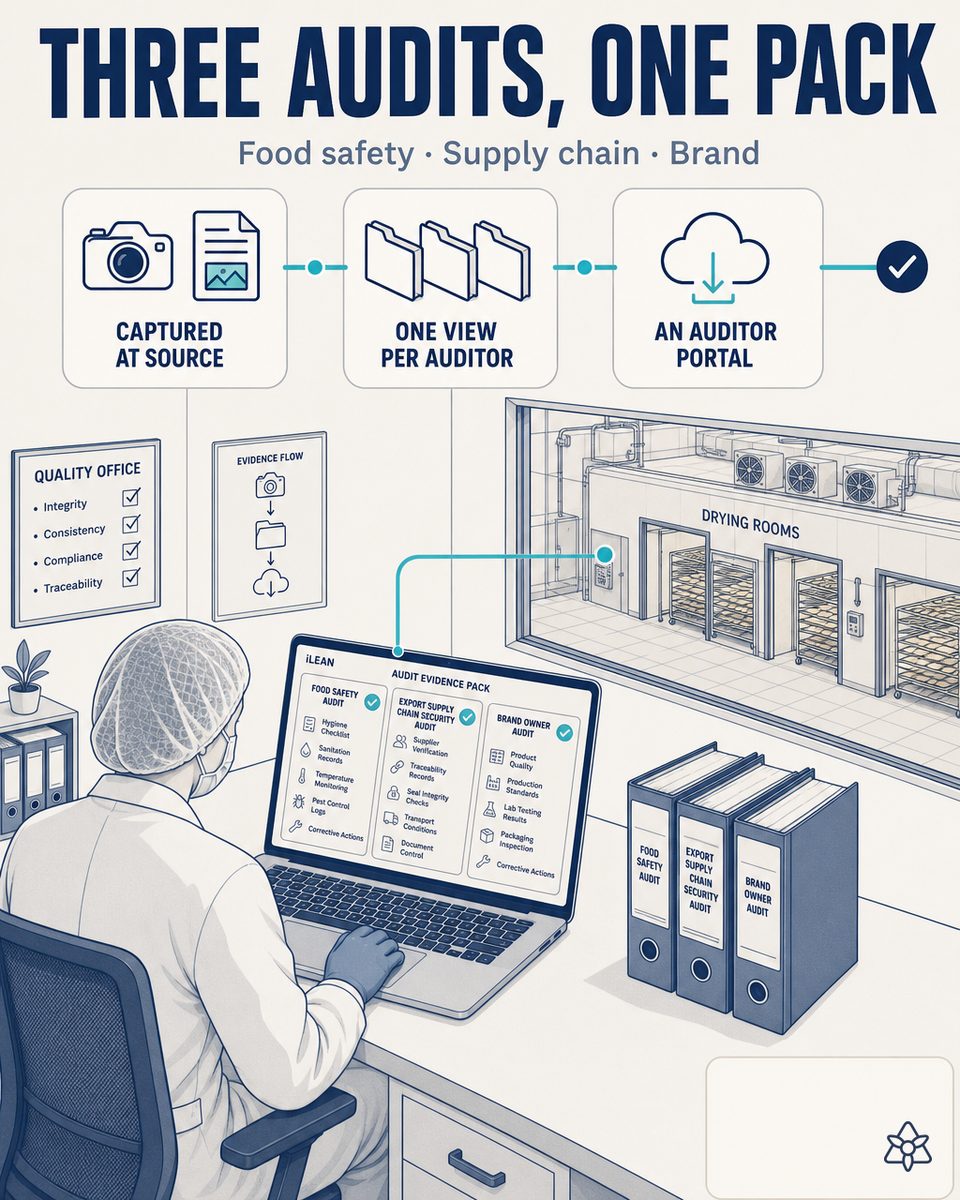
Here there is not one audit: there are three simultaneous families — food safety, export chain security and the brand owner's own audit —, and each asks for the same information organized differently. With iLEAN, every clearance, every drying load and every laboratory control generates its material automatically, and Agents organizes it by standard. The auditor serves themselves.
The nonconformities do not appear because the process is wrong, but because the evidence is incomplete.
The day they arrive, someone at the plant spends days or weeks reconstructing evidence from folders, loose photos on phones and signed sheets. Multiplied by several sites, the preparation work is enormous and always falls on the same people:
- It was done right, but it cannot be proven — and that is the most frustrating part: the nonconformity does not point to a process failure, it points to a documentary gap.
- Three audit families, three formats — food safety, export chain security and the brand owner's own audit. The same information, organized three different ways.
- And without those certifications there is no business — without food safety and chain security there is no contract with the big chains and no smooth operation at the border. Documentary risk is direct commercial risk.
In other words: a plant that works well can lose a contract for being unable to prove it — and the work of proving it falls, every time, on the same people who should be improving the process.
Edge captures, Connect contributes, Agents organizes — and there is no step someone can forget.
This case's key is not the later organization: it is that the material is generated as a consequence of the work itself. There is no additional documentation step depending on someone remembering.
Every line clearance, every drying load and every laboratory control generates before-and-after photos of the critical points, a decision log, timestamped signatures and measurements. Agents reorders that same material under each standard's logic and generates the dossier downloadable by batch, by period or by container, including the loading and sealing photos.
How the evidence pack is composed:
- The material generates itself — as a consequence of the clearance, the load and the laboratory control. There is no additional step someone can forget, which is where traditional documentary systems fail.
- Before-and-after photos, a log and timestamped signatures — the evidence an auditor considers proof, not a procedure saying what should be done.
- Reordered by certifying standard — the same material presented under each family's logic: food safety, export chain and brand audit.
- And by container, not only by batch — including the loading and sealing photos, which is what the chain security audit asks for and today lives on someone's phone.
- Consistent between plants — the same schema at all sites, which is what does not happen today and what makes every audit be prepared from scratch.
Manual reconstruction vs. an evidence pack generated by the work itself
| Aspect | Days or weeks of preparation | With iLEAN Edge + Connect + Agents |
|---|---|---|
| Preparation before the audit | Days or weeks, per site | Zero |
| Origin of the material | Folders, loose photos on phones, signed sheets | The clearance, load and control themselves |
| Nonconformities from documentary gaps | Appear even with the process right | Complete evidence, consistent between plants |
| "Find me last month's clearance photos" | A search through phones and folders | A download |
| Adaptation to each audit family | The dossier is redone three times | Same material, three views |
| A per-container dossier | Does not exist | With loading and sealing photos included |
Impact estimate for your plant — to be validated with your own numbers.
The block below is an estimate to be validated against your plant's actual data. We put it forward so the committee has an order of magnitude; we refine it during the assessment.
- Rawhide chew factory with several sites, export product and three recurring audit families.
- Deployment resting on the Edge and Connect cases already running: they generate the material, Agents reorders it by standard. First value expected within a few weeks of events being recorded.
- Indicative payback between 6 and 12 months depending on audit frequency, plus the quality team's time recovered. Estimate to be validated.
- And the continuous protection of the certifications enabling export: without food safety and chain security there is no contract with the big chains and no smooth operation at the border.
- The effect on the team: quality stops spending person-days reconstructing evidence and goes back to spending them on the process.
And the fair question from the quality manager
"Will an auditor accept a dossier assembled by AI?" — the auditor does not accept the dossier, they accept the evidence: the before-and-after photo, the log, the timestamped signature and the measurement, which are the same ones scattered today. Agents generates no new content: it reorders existing material under each standard's logic, which is an anchored task — where the best models brought the error below 1.5% [1]. And if a piece is missing, the pack flags it as a gap instead of disguising it.
[1] OpenAI paper "Why Language Models Hallucinate", 2025 — on the reliability of AI in anchored tasks.
What people ask about the evidence pack in an export plant
Why three audit families and not one?
Because a rawhide plant that exports answers to three distinct logics at once: food safety, export chain security and the brand owner's own audit, which has its own requirements because its name goes on the bag. The three ask to a large extent for the same information — traceability, process control, clearance evidence — but organized differently and with different emphasis. Today that means preparing three dossiers; with Agents it means three views of the same material.
What prevents someone forgetting to document something?
That there is no additional documentation step. The material is generated as a consequence of the work itself: when the crew does the clearance, the cameras are already capturing the before-and-after photos; when a drying load enters, the curve is already being recorded; when the laboratory saves its sheet, the result is already fed in. That is the difference with a traditional documentary system, where someone has to remember to upload the photo or fill in the record — and where the gaps appear precisely on the highest-pressure days.
What is the per-container dossier?
It is the view the export chain security audit asks for and that today does not exist as such. It groups, for a specific container, the evidence of the batches inside — clearances, drying curves, laboratory controls — plus the loading and sealing photos, which today usually live on the phone of whoever took them. Being able to deliver that complete and on the spot changes the conversation at the border and with the brand owner, because the question "what was in this container and how was it produced?" gains a downloadable answer.
What happens if a batch is missing a piece of evidence?
The pack flags it as a gap instead of disguising it, and does so before the audit — which is when the exception can still be documented or the process that caused it corrected. It is an important difference: today the gaps appear with the auditor present and at that moment they are a nonconformity. A visible, explained gap beforehand is manageable; a dossier that looks complete without being so is what triggers a major nonconformity, and it also destroys trust in everything else inside.
Why is documentary risk commercial risk?
Because without the food safety and chain security certifications there is no contract with the big chains and no smooth operation at the border. It is not a formal compliance matter: it is the business's entry condition. And the consequence is especially unfair — a plant that works well can lose a contract not for a process failure but for being unable to prove what it did. That is why this case's value is not measured only in freed quality hours, but in the continuous protection of what enables export.
More cases from this series
- The changes arriving by email stop being read lateiLEAN reads the client brands’ email and messaging, cross-references it with live orders and returns the…
- The last piece before the customer stops depending on typingBatch, expiry and the right brand’s artwork travel from the ERP to the coder with no typing. Zero…
- The drying chamber starts to talk without anyone touching itAn external camera reads the drying chamber’s isolated panel: temperature and humidity curve per load,…
- Backward traceability starts at the dock: receiving by photoA photo of the delivery note and the pallet labels: batches enter the ERP in minutes and the chemical’s…
- The laboratory stops transcribing: from Excel to the ERP at second zeroResidual moisture, water activity and microbiology enter the ERP as soon as the laboratory saves the…
- The batch exists at second zero: production order and drying load without paperThe production order and the drying load sheet, captured by photo: the batch exists in the system at…
How many person-days did preparing your last audit cost?
We work on your operation's real data, not ours. That number is the whole case. Assessment with no commitment.
That number is the whole case — let's talk ‹ See all 12 rawhide petfood cases See food industry