Backward traceability starts at the dock: receiving by photo
Through a rawhide plant's receiving door two flows enter that are critical for different reasons: the hide, which defines the product's yield and quality, and the process chemicals, which define the regulatory risk in the destination country. Today the manager signs the paper and then types line by line into the ERP. With Connect they take photos, validate with one tap, and everything enters.
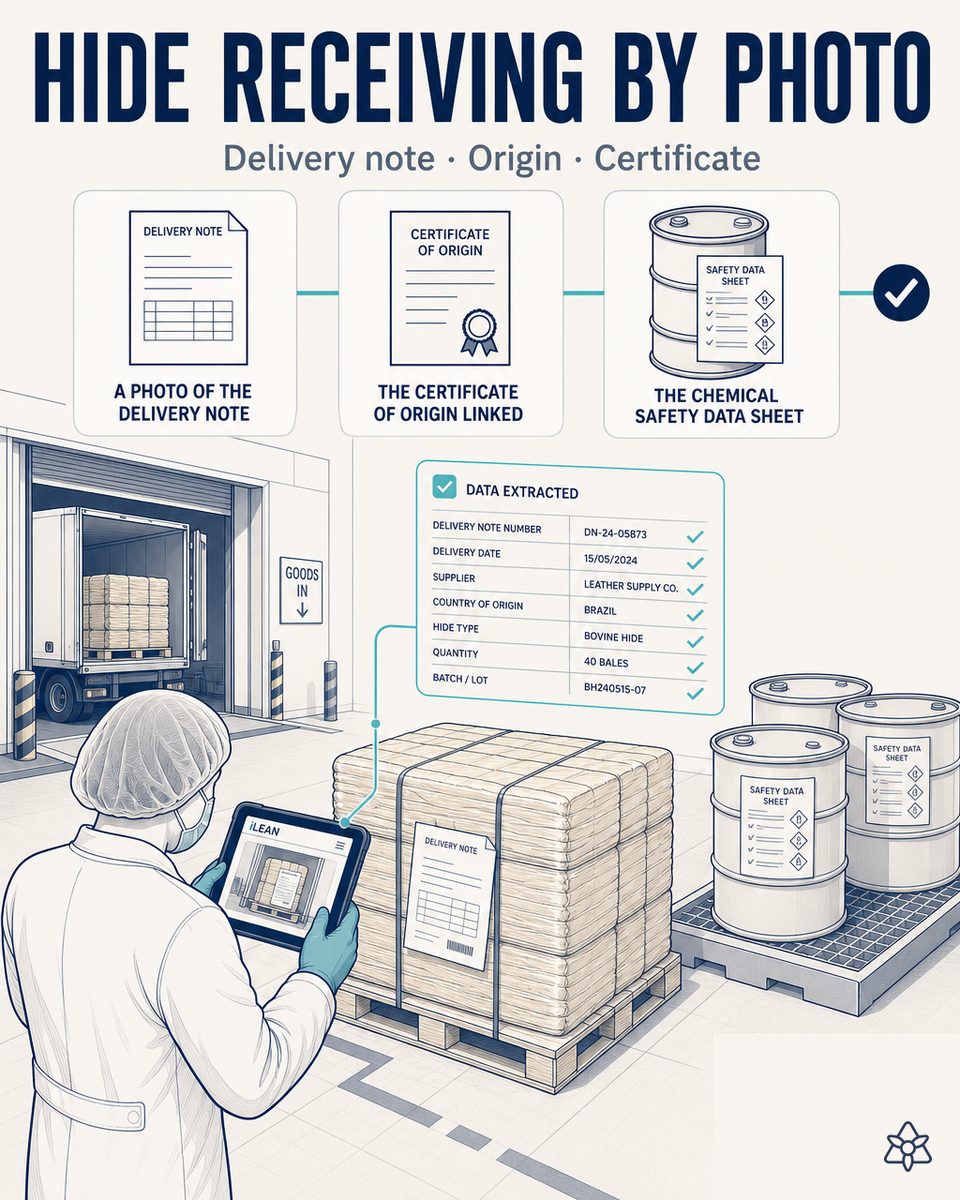
The whole operation's backward traceability starts here — and it is the most fragile point.
At the dock the same dilemma repeats every day, and both exits are bad:
- Either the carrier waits charging for the delay while someone types twelve or twenty lines, or the typing happens in a hurry and badly traced batches remain that resurface weeks later in an alert nobody can reconstruct anymore.
- If a hide or chemical batch enters misidentified, the plant loses the ability to answer the only question that matters on the day of an incident: which product did that inbound batch touch.
- And with several sites it multiplies — the same chemical batch is split between plants, so one identification error at the dock contaminates the whole operation's traceability.
In the end receiving works because someone sustains it with craft and haste. But that craft goes unrecorded, and it is no use on the day backward tracing is needed from an alert at destination.
Connect photo-the-analog — and in chemicals, a check that does not exist today.
The necessary information is already printed: on the delivery note and the pallet labels. What is missing is the path to the ERP without a keyboard — and, in the chemicals flow, a check that today is done nowhere.
A photo of the delivery note, a photo of the labels. And in the chemicals flow, iLEAN extracts the declared parameters from the certificate of analysis and checks them against the destination country's list of admitted substances. If something does not fit, it does not enter silently: the alert is raised at the dock.
How Connect operates at the receiving dock:
- The delivery note, asking nothing of the supplier — vision recognizes the format as it arrives and extracts the complete tabular structure. No templates to maintain.
- Pallet labels in any encoding — barcode, GS1-128, QR or plain text by optical recognition. The batch is read from the code instead of typed.
- A regulatory check on the chemicals — the certificate of analysis parameters are compared with the substances admitted in the destination country. It is the check that today depends on someone remembering it.
- If something does not fit, an alert at the dock — it does not enter silently. It is the only point where stopping a chemical batch is still cheap.
- One-tap validation and a feed through an interface — the manager reviews the summary and confirms. The batch enters the ERP traced from the photo.
Typed receiving vs. photo receiving with a regulatory check
| Aspect | Double typing with the truck waiting | With iLEAN Connect photo |
|---|---|---|
| Truck standing time | An hour | Minutes |
| Hide or chemical batch | Typed in a hurry | Read from the code |
| Chemical's certificate vs. destination country | Checked if someone remembers | Checked automatically, alert at the dock |
| Traceability between plants | Broken if the batch is split | A complete chain from hide and chemical to container |
| Answering "which product did that batch touch?" | Manual reconstruction, sometimes impossible | A query |
| Receiving module licenses | 2-3 users per site | 1 who validates, without entering the ERP |
Impact estimate for your plant — to be validated with your own numbers.
The block below is an estimate to be validated against your plant's actual data. We put it forward so the committee has an order of magnitude; we refine it during the assessment.
- Rawhide chew factory receiving hide and process chemicals, with several sites and product destined for export.
- Connect photo pilot at the dock with an ERP feed through an interface after one-tap validation. Without asking suppliers for changes. First value expected within a few weeks.
- Direct financial angle — the receiving and warehouse module typically demands 2-3 active users per site. With Connect a single person validates, with one tap, without entering the ERP: typical reduction of 50-70% in receiving module licenses, multiplied by the number of plants, plus the elimination of carrier delays.
- Estimated payback between 3 and 8 months. Estimate to be validated.
- The lever that is not in the spreadsheet: the check of the chemical's certificate against the destination country. It is one of the three doors through which a container is lost at customs, and today it depends on someone checking it by hand.
And the fair question from the quality manager
"What if it misreads a batch and breaks my traceability?" — hallucination is a problem of free generation, not of anchored tasks. Reading a batch printed on a label and mapping it to a known field is an anchored task, and there the best models brought the error below 1.5% [1]. On top of that the batch is read from the code, not free text, and nothing is fed in without a person confirming. The practical result is fewer errors than typing twenty lines with the truck waiting.
[1] OpenAI paper "Why Language Models Hallucinate", 2025 — on the reliability of AI in anchored tasks.
What people ask about hide and chemical receiving
Do we have to ask the supplier to change its delivery note?
No. Connect's vision recognizes the delivery note's format as it arrives and extracts its complete tabular structure, with no predefined templates. Same with the pallet labels, whether barcode, GS1-128, QR or plain text. Asking hide or chemical suppliers to adopt a specific format does not work in practice — each has its own system — and would also delay the project by months. The adapting is done by the system, not the supplier or the person at the dock.
What exactly does the chemicals' regulatory check do?
iLEAN extracts the process chemical's declared parameters from the certificate of analysis and compares them against the list of substances admitted in the product's destination country. If something does not fit — a substance not approved there, a value beyond what is allowed — it does not enter silently: the alert is raised at the dock, which is the only moment when stopping that batch is still cheap. Today that check depends on someone remembering it and doing it by hand, and it is one of the three doors through which a container is lost at destination.
Why is this the chain's most fragile point?
Because backward traceability starts here. If a hide or chemical batch enters misidentified, the plant loses the ability to answer the only question that matters on the day of an incident: which product did that inbound batch touch. And the problem does not manifest the day it happens — it manifests weeks later, with an alert from destination and no way to reconstruct. In an operation with several plants it is worse still, because the same chemical batch is split between sites and a single error contaminates the whole operation's traceability.
How does it translate into ERP licenses?
The receiving and warehouse module typically demands 2-3 active users per site, and that figure multiplies by the number of plants. With Connect a single person validates, with one tap on the tablet and without entering the ERP: the rest no longer need access to the module. The usual reduction is between 50% and 70%, and in a multi-plant operation the effect multiplies. Add the elimination of carrier delays, which today get paid on invoices but accepted as part of the process.
How long does receiving a truck really take this way?
The realistic goal is going from an hour to a few minutes. The bulk of the current time is not spent unloading: it goes into typing twelve or twenty delivery note lines and copying each pallet's batch. With Connect that part becomes a few photos and a validation over the summary, where only the lines flagged as doubtful demand attention. The most appreciated side effect is usually the delays: when the carrier stops waiting, that recurring cost disappears from the invoice.
More cases from this series
- The audit stops being a two-week projectPhotos, signatures and measurements organize themselves by certifying standard. The auditor downloads…
- The changes arriving by email stop being read lateiLEAN reads the client brands’ email and messaging, cross-references it with live orders and returns the…
- The last piece before the customer stops depending on typingBatch, expiry and the right brand’s artwork travel from the ERP to the coder with no typing. Zero…
- The drying chamber starts to talk without anyone touching itAn external camera reads the drying chamber’s isolated panel: temperature and humidity curve per load,…
- The laboratory stops transcribing: from Excel to the ERP at second zeroResidual moisture, water activity and microbiology enter the ERP as soon as the laboratory saves the…
- The batch exists at second zero: production order and drying load without paperThe production order and the drying load sheet, captured by photo: the batch exists in the system at…
How long does a truck stand at your dock today?
We work on your plant's real data, not ours. We look at your real delivery notes and certificates and calculate the case with you. Assessment with no commitment.
That number is the start of the case — let's talk ‹ See all 12 rawhide petfood cases See food industry