The drying chamber starts to talk without anyone touching it
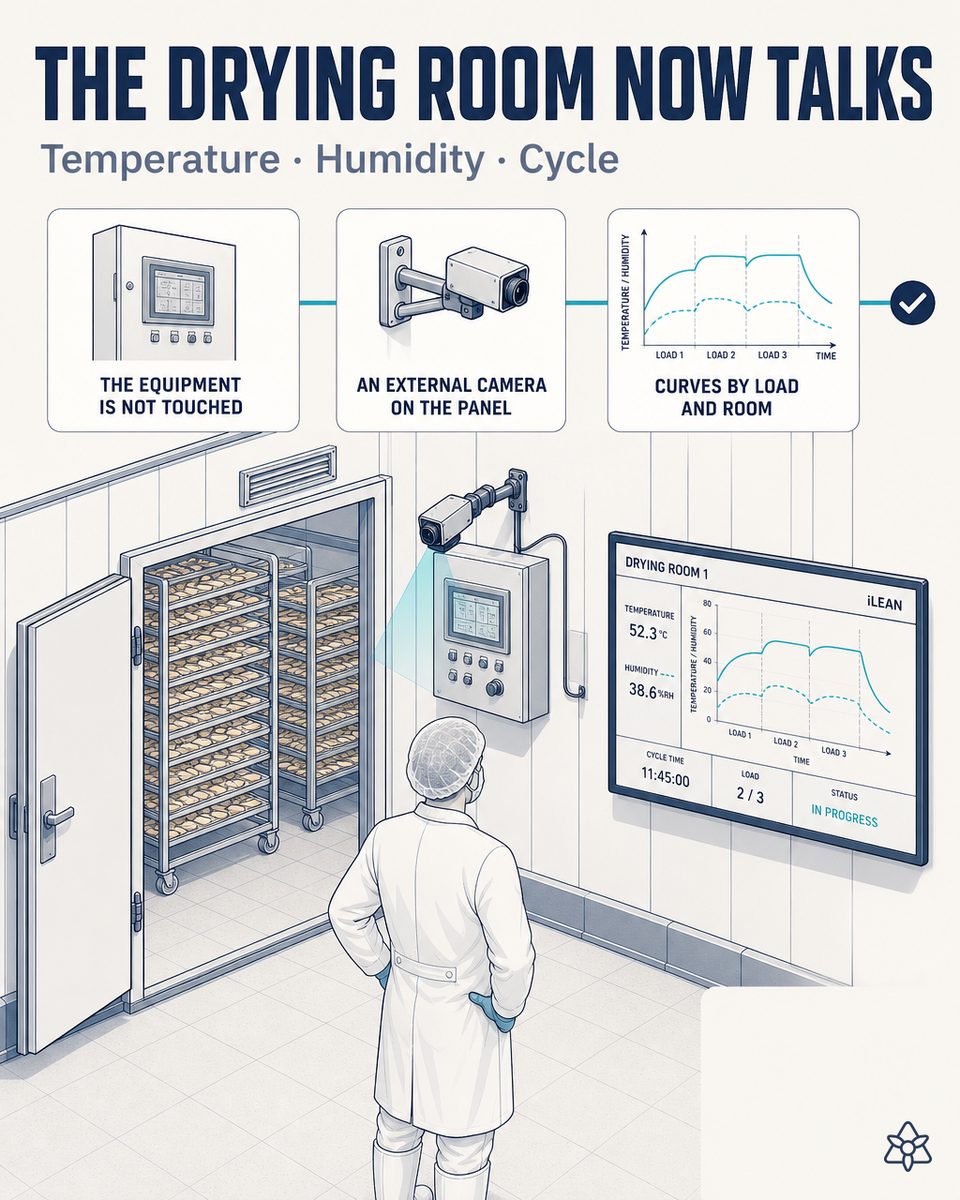
Drying is at once a rawhide plant's physical bottleneck and its critical food safety point. If the piece comes out with residual moisture above range, mold appears weeks later already in the distributor's warehouse; if it comes out below, sellable weight is lost and the piece cracks. The panel shows everything you would need to know, but it is twenty years old and lives isolated from the network. An external camera aimed at the panel turns those readings into each load's drying curve.
The plant works blind on its most critical variable.
The chamber's panel shows at all times temperature, relative humidity, air speed and elapsed time — exactly the data that would allow correlating drying curve with final moisture, with shrinkage and with a destination claim. But those readings die on the screen:
- The classic answer is replacing the equipment — and in the process's slowest stage that means a high investment and weeks of stoppage. That is why the decision is postponed year after year.
- Nobody detects that a chamber is drifting — because a heating element ages or a door closes worse — until the product says so, which is too late.
- And nobody can compare chambers with each other — objectively. They are compared by feel, not by data, so the differences between machines are not corrected: they are accepted.
The result is a bottleneck that is also a black box: the stage consuming the most time and concentrating the most risk is the only one with not a single data series.
Connect in photo mode on the panel — the equipment stays the same, its data no longer does.
The missing information is already on the screen. What does not exist is the path from that glass to the central system. Connect solves it by looking, not integrating: without opening the electrical cabinet, without touching the control and without compromising the manufacturer's warranty.
A fixed industrial camera aimed at the panel, reading every few seconds. Optical recognition interpreted by an anchored model structures each reading into fields, iLEAN reconstructs that load's complete time curve and automatically cross-references it with the batch the load sheet assigned to that chamber.
How Connect operates on the drying chamber's panel:
- Without opening the cabinet or touching the control — a mount is installed in front of the panel and that is where the intervention ends. The manufacturer's warranty stays intact and no risk is assumed on equipment in continuous production.
- Reading every few seconds — which allows reconstructing the complete curve of a load lasting between twenty-four and seventy-two hours, not a loose snapshot of an instant.
- Anchored to that specific panel — the model knows where the temperature is, where the relative humidity, where the air speed and where the elapsed time. It reads values at known positions.
- Cross-referenced with the load sheet's batch — automatically, because the startup case already assigned which trolleys of which batch entered which chamber. Without that cross-reference the curve is a chart; with it, it is traceability.
- Objective comparison between chambers — with several loads accumulated you can see that one specific chamber behaves differently, and detect its drift by process instead of by product.
Drying chamber as a black box vs. curve digitized with Connect
| Aspect | A twenty-year-old isolated panel | With iLEAN Connect on the panel |
|---|---|---|
| Curve ↔ defect correlation | Zero | Root cause analysis per load, in minutes |
| Comparison between chambers | By feel | With data |
| Detecting a chamber's drift | By product, when there is already a claim | By process, earlier |
| The load's curve | Dies on the screen | A complete time series per load |
| Intervention on the equipment | Opening the cabinet and compromising the warranty | None — external camera |
| Replacing the drying equipment | High investment and weeks of stoppage | Deferrable, potentially indefinitely |
Impact estimate for your plant — to be validated with your own numbers.
The block below is an estimate to be validated against your plant's actual data. We put it forward so the committee has an order of magnitude; we refine it during the assessment.
- Rawhide chew factory with drying chambers on old, network-isolated panels and residual moisture as the critical variable.
- Connect pilot on one chamber's panel: external mount, model anchoring to that screen and cross-reference with the load sheet's batch. First value expected within a few weeks.
- Indicative payback between 5 and 10 months. Estimate to be validated.
- Add the deferral — potentially indefinite — of the drying equipment's replacement CAPEX, which in the process's slowest stage is a figure that weighs in the committee.
- And two process savings: the shrinkage from over-drying (sellable weight lost) and the rejections for out-of-range moisture, which today cannot be attacked because there is nothing to correlate them with.
And the fair question from the maintenance manager
"What if the camera misreads a value from a twenty-year-old panel?" — hallucination is a problem of free generation, not of anchored tasks. Here the AI reads a numeric value at a known position on a known panel: the best models brought the error below 1.5% [1] in that type of task. And the reading is redundant over time — every few seconds throughout the load —, so a discordant reading is discarded against its neighbors instead of propagating into the curve.
[1] OpenAI paper "Why Language Models Hallucinate", 2025 — on the reliability of AI in anchored tasks.
What people ask about digitizing the drying chamber without touching it
Does the electrical cabinet have to be opened or the control touched?
No, and that is the approach. A fixed industrial camera aimed at the panel from outside is mounted and that is where the intervention on the equipment ends: the cabinet is not opened, nothing is connected to the control and no parameter is modified. The manufacturer's warranty stays intact and no risk is assumed on a machine in continuous production. It is exactly what allows installing without stopping the drying, in the stage that can least afford a stoppage.
How is the curve of a three-day load reconstructed?
With reading every few seconds throughout the cycle. Each capture is interpreted with a model anchored to that specific panel — which knows where the temperature, the relative humidity, the air speed and the elapsed time are — and structured into fields. The result is not a snapshot of an instant but that load's complete time series, from entry to emptying. That is what makes a progressive drift visible, which is precisely what a point reading does not show.
How is the curve associated with the batch?
Automatically, because the batch startup case already recorded which trolleys of which batch entered which chamber and at what time through the load sheet. Connect crosses that assignment with that chamber's time series, so the curve stays tied to the product that was inside and not just to the clock. Without that cross-reference, we would have a pretty chart of a chamber; with it, we have the traceability of a specific batch's real drying conditions, which is what is needed when a complaint arrives.
Does it detect that a chamber is degrading?
Yes, and it is one of the most appreciated returns. A drying chamber does not fail suddenly: it degrades. A heating element ages, a door closes worse, a fan loses flow. None of those signals is visible looking at an isolated load — they only appear when comparing successive loads and chambers with each other, which is exactly what central memory allows. The practical result is detecting the drift by process instead of by product: before the mold in the distributor's warehouse is what gives notice.
What is gained in shrinkage and rejections?
The two extremes of the same problem. If the piece comes out with moisture above range, mold appears weeks later at destination and that is a rejection. If it comes out below, it over-dried: sellable weight is lost and the piece cracks. Today that balance is tuned by experience because there is no data to refine it. With the per-load curve crossed with the final moisture measured in the laboratory, the drying window stops being an estimate and becomes a parameter that can be optimized — with direct impact on shrinkage and rejections.
More cases from this series
- The audit stops being a two-week projectPhotos, signatures and measurements organize themselves by certifying standard. The auditor downloads…
- The changes arriving by email stop being read lateiLEAN reads the client brands’ email and messaging, cross-references it with live orders and returns the…
- The last piece before the customer stops depending on typingBatch, expiry and the right brand’s artwork travel from the ERP to the coder with no typing. Zero…
- Backward traceability starts at the dock: receiving by photoA photo of the delivery note and the pallet labels: batches enter the ERP in minutes and the chemical’s…
- The laboratory stops transcribing: from Excel to the ERP at second zeroResidual moisture, water activity and microbiology enter the ERP as soon as the laboratory saves the…
- The batch exists at second zero: production order and drying load without paperThe production order and the drying load sheet, captured by photo: the batch exists in the system at…
Send us a photo of your drying chamber's panel and we will tell you whether Connect can read it.
We work on your plant's real data, not ours. Assessment with no commitment.
Check whether Connect can read it ‹ See all 12 rawhide petfood cases See food industry