The batch exists at second zero: production order and drying load without paper
In a rawhide chew factory every batch is born with two paper documents: the production order coming down from the ERP — size in inches, target weight, flavor, destination brand — and the drying load sheet filled in by hand at the chamber's door. Between the two they define everything that will matter later. With iLEAN Connect, the area lead takes two photos with the phone at startup and the batch already exists in the central system.
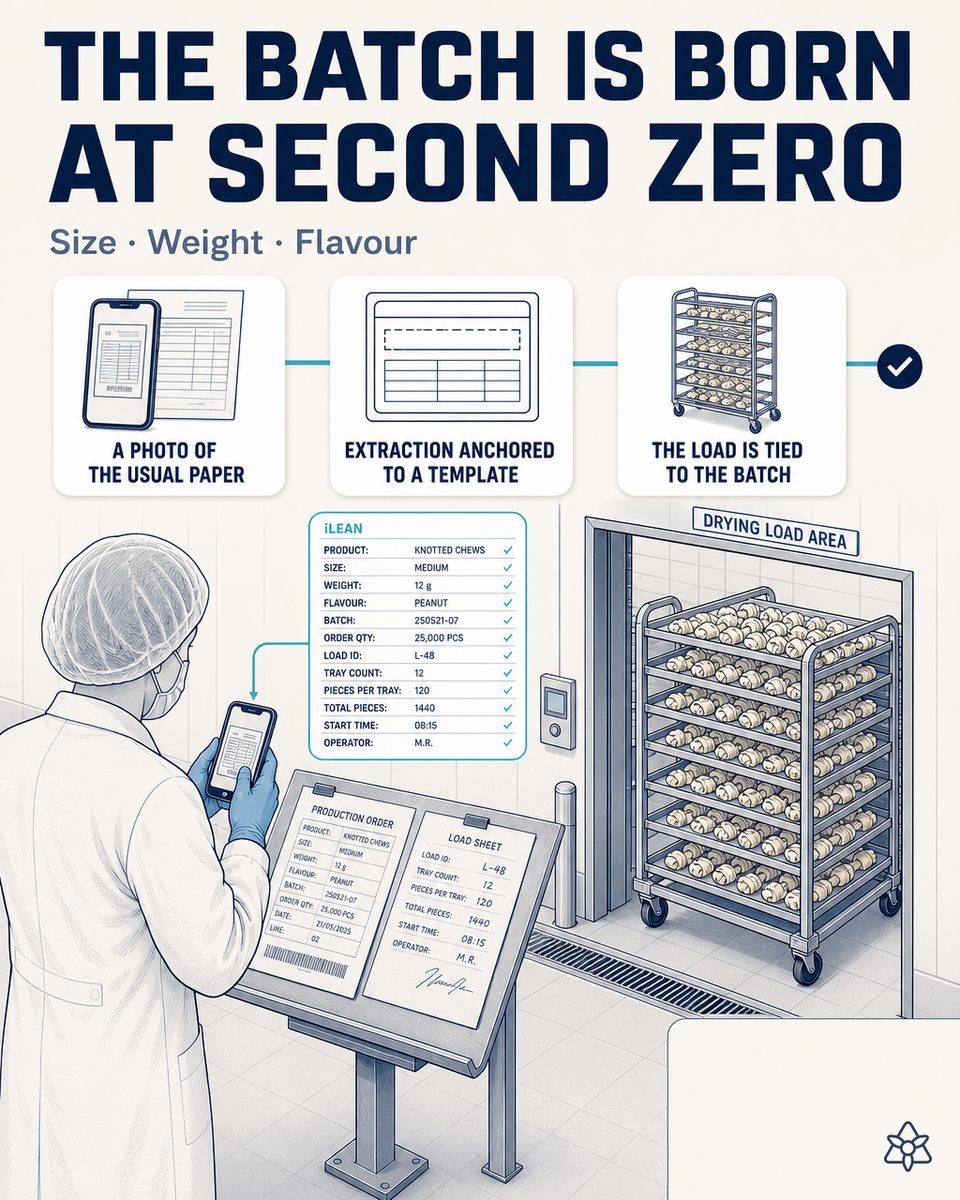
A good part of the drying cycle passes without the system knowing what is being made.
The forming area works with paper because the real workstation is a table, not a screen. The drying load sheet is written by whoever pushes the trolley. Both documents get digitized at the end of the shift, the next day, or not at all:
- Drying lasts between twenty-four and seventy-two hours — so a documentary latency of four to eight hours means a relevant part of the cycle runs blind: neither what is being made nor which chamber it is in.
- The bill is not paid in the moment — it is paid weeks later, when a mold complaint arrives from the distributor's warehouse and which trolley, which chamber, what time and which drying program have to be reconstructed by hand.
- And that is archaeology over papers — consuming days of the plant's most expensive people, exactly when a fast answer must be given to a customer.
Nobody notices the gap while everything goes well. It is noticed the day something must be proven backwards, which is exactly the day with the least margin to reconstruct it.
Connect in photo-the-analog mode — two photos at startup, and the batch exists.
Digitizing the startup demands no new workstation and asks nobody to type at a forming table. It demands that what is already written reaches the system the moment it is written.
The lead photographs the printed production order and the handwritten load sheet at startup. An anchored model extracts batch, size, flavor, destination brand, target weight, number of trolleys, chamber, drying program and entry time — and links both documents to each other, because the order and its load are the same batch.
How Connect photo operates at batch startup:
- What matters is what does not change — the operator keeps filling in the same paper, with the same pen, in the same place. No training, no resistance, no new workstation in front of a screen.
- Anchored to both documents' structure — the model knows the format of the order coming down from the ERP and of the house's load sheet, including the handwriting of whoever pushes the trolley.
- The two documents linked to each other — not as two loose captures: the order and its load are the same batch, and that is how they stay in central memory.
- Early human validation — the summary appears on the area tablet and one tap makes the data cross into the system. Nothing enters without a person seeing it.
- A per-batch query instead of archaeology — from then on, "in which chamber and with which program did this batch dry?" stops being an investigation and becomes a web query.
Paper startup vs. startup digitized with Connect
| Aspect | Order and load sheet on paper | With iLEAN Connect photo |
|---|---|---|
| Documentary latency | 4-8 h, or a full shift | Second zero |
| The batch's traceability | Reconstructed by hand | A per-batch web query |
| "Which chamber was that batch in?" | "I think chamber 3" | Certainty |
| Order ↔ drying load link | Reconstructed by crossing papers | Linked from the capture |
| Answering a mold complaint | Days of documentary archaeology | Minutes |
| The forming area's habit | The same paper — plus a late transcription | The same paper — plus two photos |
Impact estimate for your plant — to be validated with your own numbers.
The block below is an estimate to be validated against your plant's actual data. We put it forward so the committee has an order of magnitude; we refine it during the assessment.
- Rawhide chew factory with a printed ERP production order and a handwritten drying load sheet at the chamber's door.
- Connect photo pilot on batch startup — with the phone the area lead already carries, without changing the work standard. First value expected within a few weeks.
- Indicative payback between 4 and 9 months depending on the number of batches and drying loads per day, plus the administrative transcription time recovered at each site. Estimate to be validated with real volumes.
- The underlying lever is that this case is the enabler of the rest of the matrix: without the batch existing from second zero, the drying curve has nothing to attach to and a claim analysis remains archaeology.
- And the effect noticed first: no longer spending days of the plant's most expensive people reconstructing which trolley went to which chamber.
And the fair question from the quality manager
"What if the model misreads the handwritten load sheet?" — hallucination is a problem of free generation, not of anchored tasks. Here the AI recontextualizes what is already written against the house's real template: it is the class of task where the best models brought the error below 1.5% [1]. And even then, the summary passes through the validation tablet before crossing into the system: a doubtful field gets flagged and a person confirms it with one tap.
[1] OpenAI paper "Why Language Models Hallucinate", 2025 — on the reliability of AI in anchored tasks.
What people ask about digitizing batch startup in rawhide
Do the documents or the workstation have to change?
No, and it is the condition that makes the case viable. The forming area works with paper because the real workstation is a table, not a screen, and the load sheet is written by whoever pushes the trolley. Asking them to type would be asking them to stop doing their job. With Connect, the operator keeps filling in the same paper, with the same pen, in the same place: the only thing added is two photos at startup. No training, no resistance, no new station to maintain.
Why does latency matter so much if drying takes three days?
Precisely because of that. If drying lasts between twenty-four and seventy-two hours and the documentation takes four to eight to reach the system, a relevant part of the cycle passes blind: it is not known what is being made or which chamber it is in. That prevents any in-progress follow-up, but above all it prevents later associating the real drying curve with the batch that lived it. When a mold complaint arrives weeks later, the reconstruction has to be done by crossing papers by hand, and that is where the days are lost.
What exactly is extracted from each document?
From the production order: batch, size in inches, flavor, destination brand and target weight. From the drying load sheet: number of trolleys, chamber, drying program and entry time. And above all, both stay linked to each other, because the order and its load are the same batch — which is exactly what today must be reconstructed by hand. That link is what later allows crossing the chamber's real curve with the product that was inside.
What happens if a field arrives doubtful?
It gets flagged and does not cross alone. The summary of what was extracted appears on the area tablet for early human validation, with the doubtful fields highlighted, and only after a confirmation tap does the data enter the central system. It is the same boundary governing the whole architecture: capture can be automatic, entry into the master cannot. In a plant that exports and works private label, that distinction is not a technical detail — it is what lets quality back the project.
How long until the first value?
A pilot on one area can deliver value within a few weeks: anchor the model to the house's order and load sheet and start accumulating batches. The first deliverable is simple and very useful: being able to answer, for a specific batch, in which chamber it dried, with which program and at what time it entered, without hunting a single paper. From there, every week of history makes the correlation between drying conditions and outcome more solid — which is the base the panel reading and the evidence pack later rest on.
More cases from this series
- The audit stops being a two-week projectPhotos, signatures and measurements organize themselves by certifying standard. The auditor downloads…
- The changes arriving by email stop being read lateiLEAN reads the client brands’ email and messaging, cross-references it with live orders and returns the…
- The last piece before the customer stops depending on typingBatch, expiry and the right brand’s artwork travel from the ERP to the coder with no typing. Zero…
- The drying chamber starts to talk without anyone touching itAn external camera reads the drying chamber’s isolated panel: temperature and humidity curve per load,…
- Backward traceability starts at the dock: receiving by photoA photo of the delivery note and the pallet labels: batches enter the ERP in minutes and the chemical’s…
- The laboratory stops transcribing: from Excel to the ERP at second zeroResidual moisture, water activity and microbiology enter the ERP as soon as the laboratory saves the…
How many hours does your production order take today to exist in the system?
We work on your plant's real data, not ours. We show you the reading working on your own order and load sheet. Assessment with no commitment.
Put a number on it with an iLEAN consultant ‹ See all 12 rawhide petfood cases See food industry