The changes arriving by email stop being read late
In a plant manufacturing for several third-party brands, the critical changes do not enter through the ERP: they enter by email and messaging. A new bag artwork, a size that changes, a shipment brought forward, a hide arriving late. They all land in the inbox of a person who reads them when they can — and by then there is already packaging printed with the previous artwork. iLEAN Connect is silently copied, crosses the message with the live orders and returns a concrete action to the role that can execute it.
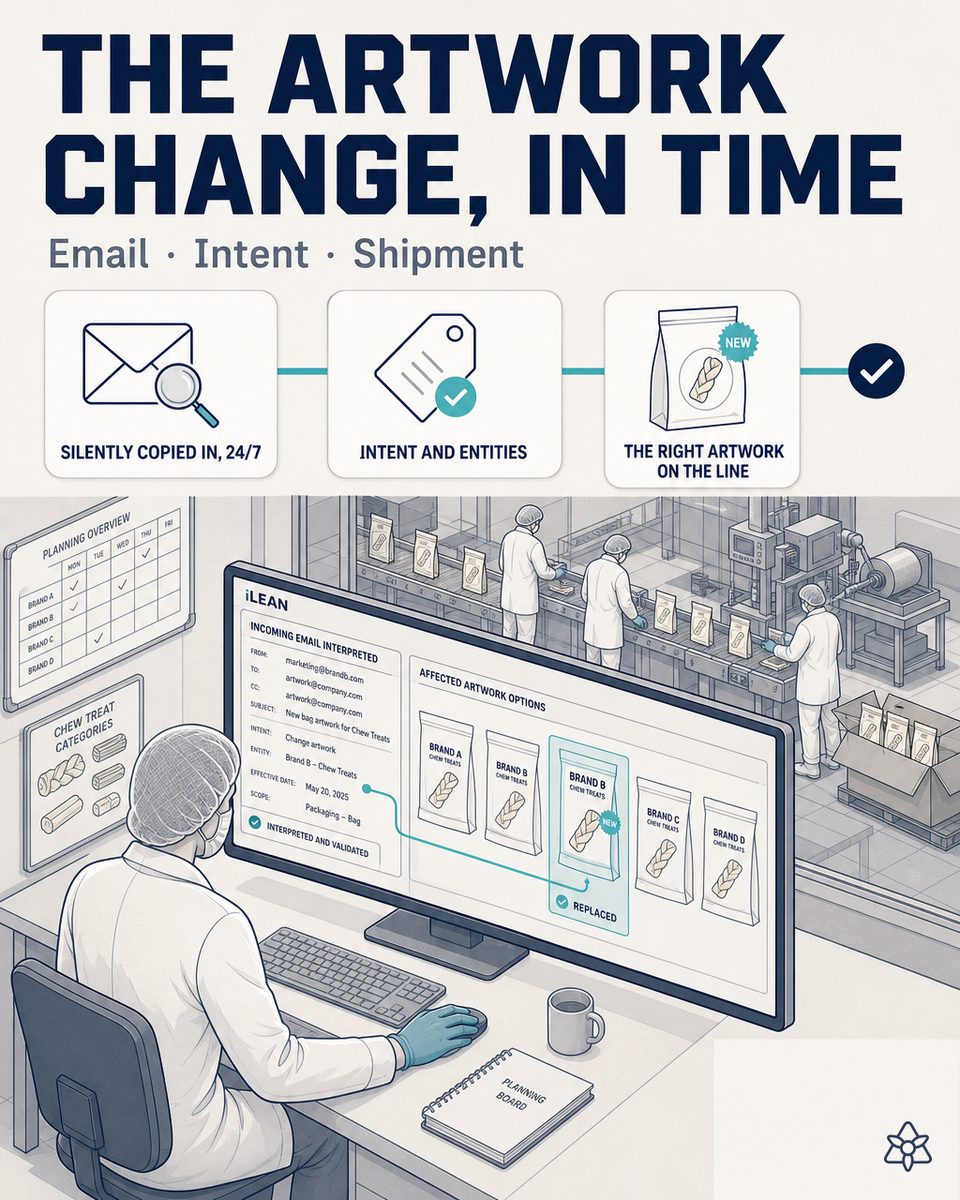
The channel carrying the most expensive information to ignore is the least structured of all.
There is no field, no validation, no alert: there is an inbox and a person. And the cost has two very concrete faces:
- Obsolete packaging material in the warehouse — which in private label cannot be reused for any other customer. It is material printed with one specific brand's artwork that is now worth nothing.
- Urgent freight or incomplete containers — when the shipment gets misaligned from production because the notice of an earlier date was read late.
- And neither appears as such in any report — they dilute into generic line items, which is why the problem never gets prioritized despite repeating every month.
Nobody is at fault: the person receiving those emails also has a job, and the email does not know a packaging print run is about to launch. The cost of that latency exists but shows on no line of the income statement.
Connect in chaotic-sources mode — it does not announce a message arrived, it says what to do with it.
A private label plant's critical information arrives through whatever channel the client brand chooses to write on. Connect does not change that habit: it gets copied and works on what arrives, continuously.
It extracts the intent — artwork, size or date change, raw material delay, nonconformity — and the entities: brand, reference, size, quantity, date. It crosses that intent with the live orders in the ERP and the planning system, and returns to the planner and the packaging manager which orders are affected and what to freeze before printing.
How Connect operates on client brand notices:
- Commercial mailbox and business messaging, silently copied — continuously. The client brand keeps writing where it writes, with no new portal and asking nothing of it.
- Intent and entities, not keywords — the model tells an artwork change from a shipment brought forward and from a nonconformity, and extracts brand, reference, size, quantity and date.
- Cross-reference with the live orders — the notice is only worth something compared against what is launched. That cross-reference is what turns a message into a calculated impact on specific orders.
- The difference with an email filter is the last piece — it does not announce a message arrived: it says which orders are affected and what to freeze before printing.
- To the role that can execute it — the action reaches the planner and the packaging manager, who are the ones who can stop a print run, not a generic mailbox.
Notices in an inbox vs. notices cross-referenced with live orders
| Aspect | An inbox and a person | With iLEAN Connect copied in |
|---|---|---|
| Notice → action latency | Several hours of human latency | Seconds |
| Where an artwork change is discovered | With the packaging already printed | Before launching the print run |
| Obsolete packaging in the warehouse | Material that in private label cannot be reused | Avoided at the origin |
| Urgent freight and incomplete containers | Recurring | Reduced by aligning shipment and production |
| What the responsible person receives | "A message has arrived" | Which orders are affected and what to freeze |
| Visibility of the cost | Diluted into generic line items | Measurable per avoided incident |
Impact estimate for your plant — to be validated with your own numbers.
The block below is an estimate to be validated against your plant's actual data. We put it forward so the committee has an order of magnitude; we refine it during the assessment.
- Rawhide chew plant manufacturing for several third-party brands, with artwork, size and date changes arriving by email and messaging.
- Connect pilot on the commercial mailbox and the business messaging number, cross-referenced against the live orders. The ERP is not touched except on human confirmation. First value expected within a few weeks.
- Indicative payback between 3 and 7 months depending on the client brands' change frequency, counting the avoided packaging obsolescence, relabeling rework and urgent freight. Estimate to be validated.
- The figure that best sizes the case is in the warehouse: how much obsolete packaging material there is today from artwork changes detected late. In private label that material has no alternative outlet.
- And the cost nobody prioritizes today because it is not seen: urgent freight and incomplete containers dilute into generic line items, so the problem repeats month after month without ever reaching the decision table.
And the fair question from the sales director
"What if the AI misreads a customer's email and freezes an order that was fine?" — freezing before printing is a reversible action: it is released and continues, and the cost of having been wrong is minutes. The irreversible — printing packaging with the previous artwork — is what gets avoided. On the reading, hallucination is a problem of free generation, not of anchored tasks: extracting brand, reference and date from an email and cross-referencing them with the live orders is where the best models brought the error below 1.5% [1].
[1] OpenAI paper "Why Language Models Hallucinate", 2025 — on the reliability of AI in anchored tasks.
What people ask about reading client brand notices
Do we have to ask the client brand to change how it notifies us?
No. Asking a brand owner to use a specific portal to communicate an artwork change does not work in practice: each has its own way of working and its own timing. Connect is silently copied on the commercial mailbox and the business messaging number, and works on what arrives as it arrives. Nobody outside the plant learns there is a system reading, and nobody inside has to forward anything. The channel is respected exactly as it is, which is the only way the solution survives the first month.
How is this different from an email filter?
In the last piece, and it is all the difference. A filter classifies and alerts: it tells you an important message has arrived. Connect crosses the extracted intent with the live orders in the ERP and the planning system and returns a concrete action: which orders are affected by that artwork change and what must be frozen before printing. The practical difference is enormous: an alert forces someone to investigate the impact; a concrete action allows deciding in seconds. And the recipient is the role that can execute it — planner and packaging manager — not a generic mailbox.
Why is obsolete packaging so expensive in private label?
Because it has no alternative outlet. In a factory producing under its own brand, leftover packaging material can be reused in another production. In private label, that material carries a specific customer's printed artwork: if the artwork changes, what remains in the warehouse is worth nothing to that customer or to any other. It is direct loss. And since the plant works for several brands at once, every artwork change detected late generates its own batch of useless material.
Can the system freeze an order on its own?
What it does is propose freezing and notify the role that can do it. And the asymmetry is worth seeing: freezing a packaging print run before launching it is reversible — it is released and continues, at a cost of minutes if the notice turned out not to apply. Printing with the previous artwork is not. That is why the system pushes the proposal towards the conservative side, but a person signs the decision with the calculated impact in front of them. It is the same principle governing the rest of the architecture: the reversible is accelerated, the expensive is decided by someone.
How is the return measured if the cost is invisible today?
Exactly by starting to make it visible. There are two figures the plant can produce even if it does not look at them this way today: how much obsolete packaging material sits in the warehouse attributable to artwork changes detected late, and how many urgent freights or incomplete containers there were in the last year from shipment-production misalignment. Both exist in the plant's data, but they are diluted into generic line items — which is why the problem never gets prioritized despite repeating every month. Putting them together is usually enough to size the case.
More cases from this series
- The audit stops being a two-week projectPhotos, signatures and measurements organize themselves by certifying standard. The auditor downloads…
- The last piece before the customer stops depending on typingBatch, expiry and the right brand’s artwork travel from the ERP to the coder with no typing. Zero…
- The drying chamber starts to talk without anyone touching itAn external camera reads the drying chamber’s isolated panel: temperature and humidity curve per load,…
- Backward traceability starts at the dock: receiving by photoA photo of the delivery note and the pallet labels: batches enter the ERP in minutes and the chemical’s…
- The laboratory stops transcribing: from Excel to the ERP at second zeroResidual moisture, water activity and microbiology enter the ERP as soon as the laboratory saves the…
- The batch exists at second zero: production order and drying load without paperThe production order and the drying load sheet, captured by photo: the batch exists in the system at…
How much obsolete packaging do you hold today from artwork changes detected late?
We work on your plant's real data, not ours. We show you the reading working on your own notices. Assessment with no commitment.
Put a number on it with an iLEAN consultant ‹ See all 12 rawhide petfood cases See food industry