The same selection criterion at seven in the morning and at the end of the shift
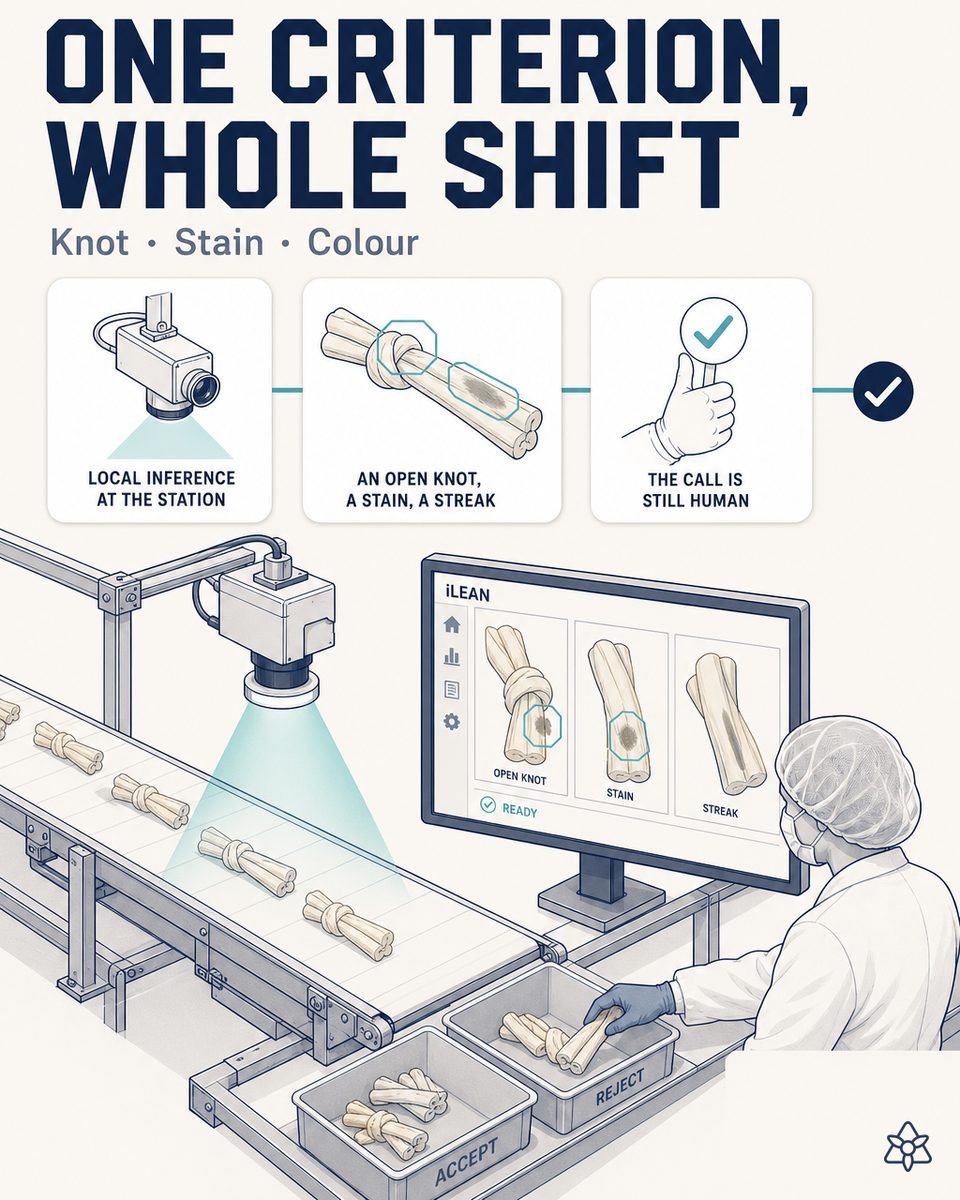
In a rawhide factory the final selection is visual and manual: the piece with the open knot must be separated, the one with a stain or dark streak, the one that came out discolored from a chamber running differently, the one that cracked while drying and the one outside the inch size the order demands. iLEAN Edge puts an overhead camera on the table and the packing line, infers in milliseconds per piece and flags or ejects the defective one before the bag.
The criterion of what passes and what does not is objectified nowhere.
It is work where the human eye tires along the shift and where the criterion changes from person to person and from plant to plant. That variability is exactly what the private label owner penalizes when opening the box at its distribution center:
- The criterion lives in each sorter's experience — which makes it impossible to defend before a customer and very hard to teach to newcomers.
- The eye tires and the shift lasts what it lasts — the piece set aside at seven in the morning is not necessarily the one set aside at three in the afternoon. It is not a lack of professionalism: it is a physical limit.
- And sampling leaves gaps exactly where the customer does look — because the brand owner reviews piece by piece when opening the box, not by sampling.
The result is a process whose quality standard cannot be written, demonstrated or transferred — in a sub-sector where supplier reputation is the main asset.
Edge — computer vision in the plant itself, with the criterion objectified.
The problem is not one of judgment but of constancy and objectification: the same threshold must be applied on every piece, every shift and every plant — and it must be teachable.
An overhead industrial camera over the sorting table and the packing line. A network trained on real pieces of the house's specific formats — knotted bone, pressed, stick, donut, braid, roll, twist —, not a generic catalog. Inference in milliseconds per piece on a local compute unit, with no image sent to the cloud.
How Edge operates at sorting and packing:
- Trained on the house's specific formats — knotted bone, pressed, stick, donut, braid, roll, twist. A generic catalog does not know what a defect is in your product.
- The sub-sector's real defects — open knot, stain or dark streak, discolored piece from a chamber running differently, piece cracked while drying and size outside the inch range the order demands.
- Local inference, no image to the cloud — solving three things at once: latency, bandwidth cost and the conversation about where the process images travel, which in private label is not minor.
- It flags or ejects before the bag — the point where the defective piece still costs only what the piece is worth.
- Every detection feeds a history — which defect, at which table, from which drying chamber, with rawhide from which inbound batch. That is what later allows attacking the cause.
Manual selection by sampling vs. 100% control with Edge
| Aspect | Visual, manual selection | With iLEAN Edge |
|---|---|---|
| Coverage | Sampling, with gaps | 100% of the pieces |
| Criterion across people and plants | Variable — lives in each one's experience | Single and auditable |
| Constancy along the shift | The eye tires | The same on the first piece and the last |
| Defending the criterion before the customer | Impossible: it is written nowhere | Objectified and demonstrable |
| Training newcomers | By shadowing, with no reference | With a common, visible reference |
| The defect's root cause | Cannot be traced | A history by table, drying chamber and hide batch |
Impact estimate for your plant — to be validated with your own numbers.
The block below is an estimate to be validated against your plant's actual data. We put it forward so the committee has an order of magnitude; we refine it during the assessment.
- Rawhide chew factory with manual visual selection at several plants and private label claims for visual defects.
- Edge pilot on one sorting table and the packing line: overhead camera, local compute and training on real pieces of the star format. First value expected within a few weeks.
- Indicative payback between 5 and 12 months depending on the current rejection rate and the weight of customer claims. Estimate to be validated.
- A secondary benefit of comparable weight: the defect history by drying chamber and by hide batch is what allows attacking the root cause — it connects directly with the drying panel reading and with the flagship.
- And the effect on the commercial relationship: an objectified selection criterion can be shown to the brand owner, which is something that today cannot be done with "our sorters' experience".
And the fair question from the production manager
"What if the camera ejects good pieces and sinks my yield?" — that is why the threshold is calibrated with real pieces of your formats, not from the factory. Hallucination, moreover, is a problem of free generation: classifying an image against a pattern trained on your own product is an anchored task, where the best models brought the error below 1.5% [1]. And there is an added advantage: since every detection keeps its image, checking whether the threshold is well set is a matter of looking, not arguing.
[1] OpenAI paper "Why Language Models Hallucinate", 2025 — on the reliability of AI in anchored tasks.
What people ask about Edge vision in rawhide selection
Does this replace the sorters?
No: it objectifies their criterion and takes off their hands the part the human eye cannot sustain. Edge flags or ejects the suspect piece, but the selection work keeps a human component — above all in the borderline cases. What changes is that the threshold stops depending on who is there that morning and how many hours they have been looking. And there is an effect usually valued more than expected: the criterion becomes something that can be taught to newcomers with a visible reference, instead of being passed on by weeks of shadowing.
Why train on our pieces and not on a catalog?
Because what counts as a defect depends on the format and the product. A slightly open knot can be a reject in a premium knotted bone and within specification in another format; a dark streak can be natural in one rawhide and a stain in another. That is why the network is trained on real pieces of the house's specific formats — knotted bone, pressed, stick, donut, braid, roll, twist. A generic catalog does not know those borders and produces two problems at once: it ejects the good and lets the bad through.
Do the process images leave the plant?
No, and it is a design decision with three motives. Inference happens on a local compute unit, in the plant itself: that solves latency (milliseconds per piece), the bandwidth cost of continuously uploading images and, above all, the conversation about where the process images travel. In a plant manufacturing for third-party brands that last question is not minor: a customer's product images do not leave the facility.
What defects exactly does it detect?
The ones leading to a claim from the brand owner: open knot, stain or dark streak, discolored piece — typically from a drying chamber running differently —, piece cracked while drying and size outside the inch range the order demands. The first three are appearance, the fourth a consequence of drying and the fifth dimensional. What matters is not only setting them aside, but that every detection is classified by type, which is what later tells whether the problem comes from the hide, the drying or the forming.
How does this help attack the cause and not just the piece?
Because every detection feeds a history with four axes: which defect, at which table, from which drying chamber and with rawhide from which inbound batch. With that, questions with no answer today resolve into a query: whether the discolored pieces concentrate in one specific chamber, whether the cracked ones appear with one hide batch, whether one table produces more open knots than the rest. It is precisely the information feeding the drying curve analysis and the flagship — without it, each of those cases would work blind.
More cases from this series
- The audit stops being a two-week projectPhotos, signatures and measurements organize themselves by certifying standard. The auditor downloads…
- The changes arriving by email stop being read lateiLEAN reads the client brands’ email and messaging, cross-references it with live orders and returns the…
- The last piece before the customer stops depending on typingBatch, expiry and the right brand’s artwork travel from the ERP to the coder with no typing. Zero…
- The drying chamber starts to talk without anyone touching itAn external camera reads the drying chamber’s isolated panel: temperature and humidity curve per load,…
- Backward traceability starts at the dock: receiving by photoA photo of the delivery note and the pallet labels: batches enter the ERP in minutes and the chemical’s…
- The laboratory stops transcribing: from Excel to the ERP at second zeroResidual moisture, water activity and microbiology enter the ERP as soon as the laboratory saves the…
Send us a hundred good pieces and a hundred bad ones of your star format and we will show you the model working.
We work on your plant's real data, not ours. Assessment with no commitment.
See the model working with your pieces ‹ See all 12 rawhide petfood cases See food industry