The brand changeover stops being signed blind
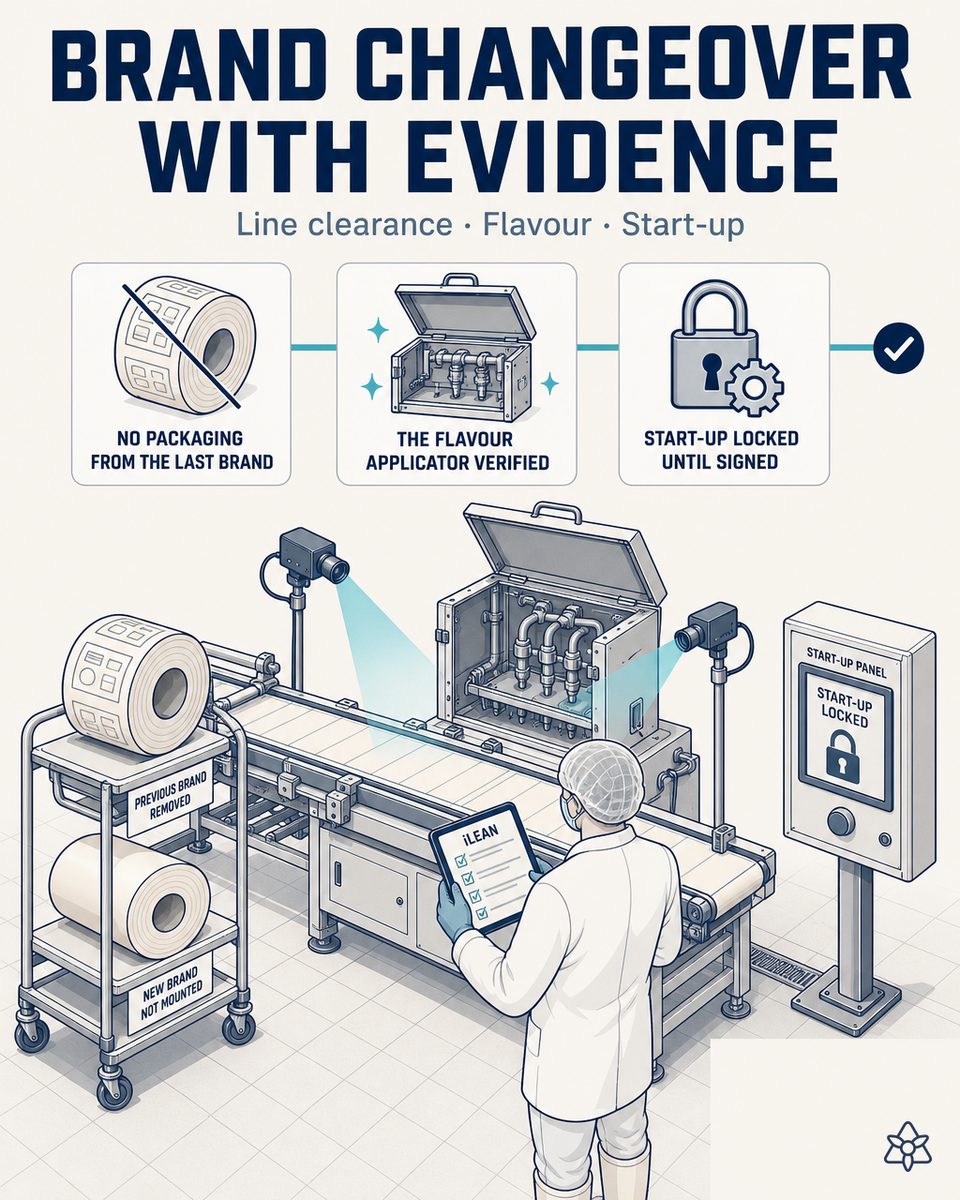
A rawhide plant's most dangerous changeover is not the format one: it is the brand and flavor change. All the previous packaging material must be removed from the line and the flavoring applicator cleaned, and today that depends on someone signing "line cleared" with no objective evidence. With iLEAN Edge, the line does not start until all the cameras give conformity and the quality manager signs on that evidence.
It must be done right for two reasons, and neither admits margin.
The first is declaration: the previous flavor can contain an ingredient the new reference does not declare. The second is allergens: on seasonal lines flavors coexist such as peanut butter, which in the destination country is a declarable allergen:
- A single blister of the previous brand forgotten at the packing station — or a flavor residue in the applicator, and the new order's first pallet leaves wrong.
- And the consequence is not internal scrap — it is one brand's product with another's material, or an ingredient declaration that does not match what is inside the bag.
- At destination that is called a recall — and it drags the brand owner down with the plant, which is exactly what cannot be afforded in private label.
Today all of that rests on a signature on a paper list. The signature is honest, but it is not evidence: nobody can demonstrate months later exactly what was seen at that clearance.
Edge + JIDOKA AI — the three safety rings active at once.
The crew that clears, the vision that checks and the human signature that authorizes. None replaces the other two: each covers what the others cannot.
Fixed Edge cameras at the critical points: flavoring applicator, table and belt, packing station, in-line packaging material and coder. Each camera compares the current state with its "line cleared" reference state. The line does not start until all give conformity and the quality manager signs on that visual evidence.
How Edge operates on the between-brand clearance:
- The five points where the clearance is decided — flavoring applicator, table and belt, packing station, in-line packaging material and coder. Each with its camera and its verdict, so exactly which one to redo is known if something fails.
- Comparison against the reference state — not a generic cleanliness check: the current image against how that point must look when the line is truly cleared.
- Conformity of all and a human signature — both conditions, not one. Vision does not authorize: it checks, and the quality manager signs on what was checked.
- It feeds the evidence pack automatically — all the material generated at the clearance enters the dossier without anyone preparing it.
- And with SMED AI, the verified clearance ends up faster — because the crew sees on screen exactly which point is missing instead of walking the line searching.
A clearance signed blind vs. a clearance verified point by point
| Aspect | A signature on a paper list | With iLEAN Edge + JIDOKA AI |
|---|---|---|
| Basis of the signature | A list walked through in a hurry | Visual evidence point by point |
| The previous brand's packaging material | A forgotten blister can remain | Verified at the packing station |
| Flavor residue in the applicator | Assumed clean | Compared with the reference state |
| Startup with a nonconforming point | Possible | Blocked, indicating which one |
| Consistency between plants | Depends on who is there that day | An identical clearance in all |
| Clearance duration | The current one | Shorter: the crew sees which point is missing |
Impact estimate for your plant — to be validated with your own numbers.
The block below is an estimate to be validated against your plant's actual data. We put it forward so the committee has an order of magnitude; we refine it during the assessment.
- Rawhide chew factory producing for several brands with different flavors, including allergens declarable in the destination country.
- Edge + JIDOKA AI pilot on the clearance's critical points, with startup blocking and a signature on evidence. Without changing the procedure or who signs.
- It directly protects the private label contracts, which are the sub-sector's most valuable commercial asset.
- And there is a surprising effect: with SMED AI, the verified clearance ends up faster than the current one, because the crew sees on screen exactly which point is missing instead of walking the line searching.
- Payback as a function of the number of brand changes per week. Estimate to be validated.
And the fair question from the plant manager
"Won't this lengthen every change?" — experience points the other way: the verified clearance ends up faster, because the crew stops walking the line searching for what is missing and sees it on screen. And on reliability, comparing a point's image against its validated reference state is an anchored task, where the best models brought the error below 1.5% [1]. Vision does not authorize the startup: it checks, and quality signs on what was checked.
[1] OpenAI paper "Why Language Models Hallucinate", 2025 — on the reliability of AI in anchored tasks.
What people ask about the verified line clearance
Why is the brand change more dangerous than the format one?
Because in the format change what is at stake is the product; in the brand and flavor change what is at stake is identity and declaration. All the previous packaging material must be removed from the line — a single blister forgotten at the station and the new order's first pallet leaves with another brand's material — and the flavoring applicator cleaned, because the previous flavor can contain an ingredient the new reference does not declare. On seasonal lines flavors coexist such as peanut butter, which at destination is a declarable allergen. The consequence is not scrap: it is a recall.
Which points exactly are verified?
Five: the flavoring applicator, the table and belt, the packing station, the in-line packaging material and the coder. Each has its camera and its separate verdict, because bundling everything into a single "cleared" loses the information that is needed: if something fails, you must know which point to redo without redoing the whole clearance. The list is tuned at the assessment to the real line, since not all plants have the same applicator configuration or packing station layout.
Does the camera replace the quality manager's signature?
No: it is both conditions, not one. The line does not start until all the cameras give conformity and the quality manager signs on that visual evidence. The three safety rings act at once: the crew that clears, the vision that checks and the human signature that authorizes. What changes versus today is not who authorizes, but on what: from signing a list walked through in a hurry to signing on each point's images. That also protects the signer, who today shoulders alone a risk they had no way to verify.
Doesn't this lengthen the changeover time?
Surprisingly, no: with SMED AI the verified clearance ends up faster than the current one. The reason is simple — today, when something is not ready, the crew walks the line searching for what is missing; with the cameras, they see it on screen directly. The search time and the repeated "just in case" checks disappear. Add that a badly closed clearance forces stopping and redoing after startup, which is the time penalty nobody counts today as part of the change.
What is recorded of each clearance?
All the material generated — each critical point's images, each camera's verdict, the time and the signature of whoever authorized — and it automatically feeds the evidence pack. That is an important point: there is no additional documentation step someone can forget, because the material is generated as a consequence of the clearance itself. Months later, when the auditor or the brand owner asks how the separation between brands and flavors is guaranteed, the answer is each change's images, not a paper procedure.
More cases from this series
- The audit stops being a two-week projectPhotos, signatures and measurements organize themselves by certifying standard. The auditor downloads…
- The changes arriving by email stop being read lateiLEAN reads the client brands’ email and messaging, cross-references it with live orders and returns the…
- The last piece before the customer stops depending on typingBatch, expiry and the right brand’s artwork travel from the ERP to the coder with no typing. Zero…
- The drying chamber starts to talk without anyone touching itAn external camera reads the drying chamber’s isolated panel: temperature and humidity curve per load,…
- Backward traceability starts at the dock: receiving by photoA photo of the delivery note and the pallet labels: batches enter the ERP in minutes and the chemical’s…
- The laboratory stops transcribing: from Excel to the ERP at second zeroResidual moisture, water activity and microbiology enter the ERP as soon as the laboratory saves the…
How many brand changes do you run a week, and how long does the clearance take today?
We work on your plant's real data, not ours. With those two numbers the case falls out. Assessment with no commitment.
With those two numbers the case falls out — let's talk ‹ See all 12 rawhide petfood cases See food industry