No data crosses into the system without a person having signed it
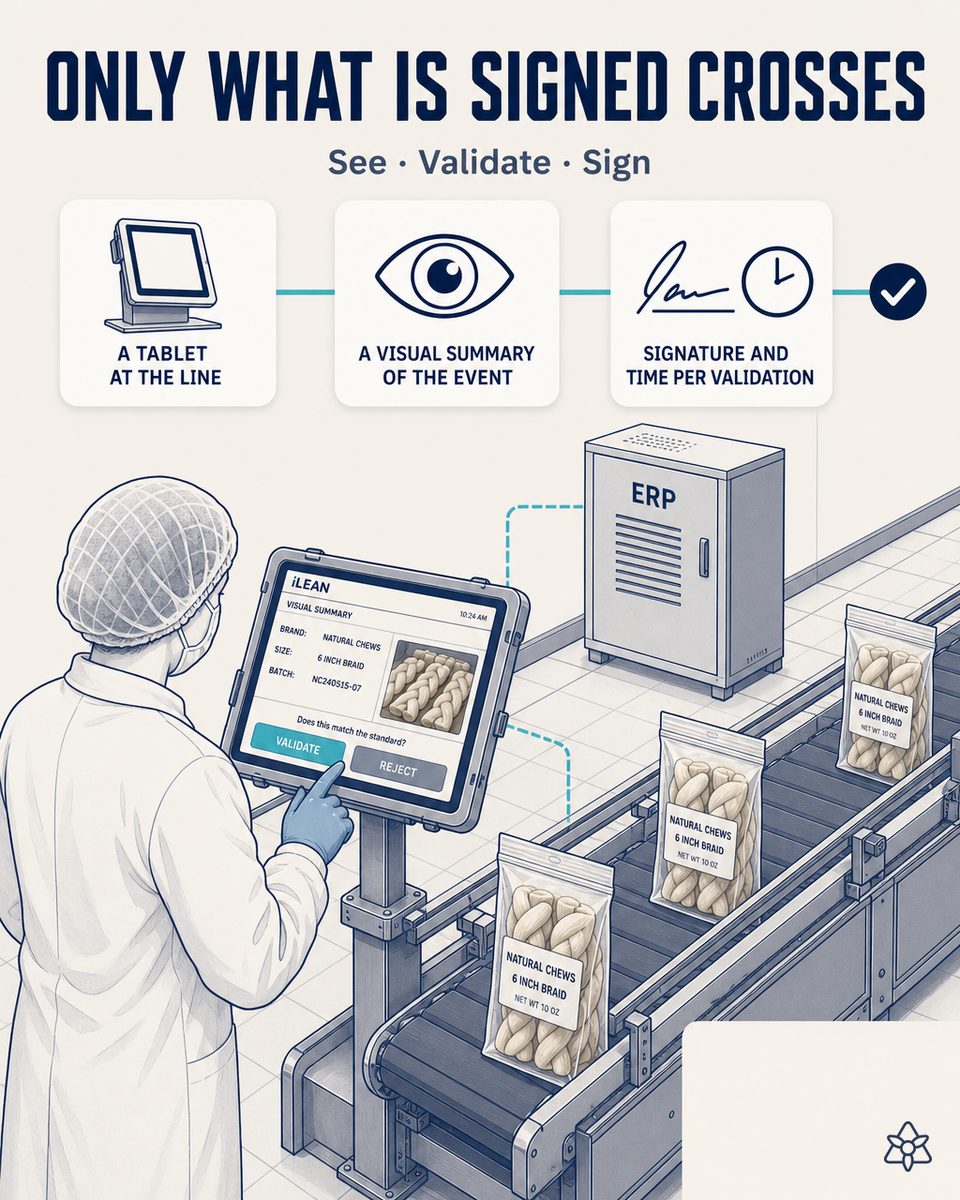
This is what separates iLEAN from an autonomous artificial intelligence agent that inserts unsigned data and ends up contaminating the master: nothing iLEAN captures crosses into the central system without a human having seen it first. In a rawhide plant that materializes as one industrial tablet in the forming area and another at the chambers' door, with two-second summaries and two-tap validation.
The real brake on digitization in a plant with many people is not technological, it is trust.
When automatic data capture is proposed in a rawhide plant, two objections appear, and both are right:
- "The AI is going to insert data on its own" — and then the ERP master will have to be cleaned. It is a completely reasonable fear, and whoever raises it is usually right.
- The operator is not going to type either — their hands are on the knotting table, and any screen demanding data entry becomes lost line time and legitimate resistance.
- Without a fast human gate there are only two exits, and both are bad — either nothing is captured, or it is captured without guarantees.
The contradiction is only apparent: there is no need to choose between automating and controlling, but to separate the capture — which can be automatic — from the validation, which must be human but can take two seconds.
Early human verification — an interface for validating, not for entering data.
The key is in the verb. A data entry screen asks for writing and at a knotting table gets abandoned. A validation screen shows what the AI understood and asks for a gesture.
An industrial tablet in the forming area and at the drying chambers' door. Each capture — a parsed production order, the drying panel's reading, a voice dictation, a parsed email — appears as a two-second visual summary. The responsible person confirms with one tap, or corrects with another. Only then does the data cross into the central system.
How early human verification operates in a rawhide plant:
- Two points, where the process happens — the forming area and the drying chambers' door, which is where the data is born. A validation demanding a walk to an office would pile up and end up done in bulk, which is the same as not doing it.
- A two-second visual summary — not a form. The interface is designed for validating, not for entering data: there is no training to give.
- One tap to confirm, another to correct — correcting is the exception, and when it applies the specific field is corrected.
- Everything converges here — whether the capture comes from a parsed order, the drying panel's reading, a voice dictation or an email: the same summary and the same gesture.
- Who validated what and when is recorded — which is exactly what the auditor asks, and what today is recorded nowhere.
No human gate vs. early human verification
| Aspect | "Autonomous" automatic capture, or nothing | With iLEAN + industrial tablet |
|---|---|---|
| The ERP master | Contamination risk, or empty out of distrust | Only what a person signed enters |
| The operator's time | Data screens that get abandoned | Two taps on a visual summary |
| Capture → system latency | Hours or nothing | Seconds |
| Traceability of the signature | Does not exist | Who validated what and when |
| Training needed | A new station to learn | None: the interface is for validating |
| The committee's stance on the project | Blocked over dirty-master risk | Backing: there is a human signature on every data point |
Value of this piece — enabling, not directly monetizable.
This case is deliberately presented without a payback: its value is structural, and it is what lets the rest get signed.
- Rawhide chew plant with manual forming, many people on the line and an ERP master nobody wants to contaminate.
- Pilot of the tablets at forming and at the chambers' door, together with the first capture case. It is not deployed on its own: it is the piece that makes the others signable.
- Enabling piece of the whole matrix: without early human verification, the other cases do not get signed in committee because nobody assumes the risk of a contaminated master. Strategic value, not directly monetizable.
- Its measurable effect appears in the other cases: they are the ones bringing payback, and they only get approved if this piece is in front.
- A data governance benefit: every record keeps its origin and the person who validated it — which is exactly what the auditor asks and what today is recorded nowhere.
And the fair question from the operations director
"If every capture must be validated, don't we lose the time we gained?" — no, because validating and typing do not cost the same. Typing is tens of seconds plus the load of remembering what goes in each field; validating is reading a two-second summary and confirming. And the volume concentrates on the area lead, not on every person at the knotting table. It is precisely that validation which lets the AI work on anchored tasks safely: even with an error below 1.5% [1], that remainder never reaches the master.
[1] OpenAI paper "Why Language Models Hallucinate", 2025 — on the reliability of AI in anchored tasks.
What people ask about early human verification
Why not let the AI write directly into the ERP?
Because the fear of it doing so is completely reasonable, and whoever raises it is usually right. Cleaning a contaminated master costs more than the automation saved: an erroneous data point does not stay still, it propagates to the batch's traceability, the audit evidence and the decisions downstream. That is why in iLEAN human validation is not a configuration option but a design principle: capture can be automatic, entry into the master cannot. It is also what lets the project pass the committee instead of stalling at the first meeting.
Won't the operator reject it, like any other screen?
Resistance to screens on the line is legitimate and must be taken seriously: at a knotting table, any interface demanding data entry is lost line time. That is why this one asks for no entry. The interface is designed for validating in two seconds, not for entering data: a visual summary appears and there are two possible gestures, confirm or correct. There is no keyboard in the normal flow, no mandatory fields and no training to give. The gesture is faster than any manual alternative.
Where are the tablets placed and why there?
In the forming area and at the drying chambers' door, which is where the data that matters is born: the production order and the load sheet. The location is not a logistical detail — it is what decides whether the case works. A validation forcing a walk to an office piles up and ends up done in bulk at the end of the shift, which is exactly the same as not doing it: signing without looking. With the screen where the process happens, the validation is done in the moment and on information the person still has fresh.
Does it serve everything iLEAN captures?
Yes, and it is deliberate. The tablet is the convergence point: whether the data comes from a parsed production order, the drying chamber panel's reading, a voice dictation by the process lead or an email from a client brand, everything is normalized to the same visual summary before being shown. The responsible person does not learn a different interface per origin. A single two-tap pattern, and a single boundary: what is not signed does not cross.
Why do you say it is not monetizable?
Because it produces no saving of its own: it enables the others'. Without this piece, the other eleven cases do not get signed in committee, because nobody wants to assume the risk of a contaminated master — and then the return of all of them is zero. Its value is strategic and it should be presented that way, without inventing a payback it does not have. What it does contribute directly and measurably is the signature's traceability: who validated what and when, which is exactly what the auditor asks in a plant that exports.
More cases from this series
- The audit stops being a two-week projectPhotos, signatures and measurements organize themselves by certifying standard. The auditor downloads…
- The changes arriving by email stop being read lateiLEAN reads the client brands’ email and messaging, cross-references it with live orders and returns the…
- The last piece before the customer stops depending on typingBatch, expiry and the right brand’s artwork travel from the ERP to the coder with no typing. Zero…
- The drying chamber starts to talk without anyone touching itAn external camera reads the drying chamber’s isolated panel: temperature and humidity curve per load,…
- Backward traceability starts at the dock: receiving by photoA photo of the delivery note and the pallet labels: batches enter the ERP in minutes and the chemical’s…
- The laboratory stops transcribing: from Excel to the ERP at second zeroResidual moisture, water activity and microbiology enter the ERP as soon as the laboratory saves the…
Humans in command is not a slogan: it is a concrete screen at the line.
We work on your plant's real data, not ours. We show you the validation working on your own captures. Assessment with no commitment.
Come see it with an iLEAN consultant ‹ See all 12 rawhide petfood cases See food industry