What the process lead sees while walking stops being lost
In a rawhide operation with several plants and hundreds of people in manual forming, the process lead spends the day walking with busy hands. They know this supplier's rawhide comes thicker, that chamber four has been producing paler pieces since the weekend, that table twelve needs reinforcement. None of that enters any system today because to write it down they would have to sit. With Connect in voice mode, they dictate it while walking.
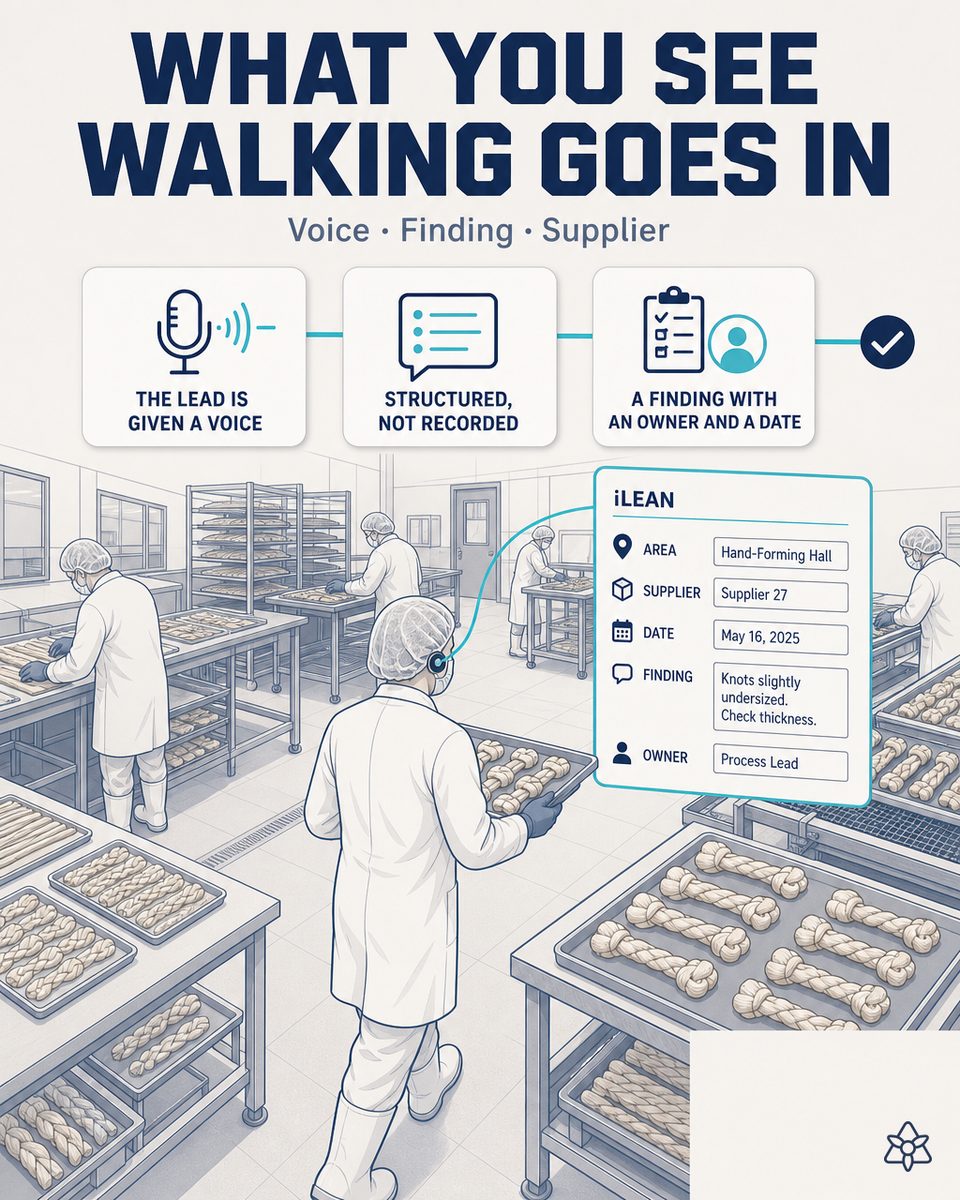
The knowledge that explains the variability lives in three or four heads.
In a process where value comes from manual work, the variability between tables, between chambers and between plants is precisely where the money is. And it is exactly what goes unrecorded:
- It dies at the end of every shift — what the process lead observes while walking reaches no system: it is shared aloud, if at all, and lost.
- Improvement plans are built on what someone remembers — at the meeting, not on what really happened. So the problems that made the most noise get prioritized, not the ones repeating most.
- The obstacle is not will — it is that recording demands stopping, sitting down and typing, and this person's job consists precisely of not stopping.
In an operation with several plants that weighs double: without a comparable record, there is no way to know whether a table in plant A works differently from its equivalent in plant B — nor, therefore, to standardize.
Connect in earpiece mode — it does not listen to the operator: it listens to whoever decides to speak to it.
The AI does not replace the process lead's judgment: it takes off their hands the administrative work of writing it down. And the boundary is clear by design — the system listens to whoever decides to speak to it, when they decide to.
A Bluetooth earpiece with its own wake word. iLEAN listens to the dictated sentence, structures it as an incident or a process observation, automatically ties it to the active batch, table, chamber or plant, and returns immediate support through the earpiece itself or the area's tablet.
How Connect operates in voice mode in a multi-plant operation:
- Its own wake word — outside it, the earpiece transcribes and sends nothing. There is no continuous listening or background recording.
- Structured as an incident or observation — not as a loose audio note. That is what later allows counting, grouping and comparing.
- Tied to the active context — batch, table, chamber or plant, without reciting any reference. "Four is producing paler pieces" lands tied to its chamber and its plant.
- An immediate return — what got recorded, who else sees it and what response there is. A system that only stores gets abandoned; one that returns something useful sustains itself.
- Comparable between plants — which is where the big return lives: for the first time one plant's observations and another's speak the same language and can be put side by side.
Knowledge that dies in the shift vs. knowledge that enters in real time
| Aspect | Without voice capture | With iLEAN Connect voice |
|---|---|---|
| What survives the shift | What someone remembers at the meeting | The structured observation, with its context |
| Link to batch, table, chamber or plant | Depends on memory | Automatic |
| Basis of continuous improvement plans | Minutes written from memory | A queryable history by area and by plant |
| Comparison between plants | By feel | With comparable observations |
| Cost of recording something | Stop, sit down and type | Talking while walking |
| Table-to-table variability | Known but undocumented | Documented and attackable |
Impact estimate for your plant — to be validated with your own numbers.
The block below is an estimate to be validated against your plant's actual data. We put it forward so the committee has an order of magnitude; we refine it during the assessment.
- Rawhide chew operation with several plants and hundreds of people in manual forming, where the operational knowledge lives in three or four people.
- Connect voice pilot with an earpiece for the process lead, anchored to the active context. First value expected within a few weeks: the volume of what surfaces always surprises.
- Hard to monetize in isolation, and worth saying honestly. Its value is enabling: it is the piece that feeds any cross-plant standardization plan with real data.
- And that is where the big return lives in a multi-plant operation with a manual process: standardizing between plants demands first being able to compare, and comparing demands a record that does not exist today. Strategic value, to be validated with the continuous improvement manager.
- A side benefit that tends to weigh: when that person changes role or plant, part of their judgment stays in the system instead of leaving with them.
And the fair question from the works council
"Is this a microphone over the forming people?" — no, and the boundary is explicit: iLEAN does not listen to the operator, it listens to whoever decides to speak to it, when they decide to. The earpiece activates with its own word and captures what the process lead chooses to dictate, just as if they wrote it. What is stored are process observations tied to batch, table, chamber or plant. And reliability plays on anchored ground: structuring a short dictation against a known context is where the best models brought the error below 1.5% [1].
[1] OpenAI paper "Why Language Models Hallucinate", 2025 — on the reliability of AI in anchored tasks.
What people ask about the process lead's earpiece
Does the earpiece listen to the people at the tables?
No. The boundary is explicit in the design: iLEAN does not listen to the operator, it listens to whoever decides to speak to it, when they decide to. The earpiece activates with the process lead's own wake word and captures only the sentence they dictate. Outside that it transcribes and sends nothing: there is no continuous listening, no conversations with the forming people are picked up and nobody's activity is logged. What stays in the system are process observations tied to the batch, the table, the chamber or the plant.
How is it different from writing things down later?
Later they do not get written — not from a lack of will, but because the job consists of not stopping. Recording demands sitting down and typing, and in a day spent walking between tables that does not happen. The result is that the knowledge explaining the variability between tables, between chambers and between plants dies at the end of every shift. With the earpiece, the cost of recording drops to nearly zero — talking while walking — which is the only condition under which recording holds beyond the first weeks.
What does continuous improvement gain from this?
It stops being built on what someone remembers at the meeting. Today the improvement minutes collect what made the most noise; with the observations recorded and tied, you can see what repeats, at which table, in which chamber and in which plant. In a process where value comes from manual work, that variability is exactly where the money is: not in one big isolated improvement, but in reducing the dispersion between stations doing the same thing differently.
Why do you say it is hard to monetize?
Because it is, and we prefer saying so over inflating a number. This case does not produce an isolated saving that can be invoiced: it produces the data on which the plans that do have a return are built. In a multi-plant operation with a manual process, the big return lies in standardizing between plants — and standardizing demands first being able to compare. Without a comparable record of what happens in each place, that plan is made on impressions. It is strategic value, and it is sized with the continuous improvement manager against their own plan.
How is what is observed compared between different plants?
Because everything enters structured with the same schema and tied to a known context: batch, table, chamber and plant. That is what makes an observation from plant A and one from plant B speak the same language and sit side by side, instead of being two anecdotes told by two different people. In practice it is the difference between suspecting a plant works differently and being able to demonstrate in which specific operation it diverges — which is the starting point of any real standardization.
More cases from this series
- The audit stops being a two-week projectPhotos, signatures and measurements organize themselves by certifying standard. The auditor downloads…
- The changes arriving by email stop being read lateiLEAN reads the client brands’ email and messaging, cross-references it with live orders and returns the…
- The last piece before the customer stops depending on typingBatch, expiry and the right brand’s artwork travel from the ERP to the coder with no typing. Zero…
- The drying chamber starts to talk without anyone touching itAn external camera reads the drying chamber’s isolated panel: temperature and humidity curve per load,…
- Backward traceability starts at the dock: receiving by photoA photo of the delivery note and the pallet labels: batches enter the ERP in minutes and the chemical’s…
- The laboratory stops transcribing: from Excel to the ERP at second zeroResidual moisture, water activity and microbiology enter the ERP as soon as the laboratory saves the…
What does your plant manager know that is in no system?
We work on your operation's real data, not ours. A short pilot is enough to see the volume of what is lost today. Assessment with no commitment.
Start there with an iLEAN consultant ‹ See all 12 rawhide petfood cases See food industry