No more toll-client surprises
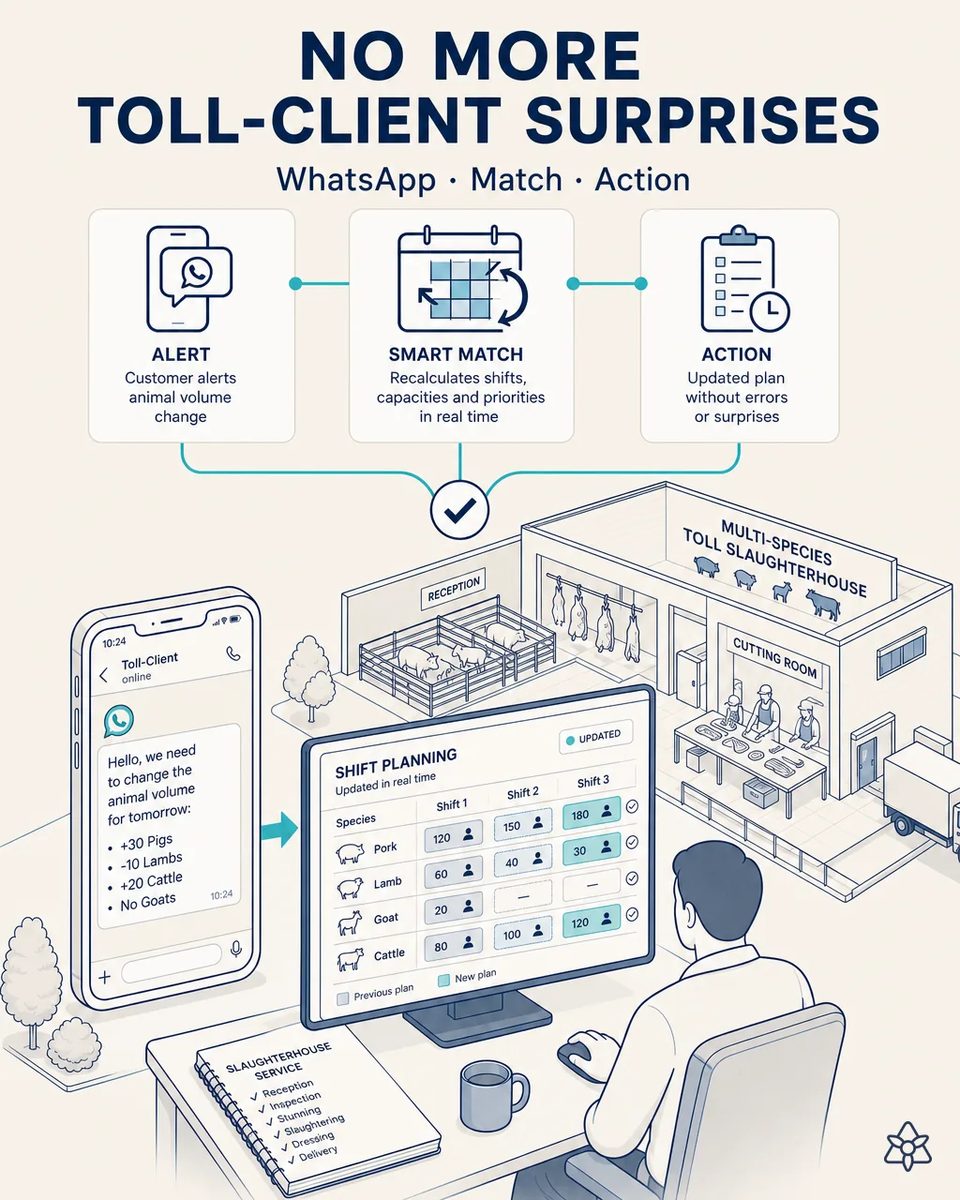
A toll-processing client sends a last-minute WhatsApp about a change in the batch they're bringing in. The message is read late, once the shift is already planned for the old volume. With iLEAN Connect, the system reads it at zero second.
Nobody designed the channel the toll business actually runs on.
The toll-processing business depends on third parties, and change notices arrive on personal channels to one person.
- The agreed program arrives as an order. What changes the day arrives as a message: thirty more pigs, ten fewer lambs, the goats cancelled, the cattle moved to the afternoon.
- It lands in natural language, unformatted, on the personal phone of the one person the client has a number for, competing with everything else in the same inbox.
- A volume change read three hours late is a crew already called in for the old plan, plus lairage pens booked for animals that are not coming.
- And in a plant that also runs its own production, a misread toll change does not only cost a shift: it pushes somebody else's order into your own line's window, so the delay lands on a customer who had nothing to do with it. That is the kind of knock-on nobody attributes correctly afterwards, because the message that caused it is buried in a phone.
Connect in chaotic-sources mode — the client keeps writing however they like.
Connect chaotic-sources mode. An LLM extracts client, species, volume and new date/time, cross-references the active schedule, and returns the concrete action.
The client is not asked to change anything. They keep sending the same message to the same person, and what changes is that the message stops depending on that person being free to read it in the next ten minutes. The system extracts client, species, volume and slot, compares them against the schedule as it stands right now, and hands the difference to whoever has to act on it.
The alert today versus the alert crossed with the schedule
| Aspect | Today | With iLEAN Connect |
|---|---|---|
| Who reads the change | One person, when they can | The system, at second zero |
| What is extracted | Read and remembered | Client, species, volume, new slot |
| Crossing it with the plan | By hand, if there is time | Automatic against the live schedule |
| What comes back | A message to answer | A concrete action for the role |
| Crew called in for the old volume | Happens | Caught before the call |
| If that person is off | The change waits | The alert routes on |
hours of human latency → seconds.
Impact estimate — to be validated with your numbers.
The block below is an estimate to be validated against your plant's actual data. We put it forward so the committee has an order of magnitude; we refine it during the assessment.
- Estimated payback 3-7 months, depending on how often toll incidents actually occur.
- From hours of human latency to seconds between the client's message and a decision somebody can act on.
- Lairage capacity and shift staffing reassigned before the crew is called in, not after they have arrived to find the animals are not coming.
- And your own production stops absorbing the cost of somebody else's last-minute change, which today is the quiet way a toll contract loses its margin.
Estimated payback of 3-7 months depending on toll-processing incident frequency. *Estimate to be validated*.
And the fair question from the production manager
“Are we going to let a model reschedule the kill?” — no, and it is worth being precise: what the system does is extract client, species, volume and slot, cross them with the live schedule and propose. Extracting those four fields from a short message is an anchored task where the best models drop below 1.5% error [1], and the proposal is always confirmed by the person who owns the schedule before anything moves.
[1] OpenAI paper "Why Language Models Hallucinate", 2025 — on the reliability of AI in anchored tasks.
What people ask about toll-client alerts
Do the clients have to use a form or a portal?
No, and that is deliberate: a portal your clients do not use is worse than the message they already send, because it creates the illusion of a channel while the real one keeps running in parallel. The change is read where it actually arrives, on the phone of the person they always write to.
What if the same client sends three contradictory messages?
The most recent one for the same day and species prevails, and the earlier ones stay attached so the planner can see the sequence before confirming.
Does it distinguish a toll order from our own production?
Yes, by the client on the message and the order it matches. That separation is the one thing that must never be guessed in a plant that runs both flows.
Who receives the proposal?
The role that has to act, not a generic inbox: the schedule owner for a volume change, and lairage when the arrival time moves.
What happens outside working hours?
It is read and queued with its proposal ready for the first person who opens the schedule. That window is where a change costs the most today, because the message lands at nine at night and the crew is called at five in the morning.
More cases from this series
- Paperless carcass grading logThe grader photographs the grading log and the carcass record already exists in the central system at…
- The chilling tunnel finally gets loggedAn external camera reads the chilling tunnel's temperature curve without touching the controller.
- Two taps before flows could mixNothing enters the ERP without a human seeing it first — prevents mixing own production and toll orders.
- The GS1-128 label fills itself inThe 20+ logistics label fields fill themselves in from the ERP's active batch.
- What's said between lines staysThe cutting-room lead dictates while walking between species and the AI structures, stores and replies…
- Origin docs and ear tag enter on their ownPhoto the health certificate and the ear tag: the animal traceability table fills itself in, ear tag…
Tell us how a toll client warns you today that tomorrow's volume changed.
We work on your plant's real data, not ours. Assessment with no commitment.
Request estimated ROI within 48h ‹ See all cases of multi-species abattoirs See food industry