What's said between lines stays
The cutting-room lead walks between several species lines with both hands busy. With iLEAN Connect's earpiece mode, they dictate while walking and the system listens, structures and replies in seconds.
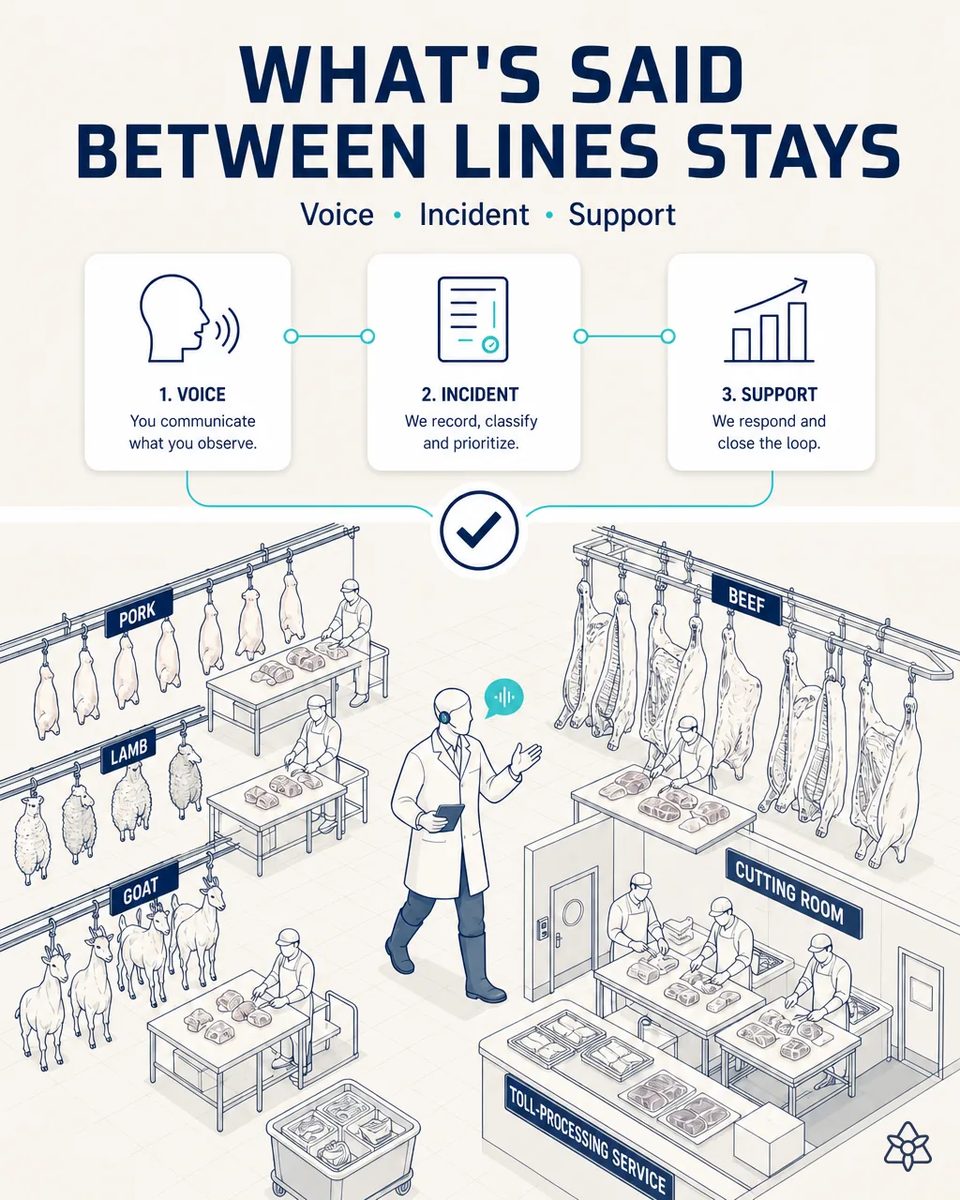
Four species in parallel, and the coordination lives in one head.
With several species cut in parallel, the lead's operational knowledge lives in their head and dies at shift's end.
- The cutting-room lead crosses the floor all shift with both hands busy: yields on the pork line, a knife team short on the lamb line, a beef primal coming out badly trimmed, a toll order that has to stay physically separate.
- What they see is real operational knowledge, and today it is held in memory, half a scrap of paper and a conversation in the corridor at handover.
- At shift end most of it evaporates, and the next lead starts by reconstructing what they can from whoever is still around.
- Which means that when yield on one species drifts over three weeks, nobody has the observations that would have explained it on day one. The analysis then starts from figures alone, and figures on their own tell you that something changed without ever telling you what.
Connect in voice mode — the lead speaks, the system files.
Connect voice mode with a custom wake-word; the grounded LLM structures the dictation linked to the active line/species/shift.
The earpiece works with hearing protection and a custom wake word, so nothing is listening until the lead decides to speak. What they dictate arrives already tied to the active line, species and shift, and comes back read aloud for confirmation before it is filed. That is what turns a passing comment into something a yield analysis can actually use three weeks later.
The lead's shift today versus the shift captured
| Aspect | Today | With iLEAN Connect |
|---|---|---|
| An observation on the lamb line | Remembered, maybe | Filed with line, species and time |
| Handover | Three minutes in a corridor | A written summary already waiting |
| A recurring trim problem | Noticed by three people separately | Visible as a repeated entry |
| Lead's effort | Walk back to the office | Speak while walking, hands free |
| A toll order needing separation | A verbal instruction | An instruction with a trace |
| Ordinary floor conversation | — | Not recorded |
knowledge dying at shift's end → entering the system in real time.
Impact estimate — to be validated with your numbers.
The block below is an estimate to be validated against your plant's actual data. We put it forward so the committee has an order of magnitude; we refine it during the assessment.
- No standalone payback — an enabling piece. We do not put a month range on this one, because its value is not a line you can bill.
- What it buys is context: without these observations, no yield-per-species analysis explains why a line drifted, and no improvement plan knows where to start.
- Handover stops being reconstructed from memory, and the incoming lead walks in with the open issues already on screen.
- To be validated with whoever owns continuous improvement in the cutting room, since they are the ones who know what a repeated problem costs you today.
Hard to monetize upfront, but key to coordinating an abattoir running several species in parallel. *Estimate to be validated*.
And the fair question from the production manager
“Is this a way of keeping tabs on my team?” — no: iLEAN listens to the lead, not to the boners, and only to what the lead chooses to dictate after the wake word. There is no continuous listening and no tracking of where anyone is. On the structuring side, turning a dictated sentence into line, species, shift and issue type is an anchored task where the best models drop below 1.5% error [1], and what was understood is read back before it is filed.
[1] OpenAI paper "Why Language Models Hallucinate", 2025 — on the reliability of AI in anchored tasks.
What people ask about the cutting-room earpiece
Does it work with the noise of a cutting room?
That is the design condition. The earpiece is compatible with hearing protection and recognition is prepared for industrial noise and for the trade vocabulary: primal, trim, boning, yield, carcass half.
Does the lead have to say which line they are on?
Not usually, because the active line and species are already in central memory. If the lead names a different line, what they say takes precedence.
Can it be used in Spanish and English on the same shift?
Yes. The plant floor rarely speaks one language only, and the dictation is structured into the same fields whichever one is used.
What happens to a dictation that mentions a person by name?
It is stored as what it is, an operational note, and the same access rules apply as to any other record in the system. Nothing is published to the floor.
Why deploy it if it does not pay for itself on its own?
Because it is what the other pieces read. Captured data explains what happened; these observations explain why, and without them a yield analysis on the beef line is a number with no story behind it and no action attached to it.
More cases from this series
- Paperless carcass grading logThe grader photographs the grading log and the carcass record already exists in the central system at…
- The chilling tunnel finally gets loggedAn external camera reads the chilling tunnel's temperature curve without touching the controller.
- Two taps before flows could mixNothing enters the ERP without a human seeing it first — prevents mixing own production and toll orders.
- The GS1-128 label fills itself inThe 20+ logistics label fields fill themselves in from the ERP's active batch.
- Origin docs and ear tag enter on their ownPhoto the health certificate and the ear tag: the animal traceability table fills itself in, ear tag…
- The quality module stops sitting emptyiLEAN absorbs the real control and fills the quality module your ERP already had built, no new licenses.
Tell us what your cutting-room lead is carrying in their head at the end of a shift.
We work on your plant's real data, not ours. Assessment with no commitment.
Request estimated ROI within 48h ‹ See all cases of multi-species abattoirs See food industry