Two taps before flows could mix
With own production and toll orders from several clients sharing the same ERP, the risk of mixing up a batch is real. The tablet shows a 2-second summary of every capture, validated with 2 taps.
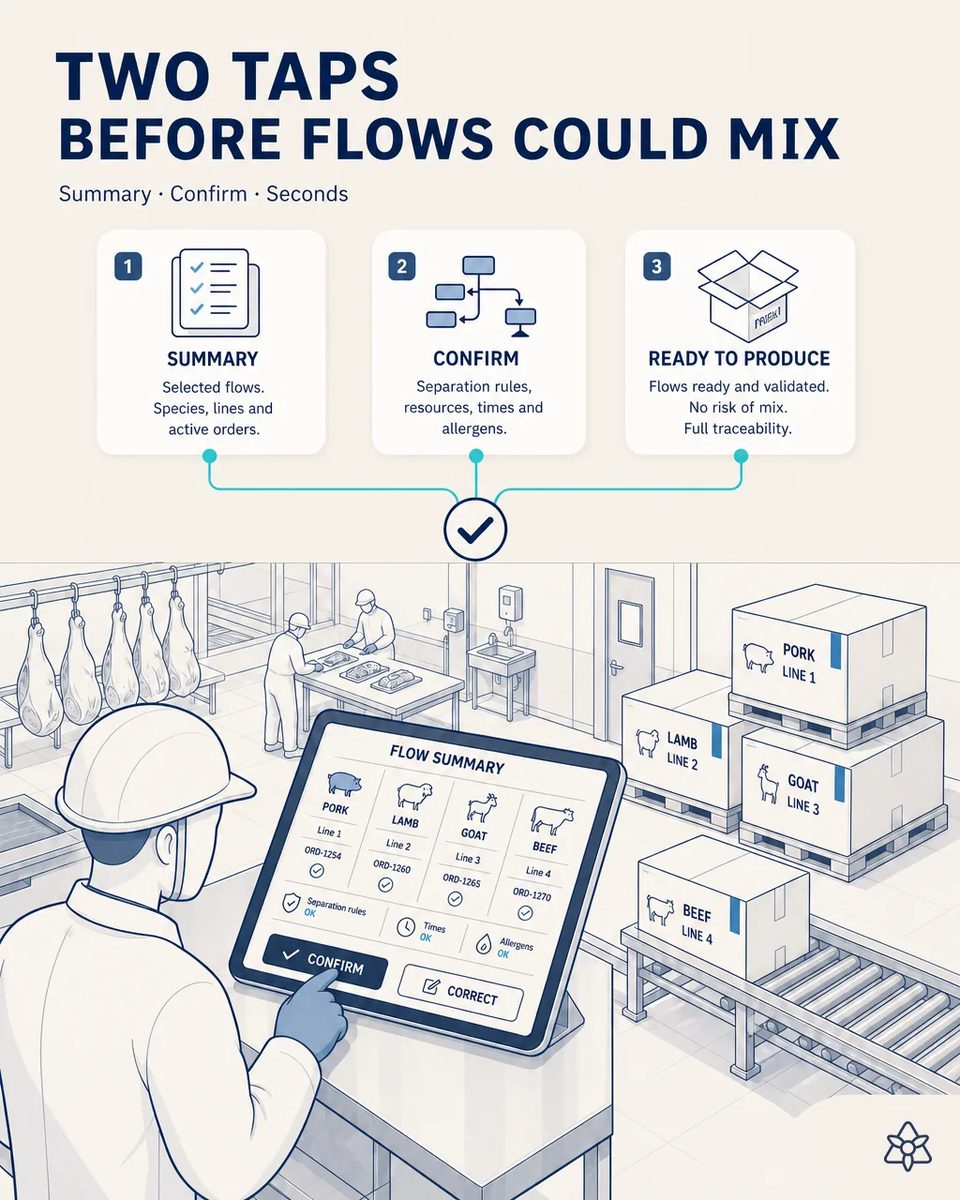
Several product flows, one system, and no gate between them.
Several product flows share the same system, and no one wants to type more on the floor.
- Your own production and toll orders from different clients run through the same ERP, sometimes on the same shift and the same species.
- A box that lands under the wrong order is not a data error: it is somebody else's meat in your stock, or yours in theirs, and it is found when the client counts.
- The obvious fix — make the floor type more — is the one that never works: a screen nobody has time for produces late data or no data at all.
- So the plant ends up choosing between data it does not fully trust and a paper habit that at least it understands. Neither option is good, and the choice gets remade every time somebody proposes a system that assumes the floor has spare minutes it does not have.
Connect with early human verification — a summary, two taps, done.
Connect early-human-verification mode. Every capture lands on the tablet as a visual summary before crossing into the master.
Every capture from the other pieces lands first on the cutting-room tablet as a visual summary that takes two seconds to read: species, line, order and whether it is own production or a toll client's. Only after a human confirms does anything cross into the master, and the confirmation carries their name. No new typing is added anywhere; what is added is a pair of eyes at the only point where it matters.
Data entry today versus the verification gate
| Aspect | Today | With iLEAN |
|---|---|---|
| Own production versus toll | Told apart by whoever types it | Shown and confirmed before posting |
| What reaches the master | Whatever was typed | Only what a person validated |
| Time it costs the floor | A trip to a terminal | Two taps where they stand |
| Who appears as author | Whoever typed it | Whoever saw the boxes |
| A correction on the floor | Lost | Stored with its author |
| Can the AI post on its own | The fear | No, by architecture |
unvalidated data mixing flows → data captured and validated with seconds of latency.
Impact estimate — to be validated with your numbers.
The block below is an estimate to be validated against your plant's actual data. We put it forward so the committee has an order of magnitude; we refine it during the assessment.
- No standalone payback — an enabling piece. We do not attach a month range here either, and it is fairer to say so than to dress one up.
- Its value is what it unlocks: without this gate the other eleven pieces do not get approved, because no sensible management team lets a system write into the master with nobody in front of it.
- From unvalidated data mixing two commercial flows to data captured and confirmed within seconds of the event.
- And who validated what, on which line and at what time stops being a reconstruction exercise when a toll client queries a delivery.
The enabling piece of the whole matrix. *Strategic value, not directly monetizable*.
And the fair question from the production manager
“If a person confirms anyway, what has the AI saved?” — the work is not in deciding, it is in assembling. Today somebody walks to a terminal, finds the order and types. With the gate, the extraction — an anchored task where the best models drop below 1.5% error [1] — arrives already assembled and the operator only confirms or corrects. Every correction is stored, so the system learns exactly where it misreads your documents.
[1] OpenAI paper "Why Language Models Hallucinate", 2025 — on the reliability of AI in anchored tasks.
What people ask about the verification gate
Can the system post to the ERP without a tap?
No, and it is not a setting that can be turned on later when things get busy. Human confirmation is part of the architecture, not a policy, which is precisely what makes the rest of this matrix approvable at steering level rather than an experiment quality tolerates.
Is the tablet fixed or does it move with the operator?
Both are used. In a cutting room it usually travels on the trolley, because what matters is that confirming costs no walking.
What if the person confirms without reading?
The summary is designed to be read in two seconds and shows the flow separation first. Beyond that, the confirmation carries a name, which is a very different thing from an anonymous typed record.
Does every capture go through the tablet?
The ones that write into the master do. A reading kept only as history does not need the gate, and loading it with everything would defeat the purpose.
What if a toll client disputes a quantity?
You can show the summary that was displayed, who confirmed it and at what time, instead of comparing two spreadsheets built after the fact from two different memories of the same shift.
More cases from this series
- Paperless carcass grading logThe grader photographs the grading log and the carcass record already exists in the central system at…
- The chilling tunnel finally gets loggedAn external camera reads the chilling tunnel's temperature curve without touching the controller.
- The GS1-128 label fills itself inThe 20+ logistics label fields fill themselves in from the ERP's active batch.
- What's said between lines staysThe cutting-room lead dictates while walking between species and the AI structures, stores and replies…
- Origin docs and ear tag enter on their ownPhoto the health certificate and the ear tag: the animal traceability table fills itself in, ear tag…
- The quality module stops sitting emptyiLEAN absorbs the real control and fills the quality module your ERP already had built, no new licenses.
Tell us how you keep own production and toll orders apart in your system today.
We work on your plant's real data, not ours. Assessment with no commitment.
Request estimated ROI within 48h ‹ See all cases of multi-species abattoirs See food industry