Paperless carcass grading log
The grader writes down gross weight, net weight, grading code and carcass number by hand on the slaughter line. That paper defines the carcass's traceability, but today it takes hours to digitize. With iLEAN Connect, a photo when each batch closes logs the record at zero second.
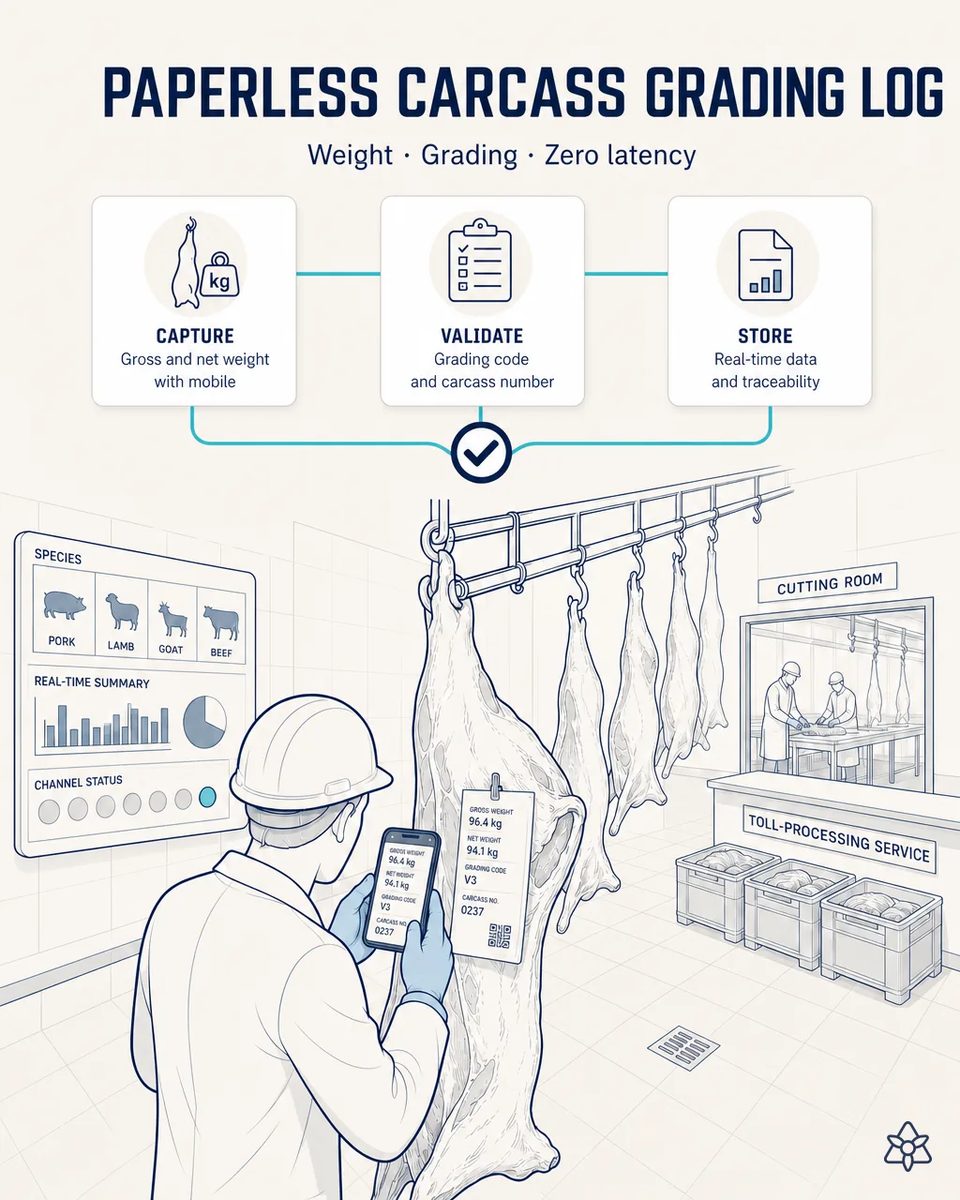
The paper that defines the carcass travels slower than the carcass.
The grading log is filled in by hand right on the line; it can sit undigitized for hours, and any transcription error breaks traceability at the first link.
- Gross weight, net weight, grading code and carcass number are written by hand on the rail, with wet gloves and the line moving. That sheet is the first link of traceability for every animal that enters the plant.
- Between the grader's signature and somebody typing it into the system, hours go by — and a whole weekend when the kill closes on Friday.
- In that window the carcass physically exists, hangs in the chill room and can already be assigned to a cutting order, but it exists in no queryable system.
- And one transposed digit in a carcass number does not stay a typo: it breaks the chain at the first link, exactly where nobody looks for it later. By the time the mismatch surfaces, the meat is boxed and the only honest answer is that two records disagree and neither can be trusted.
Connect in photo mode — the grader keeps writing on the same log.
Connect photo mode. A grounded LLM extracts gross weight, net weight, grading and carcass number, storing them in central memory before the carcass leaves the line.
It asks for no change on the rail: the grader fills in the log they already fill in and adds one photo when the batch closes. No terminal is installed at the grading station, no new sheet replaces the old one and nobody has to learn a screen with wet gloves on. That is usually why it is the first case approved in a plant that kills four species and has no appetite for anything new on the floor.
The grading log today versus the grading log captured
| Aspect | Today, on paper | With iLEAN Connect |
|---|---|---|
| Capture latency | Hours, a weekend if it closes Friday | Second zero |
| Carcass number | Retyped once or twice | Read from the original log |
| Gross and net weight | In a folder in the office | History queryable per species and day |
| A transposed digit | Found when the chain is already broken | Flagged as low confidence |
| Yield per kill batch | An estimate argued about | Calculated on the logged data |
| Grader's habit | — | Unchanged: one photo |
hours of latency → zero second. Manual transcription with errors → direct capture from the original log.
Impact estimate — to be validated with your numbers.
The block below is an estimate to be validated against your plant's actual data. We put it forward so the committee has an order of magnitude; we refine it during the assessment.
- Estimated payback 4-9 months, depending on the daily carcass volume.
- From hours of latency — a whole weekend at the worst moment of the week — down to second zero.
- Transcription hours recovered from whoever types the log today, usually somebody in the office who never saw the carcass.
- And the grading mix per species stops being reconstructed at month end: it is data from the moment the batch closes.
Estimated payback of 4-9 months depending on daily carcass volume. *Estimate to be validated*.
And the fair question from the production manager
“What if it misreads a weight or a carcass number?” — reading fields from a log with a known layout is an anchored task, where the best models drop below 1.5% error [1]. There is a second net on top: any weight falling outside the physical range for that species is rejected instead of accepted, and the summary goes back to the grader, who confirms or corrects before anything is stored.
[1] OpenAI paper "Why Language Models Hallucinate", 2025 — on the reliability of AI in anchored tasks.
What people ask about digitizing the grading log
Do we have to redesign the grading log?
No. It stays exactly as it is, with its columns, its abbreviations and the corrections made on the rail. Vision reads the layout you already use, which is also what keeps the change from needing approval on the floor: nobody is being asked to work differently, only to take one photo at the end.
Does it read handwriting made with wet gloves?
That is the design condition, and it is why low-confidence values are not stored silently: they come back highlighted for the grader to confirm in the same gesture that took the photo.
What about a batch that closes on Friday afternoon?
That is where it shows most. Today those carcasses spend the weekend outside any system; with capture they are queryable from the first minute, exactly as on a Tuesday.
Does it have to write into our system from day one?
No. It works from the first batch against iLEAN's central memory, and the push into the carcass record is connected afterwards, once the plant has seen the value.
Does it work with four species on the same rail?
Yes, and the species is taken from the active kill batch, not guessed from the sheet. That is what keeps a lamb log from landing in the beef record, which is the kind of mistake nobody finds until the month-end figures refuse to add up.
More cases from this series
- The chilling tunnel finally gets loggedAn external camera reads the chilling tunnel's temperature curve without touching the controller.
- Two taps before flows could mixNothing enters the ERP without a human seeing it first — prevents mixing own production and toll orders.
- The GS1-128 label fills itself inThe 20+ logistics label fields fill themselves in from the ERP's active batch.
- What's said between lines staysThe cutting-room lead dictates while walking between species and the AI structures, stores and replies…
- Origin docs and ear tag enter on their ownPhoto the health certificate and the ear tag: the animal traceability table fills itself in, ear tag…
- The quality module stops sitting emptyiLEAN absorbs the real control and fills the quality module your ERP already had built, no new licenses.
Tell us how long a closed kill batch takes to exist in your system today.
We work on your plant's real data, not ours. Assessment with no commitment.
Request estimated ROI within 48h ‹ See all cases of multi-species abattoirs See food industry