The chilling tunnel finally gets logged
Every carcass goes through a chilling tunnel with an old, offline controller showing temperature and time. That critical data isn't logged per batch today. With iLEAN Connect, an external camera digitizes the curve without touching the controller.
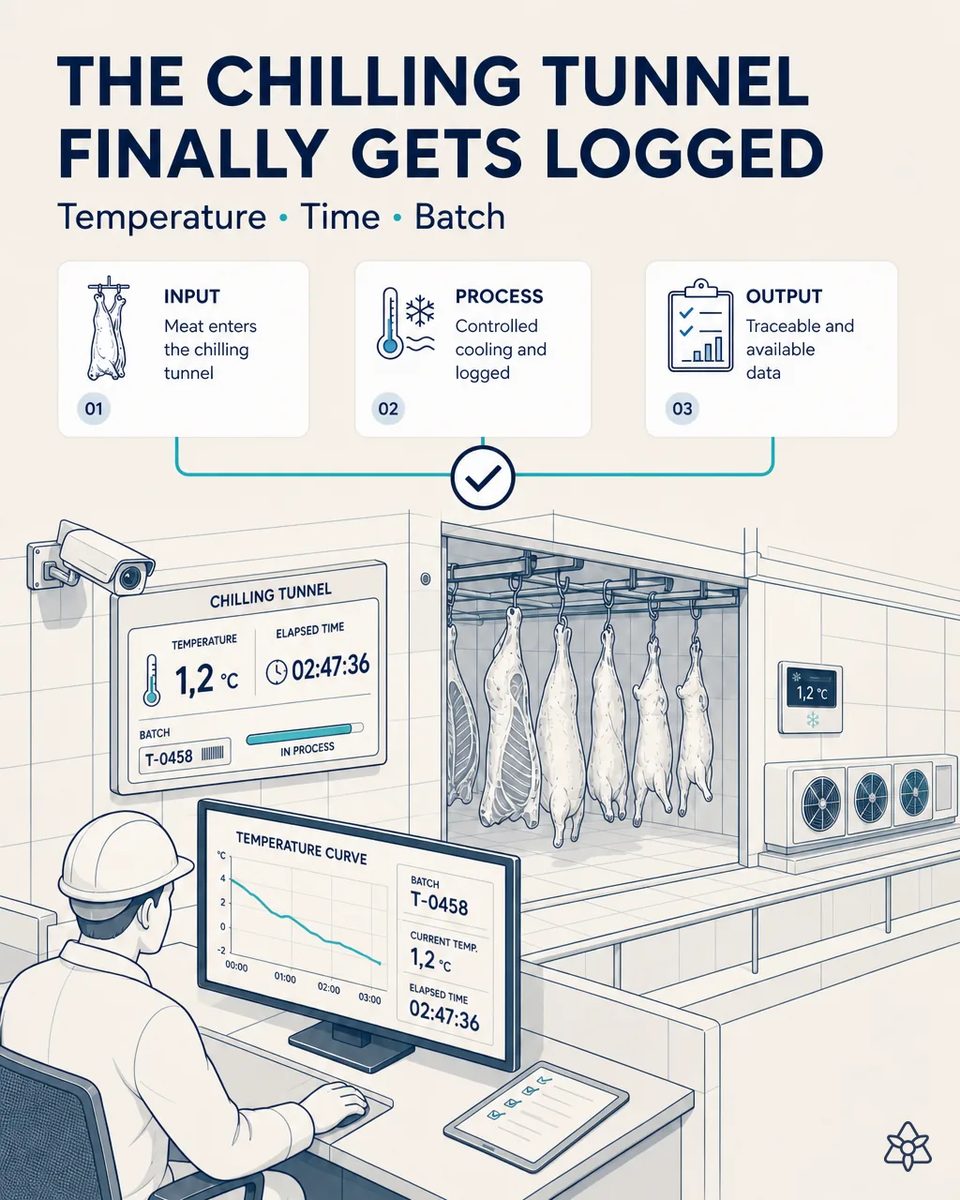
The step that decides whether the carcass can be cut leaves no trace.
The chilling tunnel decides if the carcass is ready for cutting, but its data dies every time the batch changes.
- The chilling tunnel is what takes the carcass down to the temperature the cutting room requires. It is the gate between the rail and the primals.
- Its controller is often fifteen or twenty years old, sits off the network by the manufacturer's own design, and shows temperature and elapsed time on a panel nobody records.
- When the batch changes, the screen resets and the previous curve is gone: what survives is at best a temperature written down once, not the curve.
- So when a cold-chain question lands — from a customer, from the official vet, or from your own incident review — the honest answer today is that the data was never kept. The tunnel almost certainly did its job; what is missing is any way of demonstrating it for the batch being asked about.
Connect in photo mode on the panel — solved from outside, not inside.
Connect photo mode on the panel. Fixed camera + OCR with a grounded LLM structuring the time curve per batch.
Nothing is installed on the controller, no port is opened and its behavior is not modified. A camera sees the panel and a grounded model structures what is on it, batch by batch. On the machine that governs the cold chain, solving it from outside is the difference between a case quality can approve in a morning and a project that never leaves the meeting room.
The tunnel today versus the tunnel being read
| Aspect | Today | With iLEAN Connect |
|---|---|---|
| The chilling curve | Erased on every batch change | Stored batch by batch |
| Temperature entering the cutting room | A figure somebody remembers | A logged value with its timestamp |
| Time inside the tunnel | Estimated from the shift plan | Measured from the panel itself |
| A cold-chain question | Nothing to show | Curve and batch on screen |
| The controller | — | Untouched, no new software |
| Replacing the tunnel controller | Budgeted | Deferrable |
zero per-batch logging → digitized curve available for any audit or incident.
Impact estimate — to be validated with your numbers.
The block below is an estimate to be validated against your plant's actual data. We put it forward so the committee has an order of magnitude; we refine it during the assessment.
- Estimated payback 5-10 months, counting the avoided capex of replacing the controller.
- From zero per-batch record to a curve available for any inspection or incident review.
- Carcasses released into the cutting room on a documented temperature instead of on somebody's judgment about the clock, which is what that decision rests on today.
- And a tunnel drifting slowly — a fan losing performance, a door left open on the night shift — shows up as a trend across batches, while it is still maintenance rather than a batch you have to argue about with a customer.
Estimated payback of 5-10 months, avoided controller-replacement CAPEX. *Estimate to be validated*.
And the fair question from the production manager
“Can a camera reading an old panel really stand as a record?” — the task here is anchored: a fixed screen, fields in known positions and temperatures inside a narrow physical range, where the best models drop below 1.5% error [1]. On top of that, any frame whose reading falls outside the possible range for the tunnel is discarded rather than stored, which is precisely what would invalidate a series in front of an inspector.
[1] OpenAI paper "Why Language Models Hallucinate", 2025 — on the reliability of AI in anchored tasks.
What people ask about reading the chilling tunnel panel
Does the controller have to be replaced or reprogrammed?
Neither, and that is the whole point of solving it from outside. The tunnel keeps running exactly as it does today, with the same setpoints and the same manufacturer support; what changes is that its screen stops being the only place the data ever lives. No cable enters the machine and no software is installed on it.
Does it record the full curve or only the final temperature?
The full curve, sampled while the batch is inside. The final temperature you already have; what is missing is how it got there, which is what explains a slow batch.
What happens if steam or condensation blurs the panel?
Unreadable frames are discarded and not interpolated. A gap is visible as a gap, which is the only honest way to keep a record you may have to defend.
Can the curve be tied to a specific kill batch?
Yes, through the batch active on the rail at that moment, so the carcasses that went in are the ones that carry the curve when they reach the cutting room and, later, when a box leaves the dock.
Does it work for the chill rooms as well?
Yes, the pattern is identical, and most plants extend it there once the tunnel is running. The tunnel is where you start because it is the step that gates the cutting room and the one with the least evidence behind it today.
More cases from this series
- Paperless carcass grading logThe grader photographs the grading log and the carcass record already exists in the central system at…
- Two taps before flows could mixNothing enters the ERP without a human seeing it first — prevents mixing own production and toll orders.
- The GS1-128 label fills itself inThe 20+ logistics label fields fill themselves in from the ERP's active batch.
- What's said between lines staysThe cutting-room lead dictates while walking between species and the AI structures, stores and replies…
- Origin docs and ear tag enter on their ownPhoto the health certificate and the ear tag: the animal traceability table fills itself in, ear tag…
- The quality module stops sitting emptyiLEAN absorbs the real control and fills the quality module your ERP already had built, no new licenses.
Tell us what your chilling tunnel leaves behind today when the batch changes.
We work on your plant's real data, not ours. Assessment with no commitment.
Request estimated ROI within 48h ‹ See all cases of multi-species abattoirs See food industry