Origin docs and ear tag enter on their own
The origin certificate has 15+ fields per animal, and the ear tag is almost never logged even though the table already exists in the ERP. With iLEAN Connect, one photo of each document fills both records.
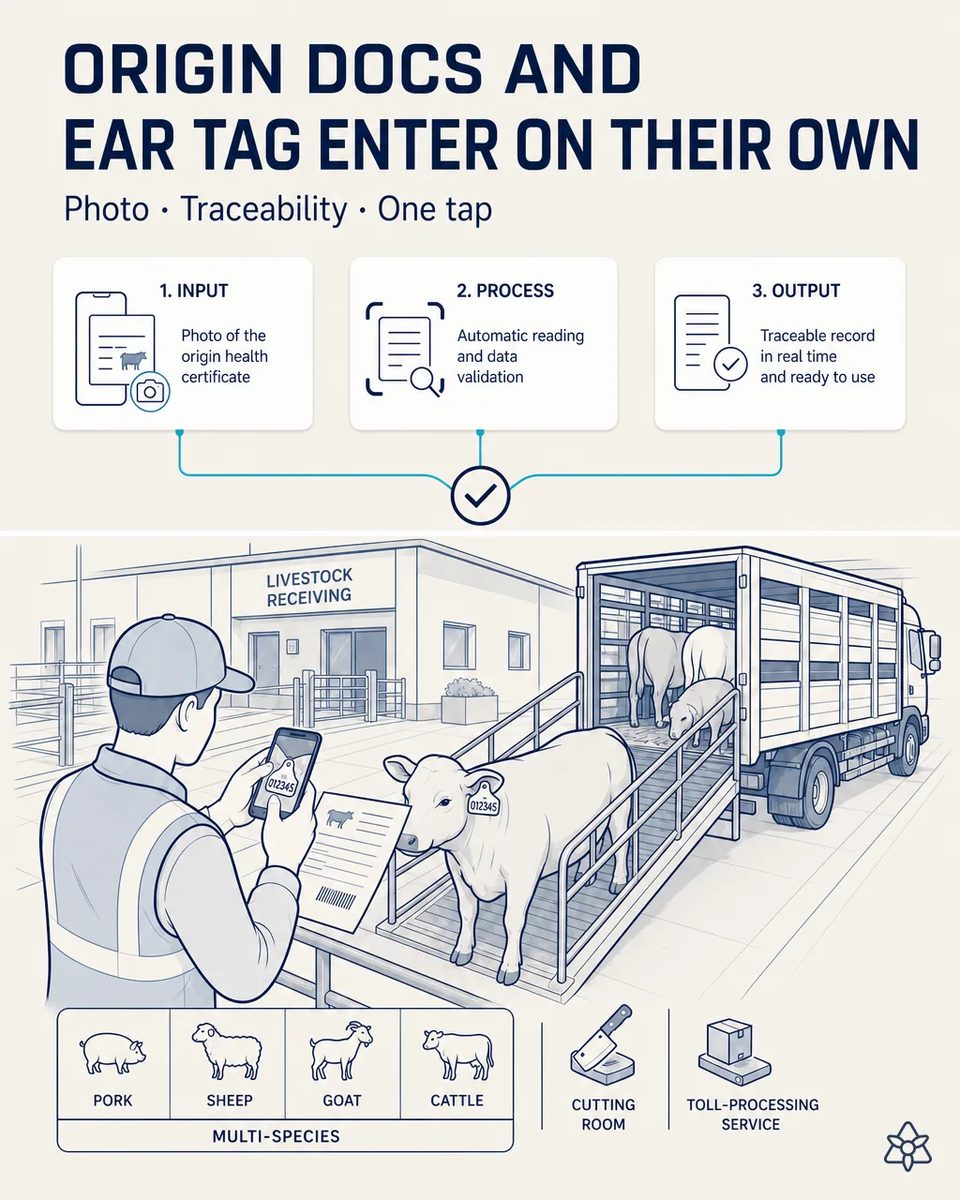
The first record of the animal is the slowest one to create.
Typing the certificate by hand is slow and error-prone; the ear-tag record simply isn't filled in today.
- The origin certificate carries fifteen or more fields per consignment: holding, species, count, transport, dates, health statements, signatures.
- It is typed by hand while the truck waits, which is the worst possible combination of pressure and detail.
- The ear-tag field exists in the system and is simply not filled, because reading tags one by one and typing them is not something a reception shift can absorb.
- And an empty ear-tag field is not a cosmetic gap: it is the difference between traceability down to the animal and traceability down to the truck. Every claim made further downstream about where a piece of meat came from rests on that field, and today it rests on nothing.
Connect in photo mode — one photo of the document, one of the tag.
Connect photo mode. Recognizes the certificate and the tag, extracts the fields and, after validation, inserts them into the ERP.
The certificate and the tag are recognized as what they are, the fields are extracted and, once validated on screen, inserted into the records that already exist in your system. Nothing new is built and no parallel register appears. Reception stops being the bottleneck of the traceability chain and becomes its first reliable link, which is where every later question ends up pointing.
Reception today versus reception captured
| Aspect | Today | With iLEAN Connect |
|---|---|---|
| Certificate fields | Typed one by one | Extracted and validated |
| Ear-tag record | Empty | Filled on every reception |
| Who does the entry | Two or three people with licenses | The lead, validating |
| The truck at the dock | Waits for the typing | Waits for the photo |
| Traceability reaches | The consignment | The animal |
| A doubtful field | Typed as best guess | Flagged before it is stored |
empty ear-tag table → populated on every reception.
Impact estimate — to be validated with your numbers.
The block below is an estimate to be validated against your plant's actual data. We put it forward so the committee has an order of magnitude; we refine it during the assessment.
- Estimated payback 3-8 months, depending on receptions per week and species mix.
- The receiving and traceability module typically needs two or three named licenses; with capture only the lead validates, a typical 50-70% reduction.
- From an ear-tag table that has never been populated to one filled on every reception, which is what makes animal-level traceability real rather than declared in a procedure nobody can evidence.
- And the certificate stops being retyped: the original image stays attached to the record, so whoever checks it later reads the source instead of somebody's transcription of it.
The receiving/traceability module typically requires 2-3 licenses; with Connect only the lead validates — typical 50-70% reduction. Estimated payback of 3-8 months. *Estimate to be validated*.
And the fair question from the production manager
“An ear tag is small, dirty and moving — can it really be read?” — reading a tag is an anchored task with a known format and a checkable structure, where the best models drop below 1.5% error [1]. There is a second net: a tag whose number does not fit the expected structure, or whose reading is uncertain, is not stored as a fact. It comes back for the operator to confirm, and the photo stays attached either way.
[1] OpenAI paper "Why Language Models Hallucinate", 2025 — on the reliability of AI in anchored tasks.
What people ask about capturing origin documents
Does it work with certificates from different regions?
Yes, and it has to: layouts differ, the boxes move and the same field is labeled three different ways. Recognition works on the document type and on what each field means, not on one single printed template, which is what lets it handle a holding that sends a form you have never seen before.
Do all the animals in a consignment have to be photographed?
That depends on the species and on what your traceability requires. For cattle, tag by tag is the norm; for smaller species the practice is usually per lot, and the system follows whichever rule you work to.
What happens with an unreadable or damaged tag?
It is marked as unread rather than guessed, and the operator resolves it there. A wrong number would be worse than an acknowledged gap.
Does it shorten the time the truck spends at the dock?
That is where the operational gain sits, because the typing moves out of the critical path entirely: the photo is taken while unloading proceeds, and the validation happens once the animals are already in the pens.
Does the animal's record link to what happens later in the plant?
Yes, and that is the whole point of filling it in at reception rather than later: the tag is what lets the origin record tie to the carcass on the rail and, from there, to the boxes that leave the dock with a customer's name on them.
More cases from this series
- Paperless carcass grading logThe grader photographs the grading log and the carcass record already exists in the central system at…
- The chilling tunnel finally gets loggedAn external camera reads the chilling tunnel's temperature curve without touching the controller.
- Two taps before flows could mixNothing enters the ERP without a human seeing it first — prevents mixing own production and toll orders.
- The GS1-128 label fills itself inThe 20+ logistics label fields fill themselves in from the ERP's active batch.
- What's said between lines staysThe cutting-room lead dictates while walking between species and the AI structures, stores and replies…
- The quality module stops sitting emptyiLEAN absorbs the real control and fills the quality module your ERP already had built, no new licenses.
Tell us how many people type origin certificates at your reception today.
We work on your plant's real data, not ours. Assessment with no commitment.
Request estimated ROI within 48h ‹ See all cases of multi-species abattoirs See food industry