The quality module stops sitting empty
The ERP already ships a per-batch quality module, but it's empty because typing there is slower than the old paper habit. iLEAN absorbs the real control and, after validation, pushes it into the module that already existed.
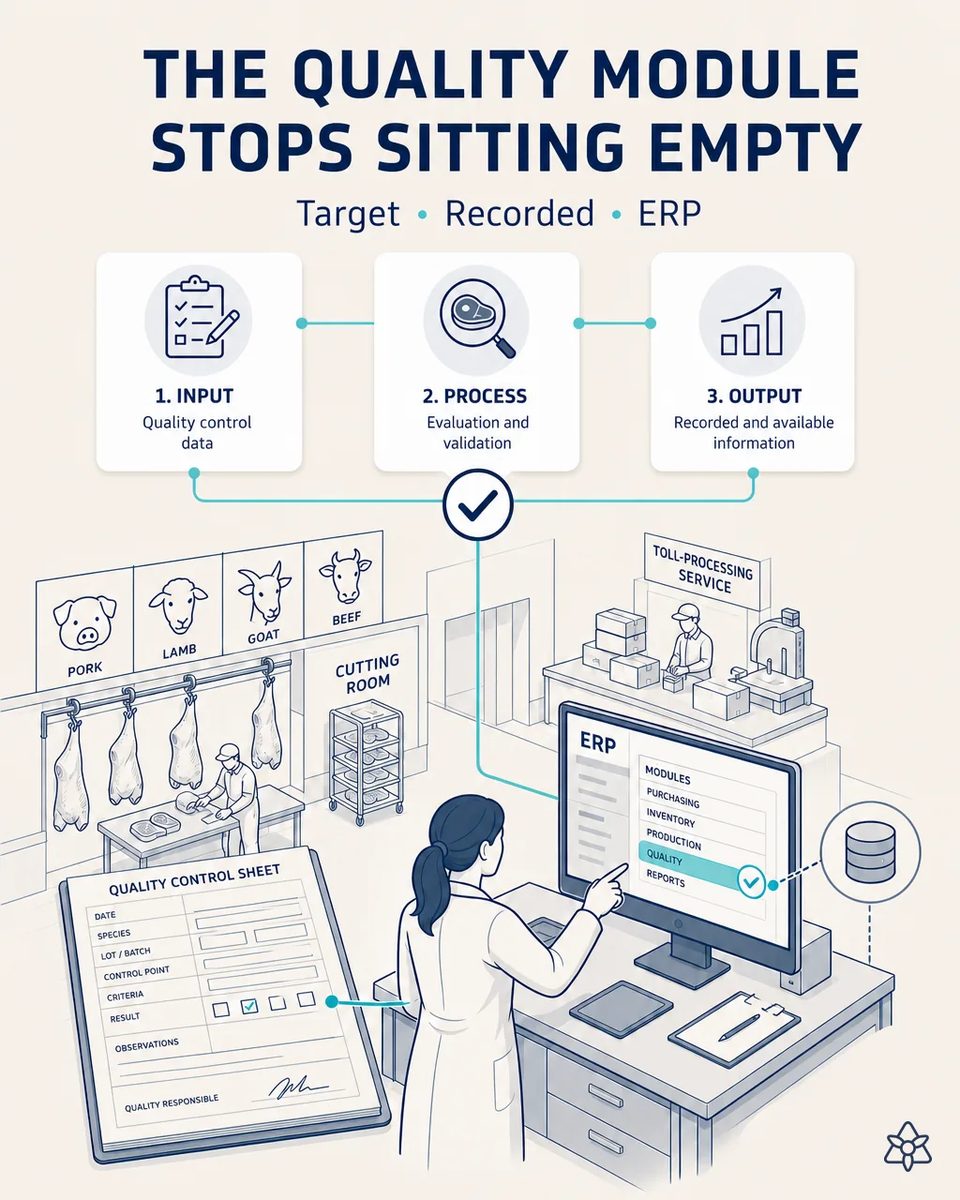
A module was configured, and the plant kept using paper.
A quality module was paid for or configured, but nobody feeds it.
- Almost every abattoir ERP ships a per-batch quality module: control point, criterion, result, observations, who signed.
- It was configured, maybe paid for as an extra, and it sits at close to zero real use.
- The reason is not resistance, it is arithmetic: typing there takes longer than filling the sheet the technician has used for years, and the sheet is what the shift allows.
- So the plant owns a module that would answer the official vet's questions in seconds and answers them by opening a folder instead. Meanwhile the license is renewed every year, the module appears in every system review as something to fix, and nothing changes because the obstacle was never the software.
Connect in listen-inward mode — the sheet stays, the module gets fed.
Connect's "listen inward" mode — watches the real paper or folder, parses with a grounded LLM, validates on screen, pushes to the ERP's already-built module.
Nobody is asked to stop using the control sheet. iLEAN watches the real sheet or the folder it ends up in, parses it with a grounded model, shows it for validation and writes into the module that already existed. The technician's routine is untouched and no second quality system appears; what changes is that the module stops being empty and starts answering questions the folder never could.
The quality control today versus the module fed
| Aspect | Today | With iLEAN Connect |
|---|---|---|
| Real use of the module | Close to zero | Fed on every control |
| Where the control lives | A sheet in a folder | The sheet, and the module too |
| New licenses needed | The usual assumption | None: the module exists |
| Answering the official vet | Open the folder, hunt | One query by batch and species |
| A control that was skipped | Noticed much later | Missing where it should be |
| Technician's routine | — | Unchanged: the same sheet |
module at 0% real use → fed at zero second on every control.
Impact estimate — to be validated with your numbers.
The block below is an estimate to be validated against your plant's actual data. We put it forward so the committee has an order of magnitude; we refine it during the assessment.
- Estimated payback 3-8 months, and part of it is simply monetizing a module already bought.
- From a module at zero percent real use to one fed at second zero on every control performed.
- No new licenses and no second quality system to maintain, which is what usually kills this kind of project in the second year, when the new tool has its own backlog and its own champion has moved on.
- And the plant stops carrying two versions of its quality history — the one in the folder and the one the system shows — which is the discrepancy an auditor finds fastest.
Monetizes an already-paid ERP module, no new licenses. Estimated payback of 3-8 months. *Estimate to be validated*.
And the fair question from the production manager
“Is this not just scanning our sheets into a drawer?” — no, and the difference matters. A scan gives you an image; here the fields are extracted, checked against the criterion defined for that control point and written as structured data into the module, which is what makes it queryable. Parsing a sheet with a fixed layout is an anchored task where the best models drop below 1.5% error [1], and the technician validates on screen before anything is posted.
[1] OpenAI paper "Why Language Models Hallucinate", 2025 — on the reliability of AI in anchored tasks.
What people ask about feeding the quality module
Do we have to change the control sheet?
No. Changing it is the fastest way to lose the technician who fills it in, and the sheet exists in its current shape for reasons somebody had. It stays as it is, and the module receives what the sheet says.
What if the module was configured years ago and nobody remembers how?
That is the normal starting point, and it is not an obstacle. Part of the work is mapping which fields the module expects, which usually also surfaces what was configured once, never used, and can now be either fed or retired.
Does it handle several species with different control points?
Yes, and it has to: a control point that applies to cattle and not to lambs must not land in the wrong record. The control plan per species drives the mapping.
What if a control was not performed?
The absence becomes visible in the module where it should have been, against the batch and the control point it belonged to. That is a very different thing from a folder, where a control nobody did looks exactly like a sheet somebody forgot to file.
Does it work if the quality module is in a separate system?
Yes. What matters is that it has a way in, through an interface or an import the vendor already supports. The pattern does not change whether the module sits inside the ERP or beside it as a separate application.
More cases from this series
- Paperless carcass grading logThe grader photographs the grading log and the carcass record already exists in the central system at…
- The chilling tunnel finally gets loggedAn external camera reads the chilling tunnel's temperature curve without touching the controller.
- Two taps before flows could mixNothing enters the ERP without a human seeing it first — prevents mixing own production and toll orders.
- The GS1-128 label fills itself inThe 20+ logistics label fields fill themselves in from the ERP's active batch.
- What's said between lines staysThe cutting-room lead dictates while walking between species and the AI structures, stores and replies…
- Origin docs and ear tag enter on their ownPhoto the health certificate and the ear tag: the animal traceability table fills itself in, ear tag…
Tell us which modules of your ERP were configured and are still empty.
We work on your plant's real data, not ours. Assessment with no commitment.
Request estimated ROI within 48h ‹ See all cases of multi-species abattoirs See food industry