Zero unplanned downtime in the paint section — 4 coordinated rings
Paint is the physical bottleneck of the whole CTO line: without a painted chassis there is no shipment. The iLEAN flagship system coordinates the previous eleven pieces into 4 rings that cross-check each other — the work order and the superintendent's voice · the curing oven's thermal curve · the real life of robots and equipment · a per-chassis evidence pack —: JIDOKA AI blocks the booth on any deviation before the next chassis, and SMED AI accelerates the change between colors. The result the superintendent defends before corporate: a ≥30% reduction in unplanned downtime (estimate to be validated), CAPEX defensible with real per-machine data and a continuously green OEM scorecard.
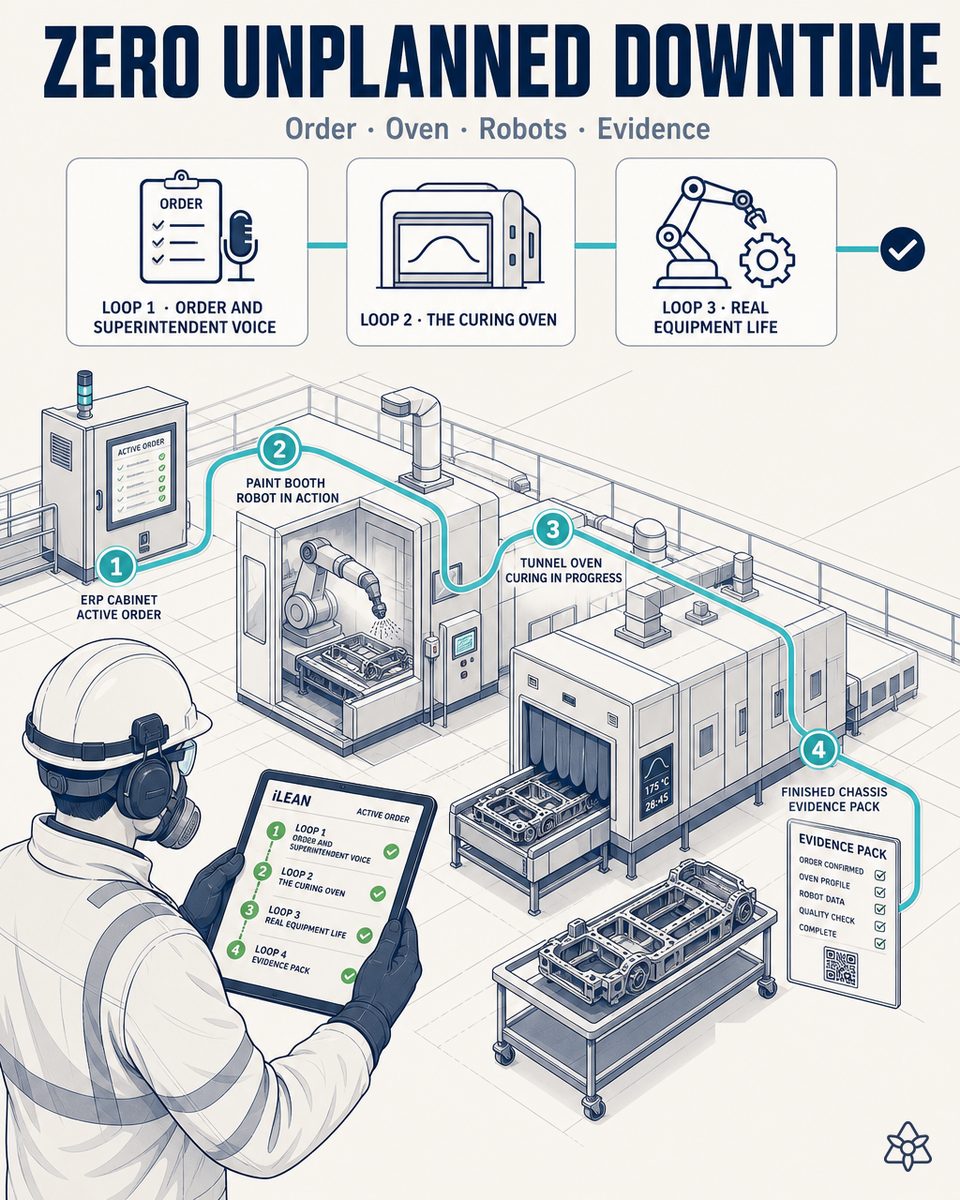
An unplanned stop in paint is not a local incident: it is the whole CTO line stopped downstream.
In an electronics plant, unplanned downtime in the paint section is the biggest local operational and economic risk. Paint is the physical bottleneck: when a booth or the curing oven stops without warning, the stop drags the whole assembly downstream — overtime to recover the schedule, a broken sequence, and the customer's delay penalty waiting at the end of the week. Every hour of stopped paint is paid twice: in the section and in everything that comes after.
The superintendent must sustain uptime against a bounded budget and with no objective per-machine data. The paint robot's and critical equipment's maintenance is decided by calendar or intuition, the renewal CAPEX is defended before corporate with estimates the committee discounts, and the oven's thermal curve is only looked at when someone walks past the panel. The equipment's drift exists days before the failure — but nobody reads it where it is born.
And the risk does not stay in the stop: paint defects escalate to customer PPM within weeks. An oven curing out of window or a robot spraying degraded produce a defective series before producing a breakdown, and the first notice arrives on the OEM's scorecard. Either the section verifies itself on the shop floor, or the downtime and the PPM are discovered when they are already expensive.
The 4 coordinated rings — the heart of the system.
No ring closes the risk on its own. What sustains the uptime is that the four cross-check each other: each one verifies what the previous one said, and no chassis leaves without the other three agreeing.
- Ring 1 · Work order and the superintendent's voice. The work order and the shift report digitized in real time by Connect, plus the superintendent's voice by earpiece. The real painting conditions — which chassis, which color, which incident the shift just reported — are always available as the single source of truth, not on a paper someone will transcribe tomorrow.
- Ring 2 · Curing oven. The oven's thermal curve read by camera over the SCADA panel, without touching the equipment or its electronics. If the curve starts drifting from the process window, the alert arrives before the defect — the intervention is planned, instead of the badly cured series being discovered at inspection or at the customer.
- Ring 3 · The real life of robots and equipment. The counters of hours, shots, consumption and alarms of the paint robot and the rest of the critical equipment reach the CMMS automatically. MTBF and MTTR are calculated on real data, maintenance goes from calendar to real condition, and CAPEX is defended before corporate with each machine's real life — not with estimates.
- Ring 4 · A per-chassis evidence pack. Every chassis leaves with a dossier crossing the three previous rings — the order that defined it, the oven curve that cured it and the real state of the equipment that processed it — plus the visual inspection photo and the quality technician's signature. If the OEM or its auditor asks, the answer already exists reconciled; nobody has to rebuild it by hand.
Two more pieces are not rings, they are what makes them operational: JIDOKA AI blocks the booth before the next chassis on any deviation — a short, controlled stop on the shop floor instead of a defective series with its rework — and SMED AI accelerates the change between colors using the evidence pack as an automated checklist, so coordinating four verification points does not mean penalizing OEE. The coordination protects without slowing down.
See the full IRIS architecture →
Satellite cases from the same plant, with each ring's technical detail: the curing oven's curve read over the SCADA panel (Ring 2) · the paint robot connected to the CMMS (Ring 3) · the per-chassis evidence pack (Ring 4).
Paint section without coordinated rings vs. section with the 4 iLEAN rings
| Aspect | Section without coordination | Section with the 4 iLEAN rings |
|---|---|---|
| Work order and shift report | Paper or a screen someone transcribes the next day; the shift's incidents travel from memory to memory | Ring 1: order and report digitized in real time by Connect, plus the superintendent's voice by earpiece; real painting conditions always available |
| The curing oven's thermal curve | Looked at on the SCADA panel when someone walks past; drift is discovered in the defect or the stop | Ring 2: a camera reading the curve over the panel; thermal drift raises an alert before the defect, at the equipment itself |
| Maintenance of the paint robot and critical equipment | By calendar or intuition; CAPEX defended before corporate with estimates | Ring 3: counters of hours, shots, consumption and alarms in the CMMS; real MTBF/MTTR and CAPEX defended with each machine's real life |
| Evidence per chassis | Rebuilt by hand if the OEM claims; the scorecard sustained audit by audit | Ring 4: an evidence pack crossing the three rings plus a visual inspection photo and quality's signature; a continuously green OEM scorecard |
| The change between colors | Penalizes OEE; changeover pressure multiplies startup errors | SMED AI accelerates the change using the evidence pack as an automated checklist; JIDOKA AI blocks the booth if something does not match |
| Unplanned downtime | Stops dragging the whole assembly downstream, with overtime and customer delay penalties | A ≥30% reduction (estimate to be validated): drift is detected at the equipment before the failure and the intervention is planned in a window |
Impact estimate for your plant — to be validated with your own numbers.
The block below is an estimate to be validated against your plant's actual data. We put it forward so the committee has an order of magnitude; we refine it during the assessment.
- Electronics plant with a CTO line and the paint section as the physical bottleneck: booths with a paint robot, a curing oven and frequent changes between colors, serving OEM customers with a demanding scorecard.
- Pilot on the paint section with the 4 rings coordinated — the work order and the superintendent's voice, the oven's thermal curve, the real life of robots and equipment in the CMMS, and a per-chassis evidence pack. First value within a few weeks starting with the robots-and-equipment ring.
- Operations' hard lever is the ≥30% reduction in unplanned downtime — the annualized saving of the stops that today drag the whole assembly, plus the overtime and customer penalties that disappear with them.
- Quality's and management's hard lever is double: defects stop escalating to customer PPM — drift is detected at the equipment itself, before the defect — and CAPEX is defended before corporate with real MTBF and MTTR, not estimates the committee discounts.
- Indicative payback between 6 and 12 months, counted against the annualized downtime saving plus the reduction of claims and spare parts optimization. Estimate to be validated.
And the fair question: "what if the system itself gets it wrong?"
The right question from management. Two answers that hold each other up. The technical one: hallucination is a problem of free generation, not of anchored tasks — reading the oven's thermal curve over the SCADA panel and comparing it with the process window, counting the paint robot's hours and shots, or verifying that a chassis's evidence pack matches the other three rings, are as anchored as tasks get. In tasks of this kind, the best models brought the error below 1.5% [1]. The architectural one: the system sits on the three IRIS safety rings — Connect transports, the Agents decide, the person signs. And because the case's 4 rings cross-check each other, an isolated failure in one is exposed by the other three before it becomes an unplanned stop or a defect escalating to the customer. It is not that everything passes through a person; it is that the system allows it where it matters — and here it matters.
[1] OpenAI paper "Why Language Models Hallucinate", 2025 — on the reliability of AI in anchored tasks.
What people ask about the iLEAN 4-ring system in chassis paint
Do the 4 rings have to be installed at once, or can we start in phases?
In phases — and that is the recommendation. Each ring protects on its own and deploys without waiting for the others. The most common sequence in a paint section starts with Ring 3 (the real life of robots and equipment), because it brings the paint robot's and critical equipment's counters of hours, shots, consumption and alarms into the CMMS — turning calendar maintenance into real-condition maintenance, the most direct lever against unplanned downtime; then Ring 2 (curing oven), with the camera reading the thermal curve over the SCADA panel to alert on drift before the defect; then Ring 1 (the work order and the superintendent's voice), so the real painting conditions are always available as the single source of truth; and finally Ring 4 (the per-chassis evidence pack), which closes the circle by crossing the previous three. The zero unplanned downtime effect appears when the four cross-check each other — each ring acting as the previous one's witness — but the risk reduction starts with the first.
How does it reduce unplanned downtime, concretely?
Through three mechanisms that add up. First, drift is detected at the equipment itself, before the failure and before the defect: the oven's thermal curve read by camera and the paint robot's real counters give warning when something starts leaving the pattern, so the intervention is planned into a color change window instead of improvised with the line stopped. Second, JIDOKA AI blocks the booth before the next chassis on any deviation: a short, controlled stop on the shop floor replaces the long stop caused by a series of defective chassis with its rework. Third, SMED AI accelerates the change between colors using the evidence pack as an automated checklist, and returns as productive uptime minutes lost today on every change. The combination of the three is what sustains the ≥30% reduction in unplanned downtime — an estimate to be validated with your line's real data.
How do you guarantee the system itself does not get it wrong — management's fair question?
Two answers that hold each other up, one technical and one architectural. Technical: hallucination is a problem of free generation, not of anchored tasks. Reading the oven's thermal curve over the SCADA panel and comparing it with the process window, counting the paint robot's hours, shots and alarms, or verifying that a chassis's evidence pack matches what the other three rings say, are anchored tasks — the best recent study (OpenAI's paper "Why Language Models Hallucinate", 2025) puts the best models' error in anchored tasks below 1.5%. Architectural: the system sits on the three IRIS safety rings — Connect transports, the Agents decide, the person signs. The critical verification never runs alone: the superintendent validates the painting conditions and the quality technician signs the evidence pack before the chassis leaves. And because the case's 4 rings cross-check each other (order against oven, oven against equipment, equipment against the evidence pack), an isolated failure in one ring is exposed by the other three before it becomes an unplanned stop or a defect escalating to customer PPM.
How long does the complete system take to be operational in the plant?
The standard iLEAN method — kick-off with AI-FDE in 2 weeks, a 3-5 day immersion with a mixed team (your plant's people + embedded industrial AI engineers), Pareto applied, first value within a few weeks on the most urgent ring, and a pilot line with the 4 rings coordinated typically in 3-4 months. In paint the natural starting point is the robots-and-equipment ring: it delivers measurable value in weeks — MTBF and MTTR on real data and the first interventions planned instead of improvised — while the other rings are assembled in parallel. The rollout to the remaining booths and lines is replicated by your own people, trained in the pilot. SMED AI enters from the start so the coordination does not penalize the changes between colors or OEE. It is an estimate to be validated with your project team.
What does the OEM's auditor see of the system?
Complete traceability per chassis, generated in the moment and not reconstructed. Every chassis leaves with its evidence pack: the active work order with the real painting conditions, the curing oven's thermal curve of its pass, the real state of the equipment that processed it, the visual inspection photo and the quality technician's signature. The OEM's auditor receives the evidence in the format its own quality system expects, with no extra work from the plant, and the scorecard stays green continuously — not audit by audit. For the auditor it is a computerized system treated as such: defined scope, a record of who signed, when, and against which specification each verification was crossed. The AI does not release the chassis: the person signs, and that signature stays anchored to the dossier. And if a claim arrives despite everything, the response starts from an already reconciled per-chassis file, not from days of reconstruction.
More cases from this series
- A customer audit evidence pack — the OEM scorecard in continuous greenEvery change generates a dossier with photos, log and signatures. Agents organizes it by standard (ISO…
- Early human verification — two taps and the ERP stays cleanNothing iLEAN captures enters the ERP without a human signature on the tablet. Two taps, seconds, the…
- The curing oven now talks — without touching the original SCADAAn external camera reads the tunnel oven’s SCADA panel without touching the machine. A per-batch thermal…
- OEM customer spec change — zero rework from reading lateiLEAN silently copied on the mailbox. When the OEM changes a paint spec, the notice reaches the…
- From the laboratory’s Excel to the ERP at second zeroiLEAN reads the laboratory’s Excel as soon as it is saved, validates and feeds the ERP. Fewer quality…
- Paint receiving into the ERP — no typing, with shielded traceabilityA photo of the delivery note, the CoA and the GS1 labels. One tap and all into the ERP. Truck from 45 to…
Sustain your paint line's uptime — ask us for the flagship project.
We work on your plant's real data, not ours. Assessment with no commitment.
Request estimated ROI within 48h ‹ See all 12 chassis paint cases See electronics