Early human verification — two taps and the ERP stays clean
The main cultural brake on digitization at an audited corporate site is the fear of the AI inserting data on its own and contaminating the ERP's master. In iLEAN nothing enters the CMMS or the ERP without a human signature: an industrial tablet at the booth shows a two-second visual summary of each capture — photo, voice, email, the laboratory's Excel — and the operator validates with two taps.
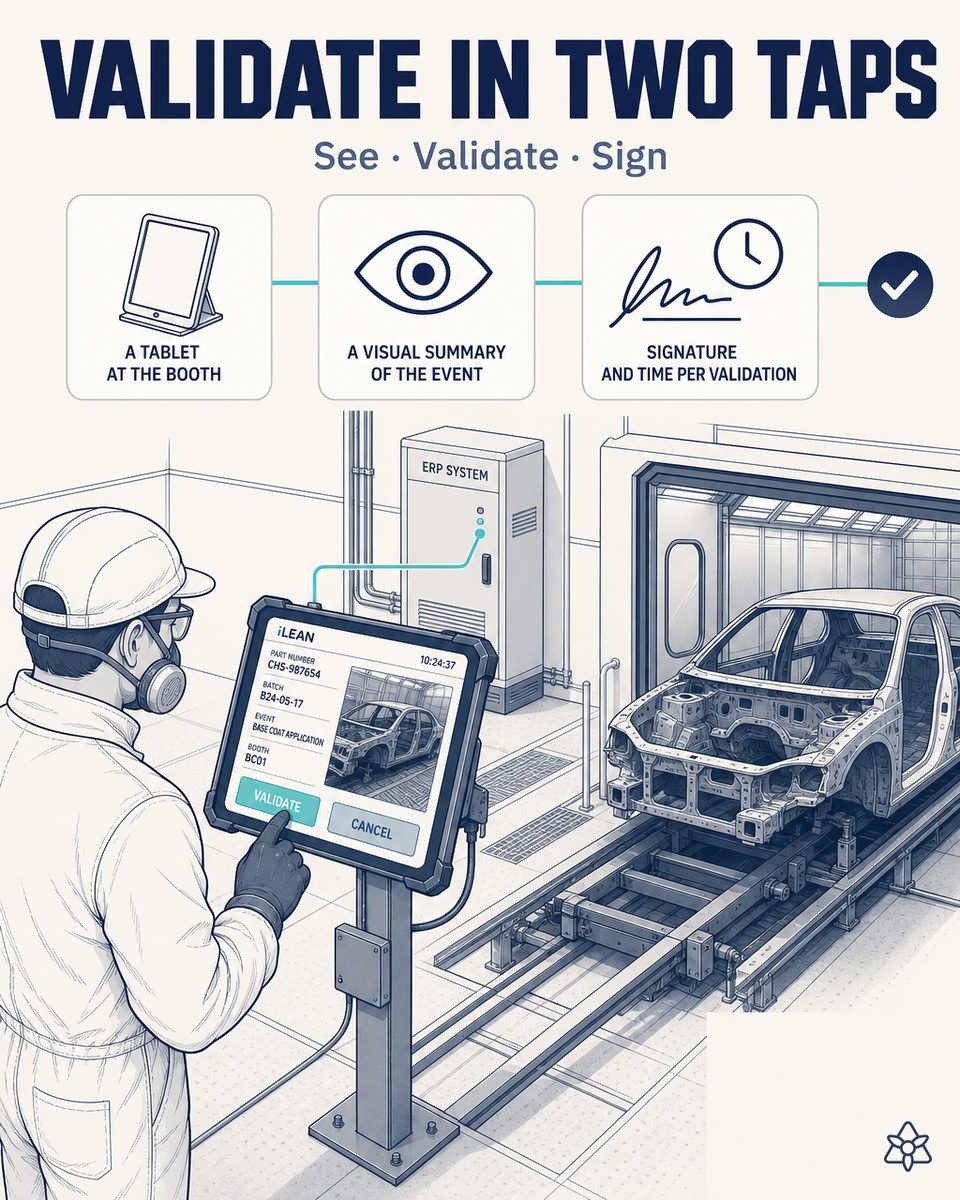
The fear is not the AI — it is it inserting unsigned data and contaminating the corporate master.
In an EMS plant painting metal chassis for OEM customers, the ERP's and CMMS's master sustains what the customer's auditor comes to check: which batch was painted with which reference, what thicknesses the laboratory gave, which specification change was in force at each moment. Any data entering wrong — a misidentified batch, a mistranscribed thickness, a badly recorded finish change — stays written in the history that auditor will review. That is why the cultural brake on digitization here is double:
- The fear of "autonomous" AI inserting unsigned data — the biggest cultural brake in an audited corporate environment. If a system writes into the master on its own and a data point later turns out wrong, the cost is not correcting a field: it is explaining it to the OEM customer's auditor with the history already contaminated. It is the committee's first question: who saw this before it existed in the ERP?
- But the operator does not want to type — and the plant cannot afford extra training or a habit change at the booth. If the alternative to the AI is transcribing by hand into a terminal, the data arrives late, incomplete or not at all — and the auditor sees the gap in the history too.
Full automation does not pass the committee's filter. Typing does not pass the booth's. And one more thing: without an early human gate, the rest of the iLEAN pieces do not get approved in an audited corporate environment — no capture, however good, gets authorization to write into the master. The answer is not choosing an extreme — it is giving the operator a fast, signed gate between the AI and the corporate system.
Connect in early-human-verification mode — the signature before the master, not after.
Everything iLEAN does rests on three safety rings: Connect transports the data as it arrives (photo, voice, parsed email, the laboratory's Excel), Agents decides what action to propose with that data, and the person signs before it crosses into the CMMS or the ERP. That separation is the backbone of the whole iLEAN matrix in chassis paint — and this piece is where the third ring becomes visible and tactile: an industrial tablet at the booth, with a two-tap gesture and a signature on every capture.
An industrial tablet at the booth. A two-second visual summary. Two taps — check to enter the ERP, correct to adjust first — and every validation keeps a timestamp and a signature.
How early human verification operates on a chassis paint line:
- An industrial tablet at the booth — a UI designed for a two-second validation, not data entry. No keyboard and no nested menus: a visual summary and a two-tap decision. No extra training, no habit change.
- A visual summary (reference, batch, event) — whether the data comes from a photo, voice, a parsed email or the laboratory's Excel, Connect normalizes it to the same simple format before showing it to the operator.
- Check to enter the ERP, correct to adjust first — if the capture arrived right, one tap and the data crosses; if something does not add up, the correction is minimal and the original stays archived next to it.
- A timestamp and signature per validation — who signed, when and what they saw are recorded, and that record is available to the OEM customer's auditor without preparing anything special.
- Latency between capture and a clean master: seconds — the signed data reaches the CMMS or the ERP almost as it is generated, not at the shift's close.
- No signature, no master — if the operator does not validate, the data stays held and contaminates nothing. The booth continues; the data waits.
Unvalidated data (or uncaptured out of distrust) vs. data signed in seconds
| Aspect | Unvalidated or uncaptured data | Data signed in seconds |
|---|---|---|
| Capture by photo/voice/email/laboratory Excel | Discarded out of distrust, or entering straight unreviewed | Always passes through a visual summary and two taps before touching the master |
| The operator's recording | Typing into a terminal — extra training and a habit change the booth cannot absorb | Check or correct on the tablet, without typing |
| Erroneous or doubtful data | Contaminates the corporate master (ERP/CMMS) and stays exposed to the OEM auditor | Zero: it is held — it does not cross into the master until someone signs it |
| Data uncaptured out of distrust | Gaps in the paint batch's quality history | All captured and validated in seconds |
| The corporate master's state | Dirty and out of sync with what happened at the booth | Clean and traceable — every data point with a human signature and timestamp |
| Posture before the customer audit | "We do not know what is entering on its own" | Every data point passed through a person before existing — and it can be proven |
Impact estimate for your plant — to be validated with your own numbers.
The block below is an estimate to be validated against your plant's actual data. We put it forward so the committee has an order of magnitude; we refine it during the assessment.
- It is the transversal enabling piece: every Connect, Edge or Agents case on your chassis paint line depends on this ring existing so the data they capture can enter the CMMS or the ERP with a signature, and not through the back door.
- It does not replace work — it replaces doubt. The cost it avoids is not an operator hour: it is the paralysis of "we are not going to let an AI write alone into the corporate master" — the sentence freezing every digitization committee at an audited site.
- It is also the piece that turns the customer audit from a threat into an argument: the record of signatures and timestamps is not prepared for the auditor — it is the system's normal operation, available as is.
- The indicators measurable from the first pilot — as estimates to be validated at each plant: the percentage of captures validated in under five seconds, and the percentage of held data that turned out to be real corrections — the latter measures whether the capture is well calibrated, not whether "the AI fails".
- We do not propose a payback in months here — that would be inventing a number only your plant's assessment can give. What we can state is that, without this piece, the rest of the IRIS roadmap at your EMS plant stays a pilot and does not scale.
And the fair question from the committee
"Why not automate fully, if we already have AI that reads well?" — because reading well is not the same as deciding well, and deciding well is not the same as having authorization to write into the corporate master with nobody reviewing. iLEAN separates the three functions on purpose: Connect transports the data as it arrives, Agents decides what action to propose, and the person signs before it crosses into the master. They are the three safety rings, and this piece is where the third becomes physical: a tablet, a two-second summary, a check or a correction. Hallucination is a problem of free generation, not of anchored tasks — in tasks where the AI limits itself to recontextualizing a data point (reading a batch label, transcribing an incident, parsing an email or the laboratory's Excel), the best models brought the error below 1.5% [1]. And even then, at an audited corporate site the critical does not enter the master unsigned: that is why the tablet exists — and why the last word remains the operator's.
[1] OpenAI paper "Why Language Models Hallucinate", 2025 — on the reliability of AI in anchored tasks.
What people ask about early human verification at the booth
Why not automate fully if the AI already reads the data well?
Because "reading well" is not the same as "having permission to write into the corporate master with nobody reviewing". iLEAN separates Connect (transports the data as it arrives), Agents (interprets and decides what action to propose) and the person (signs with two taps before the data crosses into the CMMS or the ERP) — the system's three safety rings, and none replaces another. Full automation sounds faster, but at an audited corporate site it turns a one-off error into a systemic problem: a misidentified paint batch or a mistranscribed thickness does not stay at the booth — it propagates to the quality history the OEM customer audits, and then correcting it is no longer editing a field, it is reopening traceability in front of the auditor. And there is a practical reason underneath: in a corporate environment, AI that writes alone does not pass the committee. The early human gate is not a brake on digitization — it is the condition for the committee to sign it.
How fast are the "two taps" really — or is it another form in disguise?
Two taps means exactly that: a two-second visual summary — reference, batch, event — and two possible gestures, check for the data to enter the ERP or correct to adjust it first. The UI is designed for a two-second validation, not data entry: no keyboard in the normal flow, no nested menus, no mandatory fields to fill — and that is why it demands no extra training or habit change from the booth operator. If the capture arrived right — the usual case — the operator looks, taps the check and gets on with their batch. Only when something does not add up does correction come in, made on the specific field, not a whole form. And it is measurable from the first pilot: the percentage of validations resolved in under five seconds is one of the startup indicators — as an estimate to be validated at each plant. If the operator takes longer, the defect is in the capture's design, not the operator, and what gets corrected is the capture.
What happens when the operator corrects a data point — is the AI's original lost?
No. When the operator taps correct, the original data Connect captured is archived together with the correction, not overwritten — the CMMS or the ERP receives the validated data and the history keeps both, with who signed, when and what was changed. That matters for two reasons. First, in an EMS plant audited by OEM customers traceability demands being able to prove what happened, not only what was corrected: original, correction, signature and timestamp form a chain that can be shown as is. Second, it allows detecting with evidence whether the capture fails recurringly at one specific point — a rack label with overspray, a laboratory report with a changed format — and adjusting the capture, instead of arguing over impressions. The operator's correction is not a patch: it is the signal that calibrates the system.
Does the same tablet work for all capture origins (photo, voice, email, laboratory Excel)?
Yes — the tablet is not channel-specific: it is the convergence point where the visual summary arrives, whether the data comes from a photo (a chassis batch label, a powder paint delivery note), from voice (the shift leader dictating an incident in the hanging area), from a parsed email (a finish specification change sent by the customer) or from the laboratory's Excel (coat thicknesses, adhesion, the batch's gloss). Connect normalizes each origin to the same simple summary — reference, batch, event — so the operator does not learn a different interface depending on where the data comes from. A single two-tap gesture, whatever the capture channel — and the same timestamped signature for all.
What does the OEM customer's auditor see of these validation signatures?
They see exactly what they need to close the most uncomfortable question in a customer audit: "who saw this data before it existed in your ERP?". Every validation is recorded with a timestamp and the signature of the operator who made it, and that record is available to the auditor: for any data point in the master it can be traced when it was captured, by which channel it arrived, what the visual summary showed, who signed it and — if there was a correction — what the original said. It is not a report prepared for the audit: it is the system's normal operating record, the same one the plant uses daily. That changes the conversation with the auditor — instead of defending that "the AI does not insert data alone", the working human gate is shown: no data point in the history lacks a signature, because without a signature the data does not cross into the master.
More cases from this series
- A customer audit evidence pack — the OEM scorecard in continuous greenEvery change generates a dossier with photos, log and signatures. Agents organizes it by standard (ISO…
- The curing oven now talks — without touching the original SCADAAn external camera reads the tunnel oven’s SCADA panel without touching the machine. A per-batch thermal…
- OEM customer spec change — zero rework from reading lateiLEAN silently copied on the mailbox. When the OEM changes a paint spec, the notice reaches the…
- From the laboratory’s Excel to the ERP at second zeroiLEAN reads the laboratory’s Excel as soon as it is saved, validates and feeds the ERP. Fewer quality…
- Paint receiving into the ERP — no typing, with shielded traceabilityA photo of the delivery note, the CoA and the GS1 labels. One tap and all into the ERP. Truck from 45 to…
- A paint robot without islands — the program from the ERP, real life to the CMMSProgram, shots, consumption and robot alarms travel to the ERP and the CMMS with no typing. Zero program…
Talk to your digitization committee — we will explain how the human signature on the tablet keeps the corporate master always clean.
We work on your plant's real data, not ours. Assessment with no commitment.
See the tablet at the booth ‹ See all 12 chassis paint cases See electronics