A customer audit evidence pack — the OEM scorecard in continuous green
The day the OEM customer's quality engineer arrives to audit the paint line, someone today spends 1-2 weeks reconstructing traceability of changes, measurements, CoAs and cleanings. The auditor asks for proof, the plant shows papers and Excels, and observations appear that penalize volume and price. With iLEAN Edge + Agents, every critical change automatically generates its dossier and Agents organizes it by standard. The auditor downloads the pack without the plant spending time.
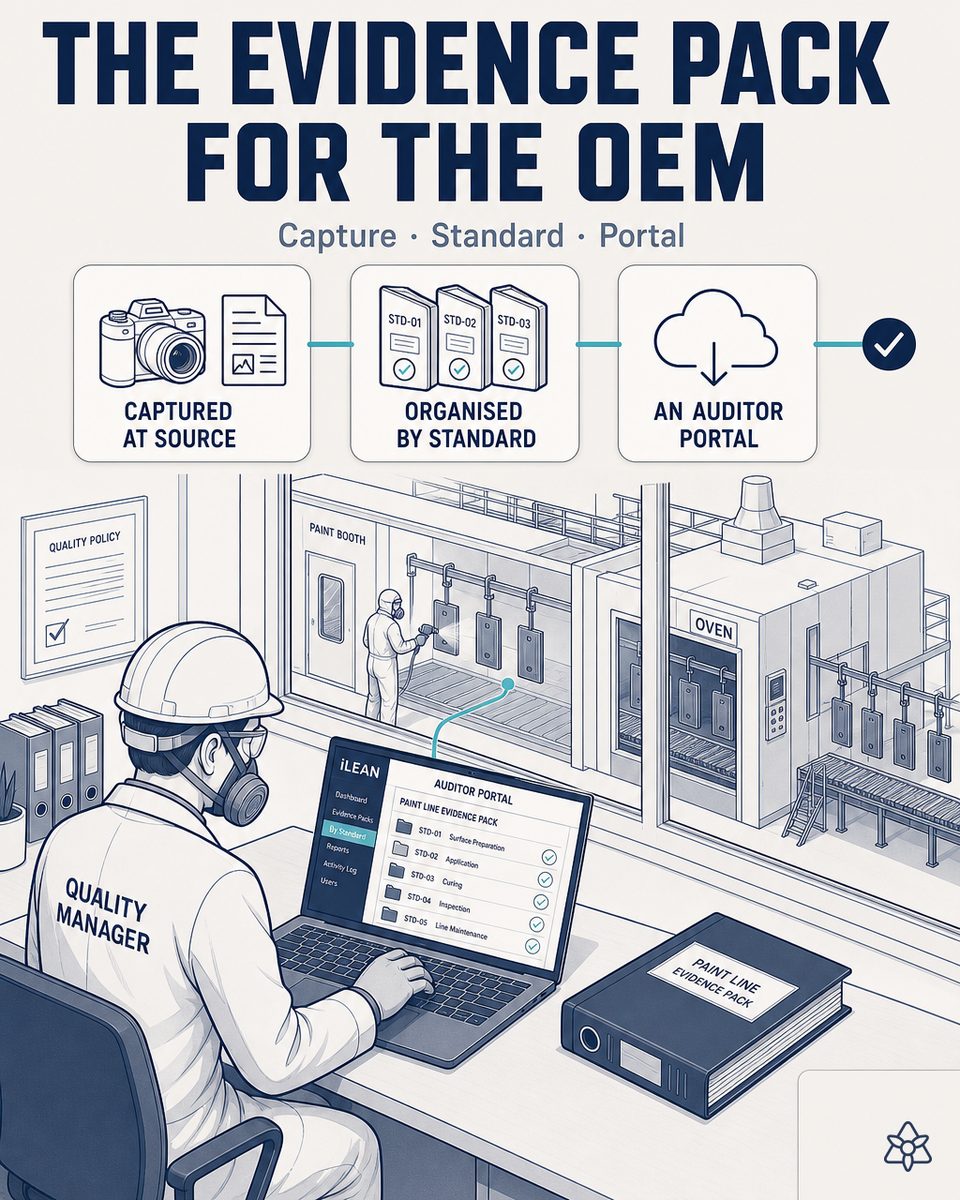
One or two weeks reconstructing traceability is not audit preparation — it is a bet with the scorecard.
An electronics metal chassis paint line is audited against ISO 9001, ISO 14001 — mandatory in practice for VOC handling — and ISO 45001, and above all against OEM customer audits: the customer's quality engineers in the plant, with their own checklist, their supplier codes and their sustainability standards. Every framework demands structured evidence: for each batch startup, color change, drum change and cleaning it must be demonstrable, event by event, what was done, who decided it, who signed it and when. Today that means:
- 1-2 weeks of human work before every audit — the Quality team preparing folders and screenshots: change traceability, measurement records, each drum's CoA and cleaning reports, with the risk that the documentary gaps only surface once the auditor is already in the plant.
- Evidence spread across papers and Excels — the color change in a booth report, the thickness measurement in a spreadsheet, the CoA in a folder and the signature on another sheet: when the auditor points at a specific batch, everything must be cross-referenced by hand hoping the trace adds up.
- A different dossier for every framework and every customer — the same evidence must be reassembled several times a year: for the ISOs, for RoHS and REACH, and with a different structure for each OEM customer's supplier codes and sustainability standards.
The real cost is not only the human work beforehand: it is the scorecard. A customer audit with documentary observations translates into a red or amber scorecard, and that scorecard penalizes volume and price in the next purchase cycle — the path through which an EMS wins or loses an entire platform.
Agents does not generate the evidence from scratch — it organizes what Edge already captured.
This case depends on the critical change being captured at the moment it happens: that is what iLEAN Edge does (pre/post photos of each critical point, a structured decision log, timestamped signatures, cross-referenced with the work order and batch for each batch startup, color change, drum change and cleaning). The Agents piece comes afterwards: it collects that already-captured evidence, organizes it by certifying standard and generates the dossier by period or by batch. Zero post-hoc human work. Without Edge capturing in the booth there is nothing to organize — Agents does not invent what was not captured.
Every startup, color change, drum change and cleaning triggers the capture. Agents organizes by standard. The auditor logs into the web and downloads the pack.
How Agents operates on the evidence already captured on a chassis paint line:
- Capture at the source (Edge) — every critical change automatically triggers its dossier: pre/post photos of each critical point, a structured decision log, signatures with user and timestamp, all cross-referenced with the work order and batch. Agents does not generate this; it collects what Edge already captured in the moment.
- Organization by standard — Agents maintains a dossier template for every framework applying to the plant: ISO 9001, ISO 14001, ISO 45001, RoHS, REACH, each OEM customer's supplier codes and sustainability standards, and IATF 16949 if the plant also serves automotive. The same body of evidence is presented correctly for each one, by period or by batch, without capturing anything twice.
- The auditor's portal — the auditor enters with a read-only access the plant grants, picks period and standard, and downloads the pre-assembled pack. The OEM customer's quality engineer sees only the batches and references belonging to them. Nobody in Quality prepares folders or screenshots.
A reconstruction sprint vs. a dossier already organized by standard
| Aspect | Manual reconstruction | With iLEAN Edge + Agents |
|---|---|---|
| Pre-audit human work | 1-2 weeks of the Quality team per audit | Zero — the pack already exists |
| Observations for documentation | Recurring in every customer audit | Eliminated — gaps visible before the audit, not during it |
| The OEM customer's scorecard | Intermittent — red or amber after every audit with observations | Continuous green — no volume or price penalty |
| Traceability of changes, CoAs and cleanings | Spread across papers, Excels and loose photos | A single piece of evidence per event, crossed with order and batch |
| Organization by standard | A separate dossier built from scratch per framework and customer | Agents presents the same data for ISO, RoHS, REACH and each OEM's codes |
| Delivery to the auditor | Folders and screenshots prepared by hand during the visit | A per-period download from the web with auditor access |
Impact estimate for your plant — to be validated with your own numbers.
The block below is an estimate to be validated against your plant's actual data. We put it forward so the committee has an order of magnitude; we refine it during the assessment.
- EMS plant with a metal chassis paint line, certified ISO 9001, ISO 14001 and ISO 45001, subject to RoHS and REACH, and audited several times a year between certification and OEM customer audits.
- Edge + Agents pilot on one line's critical changes — batch startup, color change, drum change, cleaning. First complete evidence pack expected within a few weeks of deployment.
- Estimated payback between 6 and 12 months, depending on audit frequency and the OEM scorecard's weight in the customer mix. Estimate to be validated.
- The hard lever is the continuously green scorecard: its real value is protecting the volume and price of the OEM customer's next purchase cycle. Estimate to be validated with your data.
And the fair question from the Quality manager
"What if the pack looks complete but something is missing?" — Agents' work is an anchored task, not free generation: it organizes real evidence captured by Edge by period, batch and standard, it does not fill gaps with invented content. In anchored tasks, the best models brought the error below 1.5% [1]. And if an event is missing, the pack shows it as a gap, it does not camouflage it — the Quality person reviews the dossier before handing the credential to the auditor.
[1] OpenAI paper "Why Language Models Hallucinate", 2025 — on the reliability of AI in anchored tasks.
What people ask about the customer audit evidence pack in chassis paint
What happens if a color change or a cleaning was not captured at the time?
If a critical event was not captured by Edge when it happened (a tablet offline, a change made outside the instrumented point, a photo not taken), the pack for that period explicitly shows the gap — it neither fills it nor hides it. iLEAN Agents does not generate evidence: it organizes what Edge already captured and flags, just as clearly, where something is missing. Before the OEM customer's quality engineer, a visible gap explained by Quality before the visit is manageable; a dossier that looks complete without being so is exactly what turns a minor observation into a scorecard problem.
How does it organize the same evidence for several standards and OEM codes at once?
The base evidence is the same — pre/post photos, a decision log, timestamped signatures and the cross-reference with work order and batch for every startup, color change, drum change or cleaning — but each framework asks for the dossier with a different structure and emphasis. Agents maintains an output template per standard: ISO 9001, ISO 14001, ISO 45001, RoHS, REACH, each OEM customer's supplier codes and sustainability standards, and IATF 16949 if the plant also serves automotive. The same body of evidence is reorganized according to the template the user picks in the portal, by period or by batch. Nothing has to be captured twice and no parallel dossiers per certifier or customer have to be maintained.
Who gets access to the auditor's portal?
Access is granted by the plant, not iLEAN. For a certification audit, Quality generates a temporary credential — scoped to that specific audit's period and standard — and the auditor logs in, picks period and standard, and downloads the evidence pack. For an OEM customer's audit, its quality engineer's credential is additionally scoped to the batches and references belonging to them: they see and download their chassis' evidence, nothing more — never another plant customer's. In all cases access is read-only, nobody can modify records, and every download is itself logged in the audit trail.
How much is really saved versus manual reconstruction?
Today preparing a customer audit consumes 1-2 weeks of human work reconstructing traceability of changes, measurements, CoAs and cleanings — and documentary observations still appear. With Edge + Agents that prior work drops to zero, because the pack already exists when the auditor gives notice; the direct saving is that time multiplied by the number of audits per year. The bigger lever, however, is the scorecard: going from recurring observations to a continuously green scorecard protects volume and price in the next purchase cycle. Both figures are an estimate to be validated with your plant's data.
Can it generate packs for periods before the deployment?
No. Agents only organizes evidence that exists. For periods before the Edge deployment there is no per-event photo or structured log to organize, so the pack cannot be generated retroactively — for that history, the plant keeps relying on the papers and Excels it already had on file. What changes from day one is that every batch startup, color change, drum change and cleaning going forward is captured with signature and timestamp, so each future audit covers an ever-larger window of already-secured period.
More cases from this series
- Early human verification — two taps and the ERP stays cleanNothing iLEAN captures enters the ERP without a human signature on the tablet. Two taps, seconds, the…
- The curing oven now talks — without touching the original SCADAAn external camera reads the tunnel oven’s SCADA panel without touching the machine. A per-batch thermal…
- OEM customer spec change — zero rework from reading lateiLEAN silently copied on the mailbox. When the OEM changes a paint spec, the notice reaches the…
- From the laboratory’s Excel to the ERP at second zeroiLEAN reads the laboratory’s Excel as soon as it is saved, validates and feeds the ERP. Fewer quality…
- Paint receiving into the ERP — no typing, with shielded traceabilityA photo of the delivery note, the CoA and the GS1 labels. One tap and all into the ERP. Truck from 45 to…
- A paint robot without islands — the program from the ERP, real life to the CMMSProgram, shots, consumption and robot alarms travel to the ERP and the CMMS with no typing. Zero program…
The auditor downloads the pack without the plant spending time — talk to iLEAN about your next audit cycle and we will send within 48h the estimated ROI for your plant.
We work on your plant's real data, not ours. Assessment with no commitment.
Request estimated ROI within 48h ‹ See all 12 chassis paint cases See electronics