Paint receiving into the ERP — no typing, with shielded traceability
The paint truck arrives with drums, an A3 delivery note and a certificate of analysis. The receiving manager either types 15 lines into the ERP — truck standing 45-60 minutes charging demurrage — or goes fast and enters wrong batches that surface three weeks later in a nonconformity. With iLEAN Connect they photograph the delivery note, the CoA and the drums' labels; iLEAN extracts everything and, with one validation tap, feeds it into the ERP. Truck down to 5-10 minutes and RoHS/REACH traceability shielded.
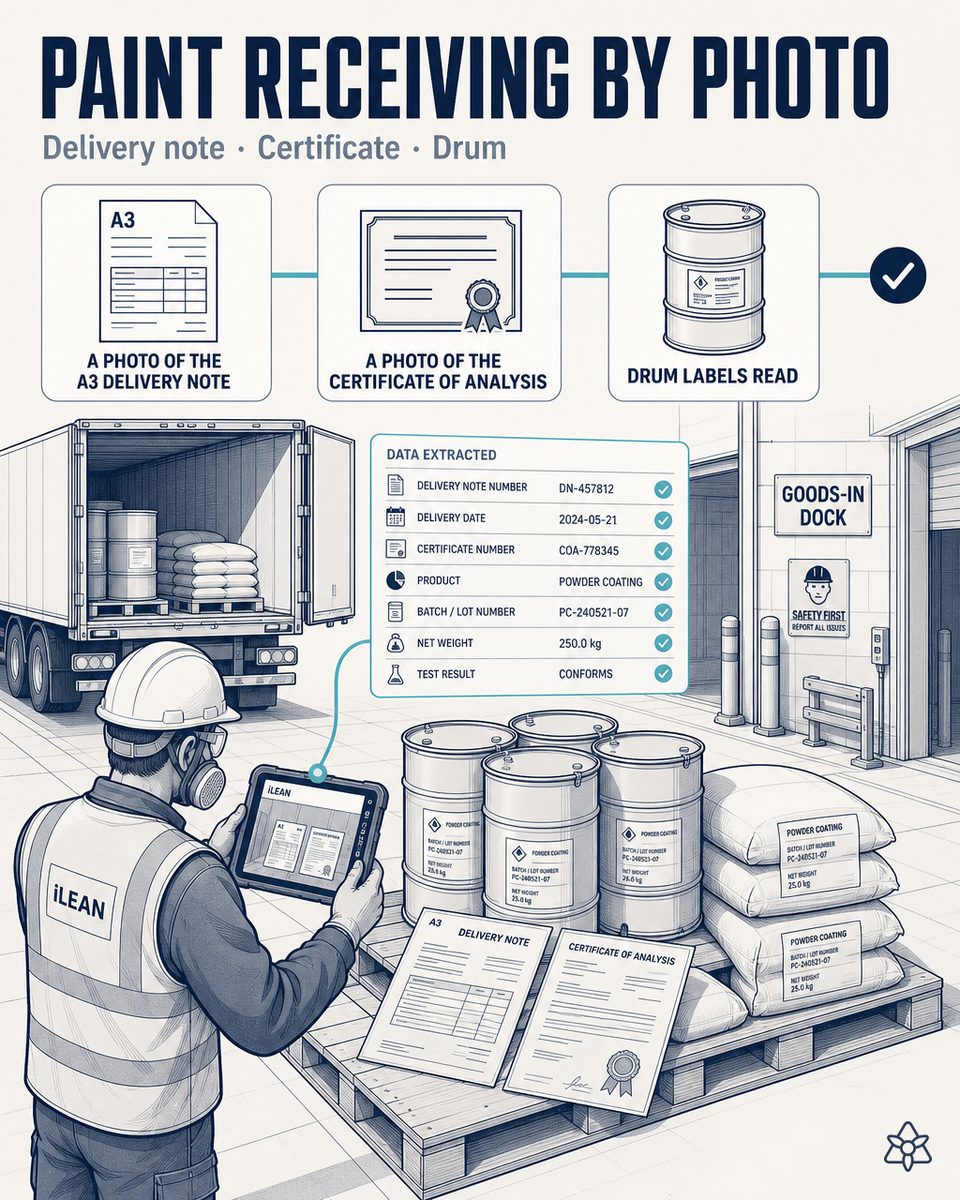
Paint receiving is where the truck gets blocked — and where the nonconformity that surfaces three weeks later is born.
In an EMS plant painting metal chassis, every drum truck arrives with its documentation, and today all that inbound passes through the receiving manager's typing:
- An A3 delivery note with 10-15 lines — references, batches, quantities and expiries typed line by line into the MM module while the truck waits 40-60 minutes charging demurrage at the dock.
- A certificate of analysis per batch — viscosity, density, solids percentage, absence of heavy metals and expiry checked by hand against the specification, with the carrier waiting for the entry to leave.
- Each drum's labels — noted in a hurry to release the truck as soon as possible, exactly when mistaking a batch is easiest.
And if the receiving manager types fast, misrecorded batches enter. A wrong batch is not seen at the dock or in the paint booth: it surfaces three weeks later in a nonconformity and in the OEM's claim. Without complete paint-batch ↔ chassis-batch traceability, the RoHS/REACH audit becomes a reconstruction exercise — hunting months-old papers to accredit the composition of every consumed batch.
Connect in photo-the-analog mode — delivery note, certificate of analysis and labels into the ERP with paint-batch ↔ chassis-batch traceability, no typing.
Paint receiving needs no new dock station and no suppliers changing their documentation. The delivery note already arriving in the truck's cab, the CoA already accompanying each batch and the labels already on the drums need to enter the ERP at second zero, with the right batch. That is what Connect in photo-the-analog mode is for.
The receiving manager photographs the delivery note, the certificate of analysis and the drums' labels with the industrial tablet. AI vision extracts references, batches, quantities and CoA parameters, cross-checks them against each other and against the purchase order, and after one validation tap everything is fed into the ERP's MM module — the truck has not waited for the typing.
How Connect photo operates at an EMS plant's receiving:
- A photo of the A3 delivery note — AI vision recognizes each supplier's delivery note format, without asking them to change theirs and with no predefined templates, and extracts the 10-15-line tabular structure in seconds.
- A photo of the certificate of analysis — OCR + LLM over the scanned PDF or the paper: viscosity, density, solids, absence of heavy metals and expiry extracted and crossed against the specification without typing a figure.
- Drum label reading — Connect recognizes GS1-128, QR and barcode, and does plain OCR when the label carries no code, with the tablet's camera, no dedicated scanner.
- One-tap validation — the receiving manager reviews what was extracted on the industrial tablet; if a batch does not match the delivery note or a CoA parameter does not reach the reliability threshold, Connect flags it before the tap. The person decides, not the system.
- A feed into the MM module via API — after validation, the entry is recorded in the ERP with batch-to-batch traceability from minute zero: each drum, with its photographed delivery note and CoA, linked to its paint batch and ready to tie to the chassis batch that consumes it.
Paint receiving with manual typing vs. receiving digitized with Connect
| Aspect | Receiving with manual typing | Receiving digitized with Connect |
|---|---|---|
| Truck time at the dock | 40-60 min, charging demurrage | 5-10 min — a photo and one-tap validation |
| Recording the A3 delivery note | 10-15 lines typed one by one into the MM module | A photo of the note — automatic extraction of the tabular structure |
| The certificate of analysis | Checked by hand against the spec and archived on paper | OCR + LLM, automatic cross-check against the spec and a link to the batch |
| Batch errors | Hidden — surface three weeks later in a nonconformity | Zero — flagged and corrected at the dock |
| Paint-batch ↔ chassis-batch RoHS/REACH traceability | Reconstructed on paper when the audit arrives | Complete by photo and GS1 from receiving |
| MM/receiving module licenses | 2-3 users with an active license | 1 validator — typical reduction of 50-70% |
Impact estimate for your plant — to be validated with your own numbers.
The block below is an estimate to be validated against your plant's actual data. We put it forward so the committee has an order of magnitude; we refine it during the assessment.
- EMS plant with a metal chassis paint line receiving drums from several suppliers: an unloading dock, a 10-15-line A3 delivery note per truck, a certificate of analysis per batch and GS1 labels on each drum.
- Connect photo pilot on receiving — only the dock's industrial tablet, with no construction work or new supplier integration. It starts after the first kick-off meeting.
- The ERP's MM/receiving module today demands 2-3 users with active licenses to type the entries. With Connect, only 1 validator remains: a typical reduction of 50-70% in the module's licenses. Estimate to be validated.
- Indicative payback between 3 and 8 months, plus a recurring ERP license saving and the elimination of carrier demurrage at the dock. Estimate to be validated with your data.
- To the CFO's hard lever — fewer MM/receiving module licenses, a recurring annual saving defensible in committee, and fewer truck hours charging demurrage — add the avoidance of the misrecorded-batch nonconformity's costs and of the paper-reconstructed RoHS/REACH audit, measurable from the pilot's first month. Estimate to be validated.
And the fair question from the plant manager
"What if the system misreads a batch or links a certificate to the wrong drum?" — hallucination is a problem of free generation, not of anchored tasks. In tasks where the AI limits itself to recontextualizing a specific data point from one medium to another (reading the printed delivery note, the certificate of analysis and the drums' labels and extracting their fields), the best models brought the error below 1.5% [1]. And even then, nothing critical is decided alone: if a batch does not match the delivery note or a CoA parameter does not reach the reliability threshold, Connect holds the entry and the person validates with one tap on the tablet. The three safety rings are there precisely for this.
[1] OpenAI paper "Why Language Models Hallucinate", 2025 — on the reliability of AI in anchored tasks.
What people ask about paint receiving at an EMS plant
Does Connect recognize the delivery note even if every paint supplier uses a different format?
Yes, with no predefined templates and without asking the supplier to change its format. AI vision recognizes each delivery note's layout — a coatings manufacturer's 10-15-line A3, each distributor's own document, the note arriving stapled to the certificate of analysis — and extracts the tabular structure with references, batches, quantities and expiries the same way in every case. When a new supplier enters the panel, Connect learns its format with the first receivings and the receiving manager's flow does not change: a photo of the note, a photo of the CoA and the drums' labels, and one validation tap on the tablet.
How is the certificate of analysis validated against the specification?
The CoA usually arrives as a scanned PDF or paper, one document per batch. Connect digitizes it combining OCR and LLM, extracts the parameters — viscosity, density, solids percentage, absence of heavy metals, expiry date — and crosses them against the purchase specification registered in the ERP. If a parameter falls out of range or a data point does not reach the reliability threshold, Connect holds the entry and flags it on the tablet before the validation tap: the doubtful batch is blocked at the dock, it does not surface three weeks later in a nonconformity. The person decides, not the system.
How does Connect close RoHS/REACH traceability between paint batch and chassis batch?
Each drum enters the ERP with its batch read from the GS1-128, QR or barcode label and linked via API to the photographed delivery note and certificate of analysis. When that paint batch is consumed on a work order, the ERP already has the paint-batch ↔ chassis-batch chain assembled from receiving: facing a RoHS/REACH audit or an OEM's claim, the certificate accrediting each batch's composition is retrieved in seconds from the entry, instead of being reconstructed by hunting months-old papers. Traceability stops being a documentary reconstruction exercise and is closed from minute zero.
What changes for the carrier at the receiving dock?
Nothing in how they work: they deliver the drums, the delivery note and the certificate of analysis, and wait for the receiving to be recorded before leaving. What changes is how long that wait lasts and how much it costs. Instead of 40-60 minutes with the demurrage clock running while the receiving manager types 10-15 lines into the MM module and checks the CoA by hand, they wait for the note and the certificate to be photographed, the drums' GS1 labels read and one tap of validation on the tablet: about 5-10 minutes. The carrier installs nothing, needs no app and does not change how they hand over the documentation.
How is the 50-70% saving in MM/receiving module licenses calculated?
Today paint receiving usually demands 2-3 users with active licenses of the ERP's MM/receiving module to type delivery notes, certificates and labels. With Connect, the capture is done by the photo and only 1 validator with a license remains: from 2-3 users to 1, a typical reduction of 50-70% in the module's licenses. The calculation is made with your plant's real per-user-per-year ERP contract rate — from there comes a recurring annual saving defensible in committee, to which add the demurrage-free truck hours and the avoided costs of the misrecorded-batch nonconformity. An estimate to be validated with your numbers at the assessment.
More cases from this series
- A customer audit evidence pack — the OEM scorecard in continuous greenEvery change generates a dossier with photos, log and signatures. Agents organizes it by standard (ISO…
- Early human verification — two taps and the ERP stays cleanNothing iLEAN captures enters the ERP without a human signature on the tablet. Two taps, seconds, the…
- The curing oven now talks — without touching the original SCADAAn external camera reads the tunnel oven’s SCADA panel without touching the machine. A per-batch thermal…
- OEM customer spec change — zero rework from reading lateiLEAN silently copied on the mailbox. When the OEM changes a paint spec, the notice reaches the…
- From the laboratory’s Excel to the ERP at second zeroiLEAN reads the laboratory’s Excel as soon as it is saved, validates and feeds the ERP. Fewer quality…
- A paint robot without islands — the program from the ERP, real life to the CMMSProgram, shots, consumption and robot alarms travel to the ERP and the CMMS with no typing. Zero program…
A Connect pilot at your receiving dock — it starts after the first kick-off meeting.
We work on your plant's real data, not ours. Assessment with no commitment.
Request estimated ROI within 48h ‹ See all 12 chassis paint cases See electronics