From the laboratory’s Excel to the ERP at second zero
In an EMS plant painting metal chassis, the quality technician fills in an Excel every shift with the batch's measurements — thickness, adhesion, gloss, color, hardness. That Excel lives in a shared folder the corporate ERP does not see: the lag between the real data and the ERP data is 15 to 30 days. iLEAN Connect absorbs the Excel as soon as it is saved, the manager validates it on screen and it is fed into the ERP via API. A direct CFO lever: −50 to −80% of quality module licenses.
Two parallel worlds: the laboratory's real Excel and the corporate ERP.
In an EMS plant painting metal chassis, the quality laboratory keeps its own Excel: coat thickness, adhesion, gloss, color and hardness, batch by batch, measured with an Elcometer, a gloss meter and a spectrophotometer. It is the living data quality actually works with, updated every shift in the shared folder. The corporate ERP, meanwhile, receives those same results transcribed by hand by a person copying from the Excel into the system — with a lag of 15 to 30 days, and with the errors inherent to typing hundreds of cells.
- Two parallel worlds — the laboratory's Excel, where the measured data lives, and the corporate ERP, where someone pecks in data 15-30 days behind. The system the corporation considers "the truth" runs a month behind the paint line's reality.
- Transcription with errors — the person moving the data to the ERP is not only late: copying per-point thicknesses and ΔE values by hand, they make errors the official system accepts as good. The ERP's data is not only old — sometimes it is not what was measured either.
- An OEM auditor with observations — when the customer's audit crosses measurements with batches and the dates do not add up, the lag generates observations. The usual defense — "it is in the Excel, it had not been transferred yet" — is exactly what the auditor does not want to hear.
- Licenses growing with the typing — the ERP quality module's cost (SAP QM style) grows linearly with the number of people entering data. Each transcriber needs their license — not to manage quality, but to be able to type what the instrument had already measured.
The cost is not only audits or old data: it is licenses. For that transcription to be possible, several people need access to the ERP's quality module — not because they manage quality in the system, but because it is the only way to enter their own measurement data.
Connect listens inward: it watches the folder, not the human.
The laboratory's Excel does not need to disappear or change format. The data that already exists in that sheet needs to reach the corporate ERP without anyone typing it again, and without the official data running a month behind the painted batch. That is what Connect is for.
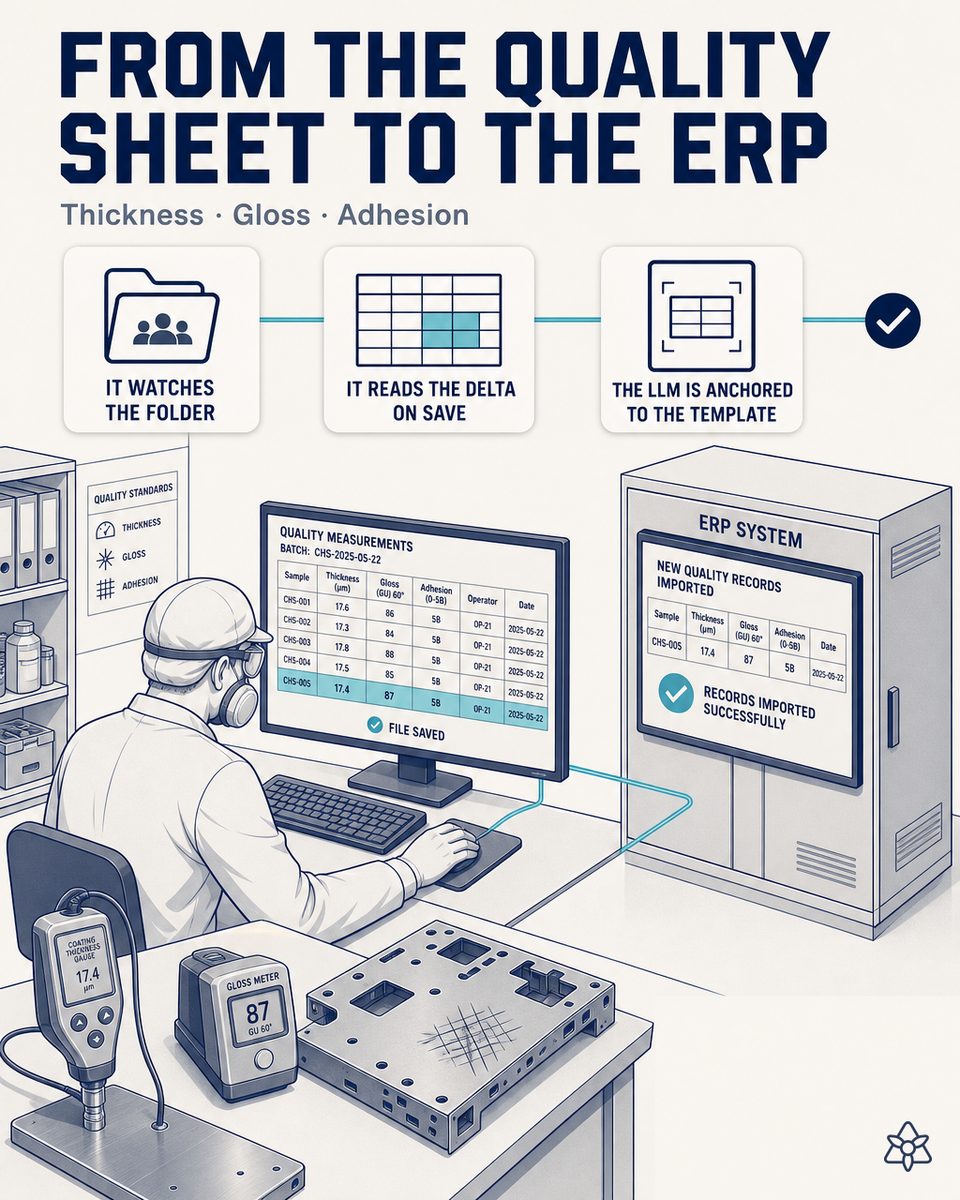
Connect watches the shared folder where quality saves its Excel — it does not watch the technician filling it. When the file is saved, it reads the delta, presents it to the quality manager on their screen and, after their validation, feeds it into the ERP via API. The paint data enters the official system at second zero.
How Connect operates on the quality Excel of an EMS chassis paint plant:
- Connect watches the folder, not the human — it points at the network location where quality saves each batch's Excel. It does not intervene while it is being filled, it times nobody: it only detects when the file has been saved.
- It reads the delta on save — as soon as the Excel is saved, Connect identifies which rows are new since the last feed and extracts them, without reprocessing the entire history each time.
- An LLM anchored to the real template — the model generates no free data: it parses exactly what is in each cell — thickness per point, cross-hatch adhesion, 60° gloss, ΔE color, pencil hardness, impact resistance — against the laboratory's real template, its own columns and usual order included.
- A delta summary to the quality manager — before anything reaches the ERP, the manager sees on their screen a summary of what was read: they confirm or correct. The data does not enter alone.
- Validation and an API feed — once validated, Connect writes the result directly into the corporate ERP, with automatic batch-to-batch traceability: who validated what and when. The Excel-ERP lag goes from 15-30 days to second zero.
Disconnected Excel and ERP vs. Excel and ERP with Connect in between
| Aspect | Disconnected Excel and ERP | With Connect in between |
|---|---|---|
| Excel-ERP lag | 15-30 days per batch | Second zero, on saving the file |
| People transcribing into the ERP | 4 | 0 — the manager validates, does not transcribe |
| Quality/QM module licenses | 4 users who only enter data | 1 license — typical reduction of 50-80% (estimate to be validated) |
| Transcription errors | Miscopied cells the ERP accepts as good | A reading of the original, validated on screen before the feed |
| The OEM auditor crosses measurements and batches | A lag generating observations | An automatic batch-by-batch cross-reference, queryable on the spot |
| Batch-quality-ERP traceability | Manual reconstruction when requested | Recorded on every feed, automatic |
Impact estimate for your plant — to be validated with your own numbers.
The block below is an estimate to be validated against your plant's actual data. We put it forward so the committee has an order of magnitude; we refine it during the assessment.
- EMS plant with a metal chassis paint line, quality measurements in Excel (thickness, adhesion, gloss, color, hardness) and a corporate ERP with the quality module billed per active user.
- If today 4 people access the quality module only to transcribe measurements, those are expensive licenses paying only for typing. With Connect the license of whoever validates — the quality manager — is enough: from 4 licenses to 1.
- Typical reduction of 50-80% in the ERP quality module's licenses — not a one-off project saving, but a recurring annual saving that disappears from the corporate invoice. Estimate to be validated against the ERP's real invoice: ask us for the study with the last year's invoice and we will calibrate the real number.
- Estimated payback between 4 and 9 months, counting Connect's setup on the laboratory folder and the anchoring to the real measurement template. Estimate to be validated with your numbers.
- A side lever: with the paint data alive batch by batch in the ERP from second zero, the measurements-batches cross-reference the OEM auditor asks for stops being a manual reconstruction and becomes a query. That offloaded quality work is not included in the license calculation.
And the fair question from the finance manager
"What if the LLM misreads an Excel cell and a wrong coat thickness reaches the ERP?" — hallucination is a problem of free generation, not of anchored tasks. In tasks where the AI limits itself to recontextualizing a specific data point from one medium to another (reading an Excel cell and moving it to the ERP's corresponding field), the best models brought the error below 1.5% [1]. And even then, nothing critical is decided alone: Connect holds the feed until the quality manager validates on screen. The three safety rings are there precisely for this.
[1] OpenAI paper "Why Language Models Hallucinate", 2025 — on the reliability of AI in anchored tasks.
What people ask about moving the paint quality Excel to the ERP with Connect
How does Connect watch the quality folder without changing the technician's work?
Connect watches the shared folder where the quality technician already saves the batch's Excel — it does not watch the technician filling it. When the file is saved on closing the shift's measurements (thickness per point, cross-hatch adhesion, 60° gloss, ΔE color, pencil hardness, impact resistance), Connect detects the delta — only the rows new since the last feed — and reads it with an LLM anchored to the laboratory's real template. The technician keeps working with the same Excel as always, the same tabs and the same per-batch habit; there is no new form to learn and no screen to install next to the Elcometer or the spectrophotometer.
What happens if quality changes the measurement Excel's template?
If the laboratory adds a column, renames a test or reorders the tabs by chassis reference, Connect does not break silently: the template-anchored LLM detects the variation and, if the change is ambiguous, flags it for the quality manager's review instead of feeding a misinterpreted value into the ERP. A template adjustment requires no new integration or IT ticket — the reading is reconfigured, not the system's plumbing. And for quality, the change is recorded: which template was active on each feed and from which batch it applies — traceability the OEM's auditor can cross-check.
How is the quality module's real license saving calculated?
The logic is one of license consumption, not hours: the corporate ERP's quality module is billed per active user, and if today 4 people access it only to transcribe paint measurements, those are expensive licenses adding no quality management — only typing. With Connect it is enough for a single person — the quality manager validating before the feed — to keep the license: from 4 licenses to 1, a typical reduction of 50-80%. It is a recurring annual saving defensible before the CFO, with an estimated 4-9-month payback — and an estimate to be validated: ask us for the study with the last year's ERP invoice and we will calculate it on your real number.
What validation exists before the data enters the ERP?
No measurement reaches the ERP without first passing through the quality manager's screen: they see a summary of the delta Connect read from the Excel — batch, chassis reference, per-point thicknesses, adhesion, gloss, ΔE, hardness — compare it with the original data and confirm before the API feed fires. Connect does not write into the ERP on its own — it prepares the data and leaves it ready to validate, and the person validates. Each feed is traced per batch: what was read, who validated it and when — exactly the Excel-ERP cross-reference the OEM's auditor asks for and does not find today.
Does it work with any corporate ERP?
Yes. Connect feeds the validated data via API, so it does not depend on a specific ERP brand or quality module: it works the same with a corporate ERP's QM module, a departmental quality system or a custom build, as long as it exposes an endpoint to write the batch's result to. It does not replace your ERP or migrate data — it automates the stretch a person does by hand today: reading the laboratory's Excel and typing it into the official system, with 15-30 days between the real data and the data the corporation sees.
More cases from this series
- A customer audit evidence pack — the OEM scorecard in continuous greenEvery change generates a dossier with photos, log and signatures. Agents organizes it by standard (ISO…
- Early human verification — two taps and the ERP stays cleanNothing iLEAN captures enters the ERP without a human signature on the tablet. Two taps, seconds, the…
- The curing oven now talks — without touching the original SCADAAn external camera reads the tunnel oven’s SCADA panel without touching the machine. A per-batch thermal…
- OEM customer spec change — zero rework from reading lateiLEAN silently copied on the mailbox. When the OEM changes a paint spec, the notice reaches the…
- Paint receiving into the ERP — no typing, with shielded traceabilityA photo of the delivery note, the CoA and the GS1 labels. One tap and all into the ERP. Truck from 45 to…
- A paint robot without islands — the program from the ERP, real life to the CMMSProgram, shots, consumption and robot alarms travel to the ERP and the CMMS with no typing. Zero program…
Bring your QM module's license bill down — ask us for the study.
We work on your plant's real data, not ours. Assessment with no commitment.
Ask us for the license study ‹ See all 12 chassis paint cases See electronics