The curing oven now talks — without touching the original SCADA
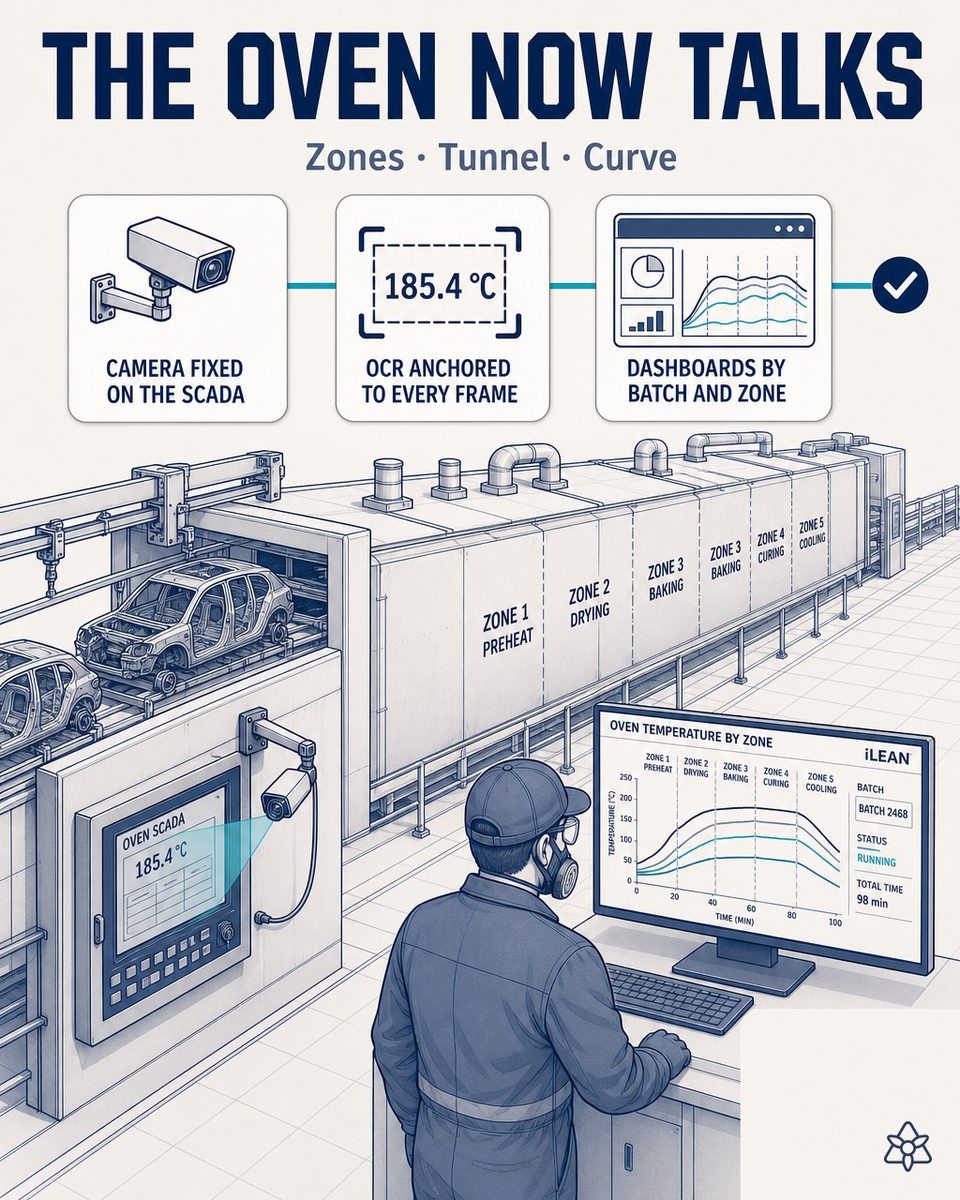
A chassis paint line's tunnel curing oven is the section's most expensive asset (CAPEX >US$1M) and its thermal bottleneck. Its proprietary SCADA panel, network-isolated and 10-20 years old, shows the gold information — per-zone thermal curve, speed, consumption, alarms — and lets it die every time the screen rotates. With iLEAN Connect an external camera aimed at the panel is enough for the curve to be digitized in central memory, batch by batch, without touching the original SCADA.
The paint section's most expensive asset is also the plant's most cut-off.
The curing oven is critical: it fixes the coating quality of every chassis that is later assembled and shipped to the OEM. Its replacement costs over a million dollars and weeks of stoppage — unaffordable in a Customer-to-Order flow where every order has a committed date. And its SCADA panel shows in real time everything needed to explain each batch, but that data lives and dies on the screen's glass.
- A proprietary SCADA network-isolated by design — per-zone thermal curve, chain speed, consumption and alarms show on screen and vanish with every rotation. When the batch leaves the tunnel, its thermal profile no longer exists anywhere.
- Replacing the oven is not realistic in the short term — it means a CAPEX above US$1M and weeks of section stoppage. While the oven keeps curing within parameters, that investment does not get signed.
- A direct consequence on quality — the panel shows everything needed to correlate thermal curve ↔ curing defect ↔ OEM claim; today nobody correlates because the data does not persist off the panel.
Curing defects — over-cure, under-cure, thermal gradient — are detected on the final chassis, or worse, at the customer, with no way to link them to the thermal profile of the moment. Investigating an OEM claim on an already-shipped lot becomes manual archaeology with a high risk of never reconstructing the root cause.
Connect in photo mode on the panel — the camera reads the curve, the oven stays itself.
The curing oven needs no new PLC, no communications gateway its manufacturer no longer supports, and no intervention on its original electronics. It needs the curve that already shows on the screen — temperature per zone, chain speed, consumption, alarms — to be recorded per batch without depending on someone noting it by hand. That is what Connect in photo-on-panel mode is for.
A fixed industrial camera watches the oven's panel without touching the original SCADA's network, mounted and calibration-verified. Connect reads the screen by OCR with an anchored LLM, structures each batch's time curve and cross-references it with the active work order: which chassis was in the oven each minute is known. The SCADA stays as it is, but now the plant sees the curve.
How Connect operates on the curing oven's panel:
- A fixed industrial camera on an external mount — installed with a mount and calibration aimed at the panel from outside, without touching the oven's network or wiring. It captures the screen frame by frame throughout the cycle, from the batch entering the tunnel to its exit. Zero risk to the SCADA and zero need for the oven manufacturer's approval.
- OCR with an anchored LLM interprets each frame — each capture is read by OCR specialized in industrial panels, anchored to that specific SCADA's layout, to extract temperature per zone, chain speed, consumption and alarms without interpretation errors.
- It structures the per-batch time curve and crosses it with the active work order — each reading is ordered into a per-batch time series and automatically associated with the CTO flow's work order that was in the oven that minute.
- Dashboards per batch and per tunnel zone — the paint manager and the quality manager see each batch's curve and the thermal drift per zone, so the oven's replacement is deferred indefinitely without going blind to the data.
A cut-off curing oven vs. an oven with Connect on the panel
| Aspect | Cut-off oven | With Connect on the panel |
|---|---|---|
| The batch's thermal curve (per-zone temperature, speed, consumption, alarms) | Only visible on screen, dies with every rotation | Camera-captured and structured as a per-batch time curve in central memory |
| Curve ↔ curing defect correlation (over-cure, under-cure, gradient) | Nonexistent — the data does not persist off the panel | Root cause analysis per batch in minutes, crossed with the active work order |
| Scrap from incorrect curing | Detected on the final chassis or in the OEM's claim | Detected in the curve itself before assembly |
| Batch ↔ CTO work order link | Manual reconstruction from shift notes | Automatic cross-reference — which chassis was in the oven each minute is known |
| Intervention on the oven's original SCADA | Any connection demands touching the proprietary electronics and asking the manufacturer's approval | None — external camera, without touching network, wiring or control logic |
| Oven replacement (>US$1M, weeks of stoppage) | Forced by the lack of data, on the committee's table | Deferrable indefinitely without going blind to the data |
Impact estimate for your plant — to be validated with your own numbers.
The block below is an estimate to be validated against your plant's actual data. We put it forward so the committee has an order of magnitude; we refine it during the assessment.
- EMS plant with a metal chassis paint line in a Customer-to-Order flow and a tunnel curing oven with a ten-or-twenty-year-old proprietary SCADA panel, network-isolated by the manufacturer's design.
- Connect pilot in photo mode on the oven's panel — only an external camera with a mount and calibration, without touching the original SCADA or the oven's electronics.
- Indicative payback between 5 and 10 months, depending on the frequency of curing defects with no reconstructible cause and the cost of each OEM claim investigation at your plant.
- Protection of a replacement CAPEX above one million dollars, no longer forced by the lack of data, plus the detection of incorrect curing in the curve itself before assembly. Estimate to be validated with your data.
And the fair question from the quality manager
"What if the camera misreads a digit of the curve on a 15-year-old SCADA and gives me false data in an OEM claim investigation?" — hallucination is a problem of free generation, not of anchored tasks. In tasks where the AI limits itself to recontextualizing a specific data point from one medium to another — reading a fixed field of the panel's curve and moving it into a structured series —, the best models brought the error below 1.5% [1]. And even then, nothing critical is decided alone: Connect discards the reading when it does not reach the confidence threshold and the person reviews the history before accepting a correlation as good. The three safety rings are there precisely for this.
[1] OpenAI paper "Why Language Models Hallucinate", 2025 — on the reliability of AI in anchored tasks.
What people ask about digitizing the curing oven's panel without touching the SCADA
Does the camera touch the tunnel curing oven's SCADA?
No. The industrial camera is an independent device installed on an external mount aimed at the SCADA panel from outside. It does not connect to the proprietary SCADA's network, shares no wiring with the oven and writes to no point of its control logic. It limits itself to photographing the screen the paint line's operator already sees, just as a person noting the curve by hand would. The oven remains exactly the same machine, with the same per-zone thermal profiles and the same original electronics, without a single change in its configuration and with no need for the oven manufacturer's approval.
How does the camera withstand the oven's environment — heat, powder paint particles?
The camera is not installed inside the tunnel or next to the oven's mouths, but aimed at the SCADA panel at the line's control station, an area already conditioned for people and electronics to work. Even so, the device goes in an industrial housing sealed against paint dust, radiant heat and vibration, and calibration is verified continuously: if a frame arrives degraded — particles on the optics, a reflection, anomalous lighting —, Connect discards it below the confidence threshold instead of forcing a value. Maintenance comes down to a periodic optics cleaning integrated into the paint section's TPM routine, as one more point of the autonomous checklist.
What happens if the oven's SCADA panel layout changes?
Infrequent on a ten-or-twenty-year-old SCADA with no firmware changes, but if the operator navigates to another view, changes the language or the screen updates, Connect detects it as a layout deviation and stops automatically structuring that reading until the model is re-anchored to the new field arrangement — a documented configuration adjustment, not a reinstall or an intervention on the oven. In the meantime it invents no data: the capture is flagged for review and the earlier curve history remains intact and traceable per batch and per work order.
How is the thermal curve ↔ curing defect correlation used in practice?
Facing a chassis with over-cure, under-cure or a thermal gradient detected at inspection — or an OEM claim on an already-shipped lot —, the quality team enters the per-batch history and sees the complete curve — temperature per zone, chain speed, consumption and alarms — crossed with the work order active at that moment. Instead of reconstructing by hand what happened weeks ago from shift notes, they filter the affected batch and check in minutes which stretch of the curve deviated versus the conforming batches — for example, a zone working below setpoint or a chain speed out of window. That root cause analysis, which today does not exist because the data dies on screen with every rotation, also allows detecting incorrect curing in the curve itself before assembly, not at the customer.
Does the oven have to stop to install Connect?
No. The installation consists of fixing an external mount with the camera aimed at the panel, powering it independently and calibrating the anchor to the SCADA's layout — all from outside the machine, without opening cabinets, without wiring signals and without stopping the chain. In a Customer-to-Order flow, where every hour of stopped oven compromises already-dated orders, this is decisive: the pilot is mounted in days using normal operating windows, not a scheduled stoppage. The only physical requirement is a stable line of sight to the panel and a nearby power point.
More cases from this series
- A customer audit evidence pack — the OEM scorecard in continuous greenEvery change generates a dossier with photos, log and signatures. Agents organizes it by standard (ISO…
- Early human verification — two taps and the ERP stays cleanNothing iLEAN captures enters the ERP without a human signature on the tablet. Two taps, seconds, the…
- OEM customer spec change — zero rework from reading lateiLEAN silently copied on the mailbox. When the OEM changes a paint spec, the notice reaches the…
- From the laboratory’s Excel to the ERP at second zeroiLEAN reads the laboratory’s Excel as soon as it is saved, validates and feeds the ERP. Fewer quality…
- Paint receiving into the ERP — no typing, with shielded traceabilityA photo of the delivery note, the CoA and the GS1 labels. One tap and all into the ERP. Truck from 45 to…
- A paint robot without islands — the program from the ERP, real life to the CMMSProgram, shots, consumption and robot alarms travel to the ERP and the CMMS with no typing. Zero program…
Your curing oven does not talk to the ERP? Talk to us — an external camera over the panel, a pilot in weeks. We will send within 48h the estimated ROI of having each batch's thermal curve in central memory.
We work on your plant's real data, not ours. Assessment with no commitment.
Request estimated ROI within 48h ‹ See all 12 chassis paint cases See electronics