A leaking container is not a return: it is an in-transit spill
At the cadence of a chemical packaging line the human eye tires, and the same operator has to watch while filling, labeling and palletizing. The badly closed cap, the weeping neck, the crooked or unreadable label and the seal that did not bond all get through. With an Edge camera over the line exit, local inference catches the defect in milliseconds and pulls it before the pallet is wrapped.
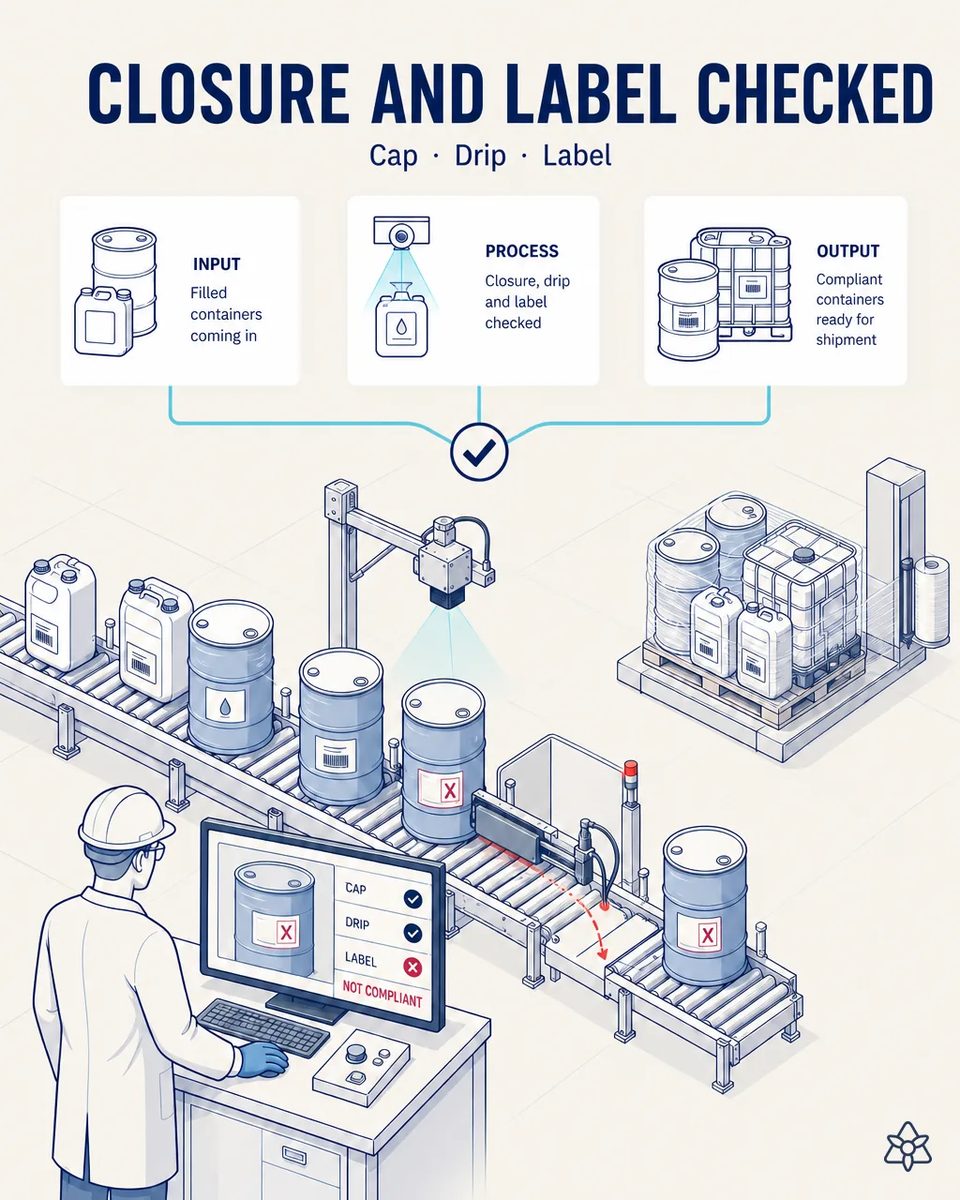
A defective chemical container does not come back: it spills in transit.
A defective chemical container does not produce an ordinary return. It produces a spill inside a hazardous goods truck, a trailer clean-up, a safety notification and, depending on the product, an incident reportable to the authorities. The receiving customer does not reject the container: they reject the whole shipment. Today's inspection depends on the attention of a person doing three other things. It is not a matter of professionalism: at sustained cadence the human eye fails, and it fails precisely after hours of watching. The defect that slips through is caught at the branch or at the customer. That is, late, far away and with witnesses.
- A cap not fully seated, a neck that weeps a few drops, a seal that did not bond, a label that is crooked or unreadable. Each one gets through the human eye at line cadence, and each one becomes a spill inside a hazmat truck.
- The consequence is not a return. It is a trailer clean-up, a safety notification, an incident reportable to the authorities depending on the product, and a customer that rejects the whole shipment, not the one drum.
- Today's inspection depends on the attention of an operator who is also filling, labeling and palletizing. At sustained cadence the human eye fails, and it fails precisely after hours of watching.
- The defect that slips through is caught at the branch or at the customer: late, far away, and with witnesses.
Edge — AI vision over the line exit, local inference, before wrapping.
Edge, AI vision on the line.
The model is trained on the plant's own containers — its jugs, its drums, its IBCs, with their caps and their labels — not on a generic catalog. Inference runs locally in milliseconds, the image never leaves the plant, and the rejected container is pulled before the pallet is wrapped, with the photo stored against the batch. The operator stays on the line; the camera takes over the part of the job the human eye was never going to do reliably for eight hours.
- Industrial camera over the packaging line exit, before stretch-wrapping.
- Vision model trained on images of the plant's real containers — jugs, drums and totes, with their caps and their labels — not on a generic catalog.
- Local inference in milliseconds: the data never leaves the plant.
- Detects incomplete closure, moisture or weeping at the neck, a missing, crooked or unreadable label, and deformed containers.
- Flags or rejects the container before wrapping and stores the image linked to the batch, where it later serves as auditable evidence.
Today's inspection versus Edge vision at the line exit
| Aspect | Visual inspection | With iLEAN Edge |
|---|---|---|
| Coverage | Depends on fatigue and cadence | Every container, every shift |
| Weeping at the neck | Seen if it drips in front of someone | Detected as moisture on the shoulder |
| Unreadable or crooked label | Caught at the branch | Rejected before wrapping |
| Where the defect surfaces | Inside a hazmat truck | On the reject conveyor |
| Evidence | None | Image linked to the batch |
| Borderline container | It ships | Escalated to a person |
from defects caught at destination to defects caught on the line · from inspection dependent on human attention to continuous inspection · from in-transit spills to incidents avoided.
Impact estimate — to be validated with your numbers.
The block below is an estimate to be validated against your plant's actual data. We put it forward so the committee has an order of magnitude; we refine it during the assessment.
- Estimated payback 6-12 months, depending on packaging cadence.
- At least 30 % fewer defective-container claims and transport spill incidents, which is the figure to validate against last year's claims log.
- Avoided cost of trailer clean-up, replacement product and re-delivery, none of which appear in the packaging line's own budget, which is why the case is usually approved by logistics and safety before production.
- And a shipment that is no longer rejected in full because of one drum, which is where the customer relationship is actually measured.
at least 30% fewer defective-container claims and transport spill incidents, plus the avoided cost of clean-up and replacement. Estimated payback of 6 to 12 months depending on packaging cadence. *Estimate to validate.*
And the fair question from the production manager
“What if it rejects good containers?” — the false positive is the real risk of any vision system on a line, which is why the model is trained on good and defective containers of your own packaging, with the lighting of that line exit, not on a generic model. Classifying a cap or a label against a known reference is an anchored task where the best models drop below 1.5% error [1], and a borderline container is not simply rejected: it is escalated to the operator, whose decision feeds back into training.
[1] OpenAI paper "Why Language Models Hallucinate", 2025 — on the reliability of AI in anchored tasks.
What people ask about closure and label vision
Does it keep up with the line?
Yes: inference is local and resolves in milliseconds per container. It does not depend on the plant network or the cloud, and it does not slow the conveyor. A container that needs a second look is diverted, not held, so the line never waits on the model.
How many images are needed to train it?
Fewer than feared, because a container's defect catalog is short and repetitive: cap, neck, seal, label, deformation. What matters is that they are real containers from your line. Thirty good and thirty defective is enough to show it running.
Does it read the label content or just its position?
Both. Position and legibility are checked on every container, and the printed product and batch are read and compared with the active blending order, which is what feeds ring 3 of the flagship case.
What does it do with a rejected container?
Flags it or diverts it, depending on the line, and stores the image linked to the batch. That image later serves as evidence in a carrier claim or a customer audit. The reject count per shift, per container family and per filling head becomes a figure the plant has never had.
Does it cover IBCs as well as drums and jugs?
Yes. The camera position and the model change per container family, and a plant that packs all three trains all three. IBC valve closure is a typical addition, and a plant that packs only drums trains only drums and adds the rest when the line does.
More cases from this series
- No liter should lose its identity between the tank and the customerFour coordinated verification rings from receiving to the branch: not one mis-identified drum, not one…
- The audit stops being a two-week projectEvery changeover, release and shipment leaves its evidence; Agents sorts it by standard and the auditor…
- From a paper blending order to a live batch at second zeroTwo photos, at start-up and at close, and the blending order and packaging log are in the central system…
- The shift supervisor's knowledge stops dying at handoverThe supervisor talks while walking with gloves on and hands busy: iLEAN listens, structures, stores and…
- The laboratory releases batches without anyone retyping into the ERPiLEAN reads the lab sheet as it is saved, drafts the certificate of analysis and, once validated, posts…
- Modern machines still worked by hand: closing the last connectionThe ERP publishes product, batch and pictograms to the labeler, and the scale returns the real weight of…
Send us thirty photos of good containers and thirty of defective ones.
We work on your plant's real data, not ours. Assessment with no commitment.
Request estimated ROI within 48h ‹ See all cases of chemical distribution See chemicals