The laboratory releases batches without anyone retyping into the ERP
In the quality control laboratory of a chemical distributor there is a spreadsheet the analysts fill in run by run, and it is in practice the batch release system. The certificate of analysis comes out of it, and from there somebody retypes it into the ERP. With Connect listening inward, iLEAN reads the file as it is saved, proposes the certificate already drafted and, once the manager validates, posts it to the ERP. With a direct license effect the finance director understands immediately.
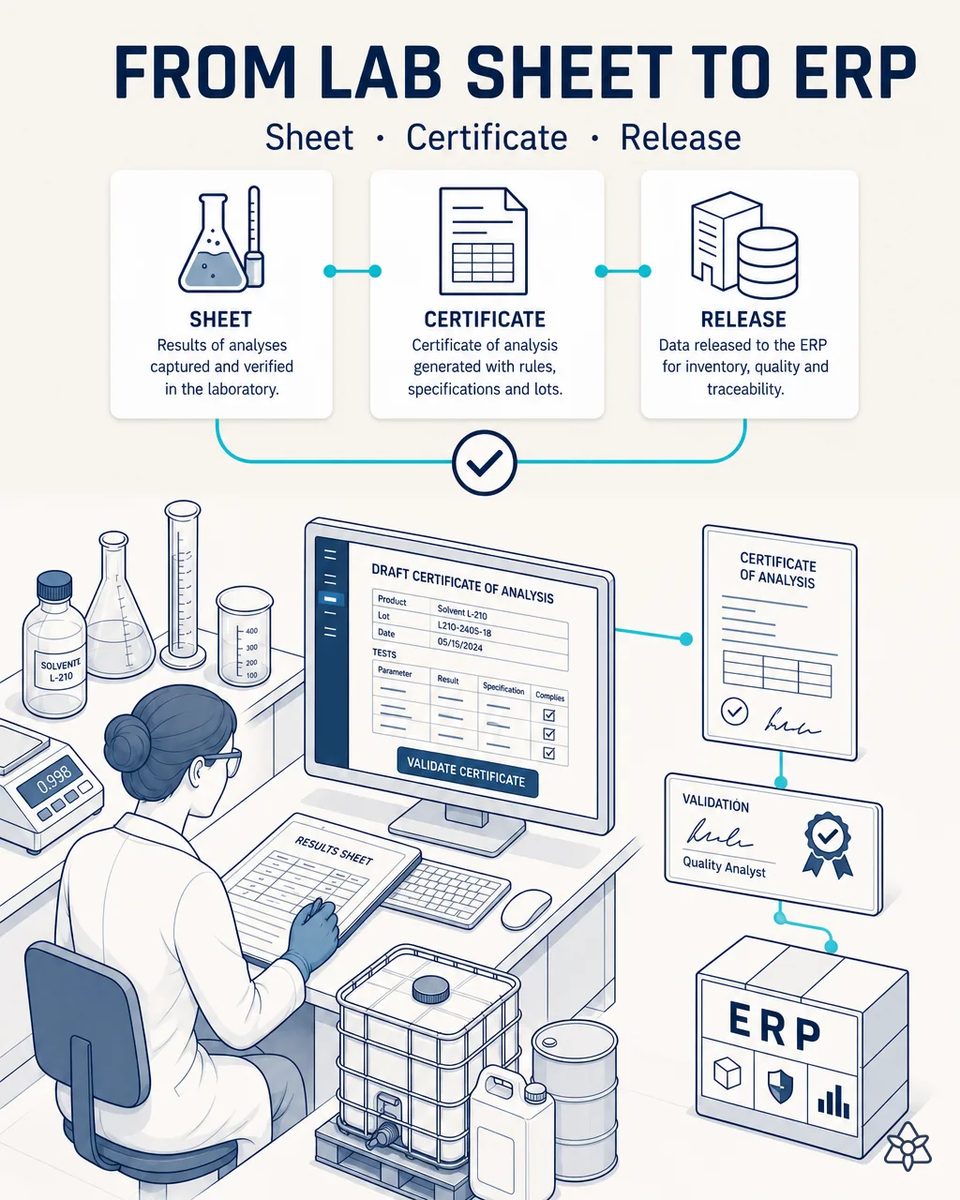
The lab releases on a spreadsheet; the ERP finds out days later.
The lab works in its sheet because it is fast and flexible; the ERP demands structured data. In between sits a person transcribing: in the order of half a day a month of work that adds nothing. The lag has commercial consequences. Sales commits deliveries on batches the ERP does not yet treat as released, even though the lab approved them that morning. Invoicing slips because of a transcription problem, not a quality one. And there is a third cost, the one visible on the ERP invoice: for lab data to reach the system today, you need a quality-module user for every analyst who types.
- The analysts run density, color, water content, flash point, viscosity, purity and pH, and type the results into a sheet that is fast, flexible and, in practice, the batch release system.
- The COA comes out of that sheet, and from there someone retypes it into the ERP quality module. Half a day a month of an analyst's time that adds nothing, and a transcription error waiting to reach a customer.
- Sales commits deliveries on batches the ERP does not yet treat as released, although the lab approved them that morning. Invoicing slips for a transcription reason, not a quality one.
- For lab data to reach the ERP today, every analyst who types needs a quality-module user. That line on the ERP invoice is the one the finance director sees first.
Connect in listening-inward mode — the file, not the person.
Connect in "listening inward" mode.
The lab keeps its sheet, in the format it has today. iLEAN reads it when it is saved, compares each parameter with the product specification, drafts the COA and waits for the quality manager to validate. One license validates instead of five typing, and the batch is released in the ERP the same morning the lab released it. The finance director sees it on the next ERP invoice; sales sees it the same week, in batches that stop being committed before the ERP treats them as released.
- iLEAN observes the shared folder and reads the file when it is saved. It observes the file, not the person.
- A model grounded in the sheet layout extracts the parameters: density, color, water content, flash point, viscosity, purity, pH.
- It checks them against the product specification and flags any out-of-range value.
- It drafts the batch certificate of analysis.
- The quality manager validates or corrects, and only then does the data cross into the ERP quality module through its interface.
Today's laboratory versus the connected laboratory
| Aspect | Today | With iLEAN Connect |
|---|---|---|
| Lab → ERP lag | Days | Minutes |
| Retyping the COA | Half a day a month | Zero |
| Out-of-spec value | Caught at review, if at all | Flagged as it is entered |
| Certificate of analysis | Rebuilt by hand per batch | Drafted, validated, posted |
| Invoicing | Waits for the transcription | Follows the release |
| Quality-module licenses | One per analyst who types | One: the manager who validates |
from half a day a month of transcription to zero · from days of lag between lab and ERP to minutes · from certificates rebuilt by hand to certificates generated and validated · from out-of-range values caught at review to values flagged as they are entered.
Impact estimate — to be validated against last year's ERP billing.
The block below is an estimate to be validated against your plant's actual data. We put it forward so the committee has an order of magnitude; we refine it during the assessment.
- Estimated payback 3-7 months, with the license line as the anchor.
- 💰 CFO angle: the ERP bills per named user. If five analysts log in purely to type results, that is five quality-module licenses: typical ratio 5 down to 1, 50-80 % less recurring cost in that module.
- Half a day a month of analyst time released, and a transcription error that no longer reaches a customer's COA, which is the kind of error that costs a credential, not a correction.
- Invoicing brought forward by earlier release: the batch the lab approved at nine is released in the ERP at nine, not on Thursday.
recurring saving on quality-module licenses — typical ratio of 5 licenses down to 1, between 50% and 80% less recurring cost in that module — plus the transcription time released and the invoicing brought forward by earlier release. Estimated payback of 3 to 7 months. *Estimate to validate against last year's ERP billing.*
And the fair question from the production manager
“That sheet has been changed by five analysts over ten years — does it hold up?” — that is the anticipated case: parsing does not rely on fixed cell positions, it interprets columns, units, merged cells and notes without asking anyone to standardize anything. Extracting parameters from a sheet with a known structure is an anchored task, where the best models drop below 1.5% error [1], and the quality manager validates every COA before it crosses into the ERP.
[1] OpenAI paper "Why Language Models Hallucinate", 2025 — on the reliability of AI in anchored tasks.
What people ask about connecting the lab sheet
Do we have to standardize the lab sheet first?
No, and it is better not to. Asking the lab to change its sheet is the fast route to the system going unused. iLEAN reads the one that exists, and keeps reading it as it evolves. When a column is added or a unit changes, the extraction follows it.
Does it check results against the specification?
Yes. Every parameter is compared with the product spec, and an out-of-range flash point or water content is flagged at the moment it is entered, not when the manager reviews the batch. The analyst sees the flag on their own sheet, so the retest happens before the manager ever opens the batch.
What does the COA look like?
Your template, with the batch's results filled in and the spec limits alongside. The manager sees the draft, validates or corrects, and only then does it post to the ERP and become the document the customer receives. Nothing on the certificate is typed twice.
Can licenses really be cut?
It depends on your ERP contract, which is why it is framed as an estimate to validate against last year's invoice. The logic is that anyone logging in purely to type stops needing to.
Does it watch the analysts?
No. It watches the shared folder and reads the file when it is saved. There is no tracking of who opens what or how long they spend on it.
More cases from this series
- No liter should lose its identity between the tank and the customerFour coordinated verification rings from receiving to the branch: not one mis-identified drum, not one…
- The audit stops being a two-week projectEvery changeover, release and shipment leaves its evidence; Agents sorts it by standard and the auditor…
- From a paper blending order to a live batch at second zeroTwo photos, at start-up and at close, and the blending order and packaging log are in the central system…
- The shift supervisor's knowledge stops dying at handoverThe supervisor talks while walking with gloves on and hands busy: iLEAN listens, structures, stores and…
- Modern machines still worked by hand: closing the last connectionThe ERP publishes product, batch and pictograms to the labeler, and the scale returns the real weight of…
- The solvent recovery panel, digitized without touching the machineA camera reads the isolated distillation column panel and delivers recovery yield run by run, without…
Tell us how many people log into the ERP today purely to type lab results.
We work on your plant's real data, not ours. Assessment with no commitment.
Request estimated ROI within 48h ‹ See all cases of chemical distribution See chemicals