The solvent recovery panel, digitized without touching the machine
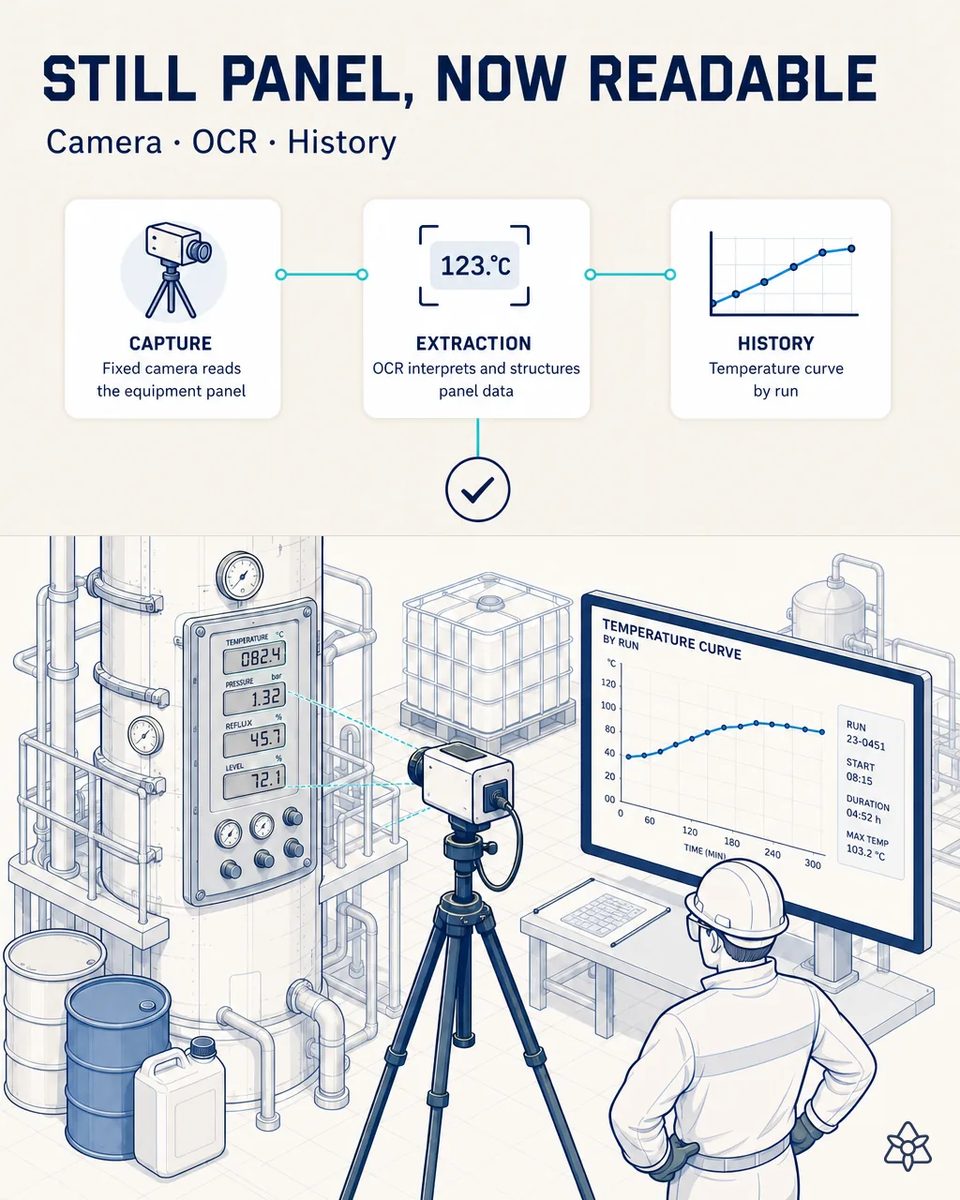
The solvent recovery unit is usually the only continuous process a chemical distributor runs, and also the oldest: proprietary panel, isolated from the network, no history export. Its screen holds everything you would need to explain why one run yields less than the last. With Connect in photo-on-panel mode an industrial camera reads that screen, and the plant gets the profile of every run linked to its batch, with nothing wired to the original control.
The number that decides whether recovery makes money is calculated once a month.
Recovery yield — how many clean liters come out per hundred dirty liters in — is the number that decides whether the service makes money. Today it is calculated at month end from inventory, not run by run. When a run comes out with more water or a lower yield, there is no way to reconstruct the temperature, pressure and flow profile it was made with: that data was on the screen and vanished with it. The obvious fix — replacing the column control — is a several-hundred-thousand project with a unit shutdown. In an operation containing costs that project does not get approved, so the plant settles for not measuring.
- Recovery yield — clean liters out per hundred dirty liters in — is what decides whether the solvent recovery service makes money. Today it comes out of the month-end inventory, so a bad run in week one is discovered in week five.
- The still's panel shows overhead and bottom temperature, pressure, reboiler level and distillate flow every second, and none of it survives the run. The profile that explains a wet run vanished with the screen.
- The control is proprietary, off the network, and the manufacturer stopped supporting it years ago. Nobody wants to open it, and nobody is authorized to wire anything to it. So the still is the plant's oldest asset and its least documented one.
- Replacing the column control is a several-hundred-thousand project with a unit shutdown. In an operation containing costs it does not get approved, so the plant settles for not measuring.
Connect in photo-on-panel mode — solved from outside, not inside.
Connect in "photo of the analog" mode on a machine panel.
A camera pointed at a screen touches nothing: no port opened, no firmware, no modification sign-off for a piece of equipment in a classified area. That is what makes it the fastest installation in the matrix to approve, and the one that gives the recovery service a per-run history for the first time. The still keeps running exactly as before; the only thing that changes is that its screen is finally remembered.
- Fixed industrial camera aimed at the panel, with whatever protection the area classification demands.
- A reading every few seconds: text recognition with a grounded model interpreting overhead and bottom temperature, pressure, reboiler level, distillate flow and alarms.
- Each reading is structured as a time series and linked to the active run and to the batch of dirty solvent that went in.
- The history becomes searchable: profile of every run, yield obtained, and the correlation between the two.
Nothing is wired to the original control, the equipment is not modified, and there is no modification sign-off to manage.
Today's recovery still versus the still being read
| Aspect | Today | With iLEAN Connect |
|---|---|---|
| Recovery yield | Known at month end, from inventory | Known per run, linked to the dirty batch |
| Temperature, pressure and flow profile | On the screen, then gone | A time series per run |
| A run with water in the distillate | No way to explain it | Profile compared with the good runs |
| The original control | Untouchable | Untouched |
| Replacement capex | Blocking measurement | Deferred indefinitely |
| Area classification | — | Camera housing rated for the zone |
from yield known at month end to yield per run · from zero correlation between distillation profile and recovered quality to root cause analysis in minutes · from replacement CAPEX "in order to measure" to zero equipment CAPEX.
Impact estimate — to be validated with your numbers.
The block below is an estimate to be validated against your plant's actual data. We put it forward so the committee has an order of magnitude; we refine it during the assessment.
- Estimated payback 5-10 months, depending on the volume of solvent recovered.
- Every percentage point of yield recovered is sellable liters, and the correlation between profile and yield is what finds those points.
- Replacement capex for the column control postponed indefinitely: the plant measures without buying a new control.
- Root cause analysis of a low-yield run goes from impossible to minutes, with the batch of dirty solvent that went in already linked and the good runs available as the reference to compare against.
every percentage point of yield recovered is sellable liters, and the control replacement is postponed indefinitely. Estimated payback of 5 to 10 months depending on recovered volume. *Estimate to validate.*
And the fair question from the production manager
“Can a camera reading digits off a panel be trusted for a yield calculation?” — this is an anchored task: fixed screen, fields in known positions and physical ranges known in advance, where the best models drop below 1.5% error [1]. And there is a second net built into the series: a reading that falls outside the possible range for that variable — a reboiler level of 150% — is discarded instead of stored, and yield is always closed against the physical liters measured at the outlet.
[1] OpenAI paper "Why Language Models Hallucinate", 2025 — on the reliability of AI in anchored tasks.
What people ask about reading the recovery still panel
Does anything get wired to the still's control?
No. The camera looks at the screen from outside and nothing is installed on the control. That is why there is no modification sign-off and no risk to the equipment warranty, where there still is one.
Is the camera allowed in a classified area?
Yes, in a housing rated for the zone the still sits in. The area classification is checked before choosing the enclosure, exactly as for any other electrical device installed there.
Does it read alarms as well as values?
Yes. An alarm on the panel is captured with its timestamp, so a run can be reviewed against the alarms it raised, which today only the operator who was there remembers. That review is what turns a bad run from an anecdote into a cause.
How is the reading linked to the batch of dirty solvent?
The run is opened against the batch that went into the reboiler, from the blending order or from receiving. From then on every reading belongs to that run and that batch. When the run ends, the yield measured at the outlet closes the record, and the profile is stored beside it.
Can the same approach cover other isolated equipment?
Yes: any machine with a screen and no export fits the same pattern. The recovery still goes first because it is the only continuous process and the one with money attached to every point of yield. A boiler panel, an old chiller, a filling machine with a local display: same camera, same reading, a different set of fields.
More cases from this series
- No liter should lose its identity between the tank and the customerFour coordinated verification rings from receiving to the branch: not one mis-identified drum, not one…
- The audit stops being a two-week projectEvery changeover, release and shipment leaves its evidence; Agents sorts it by standard and the auditor…
- From a paper blending order to a live batch at second zeroTwo photos, at start-up and at close, and the blending order and packaging log are in the central system…
- The shift supervisor's knowledge stops dying at handoverThe supervisor talks while walking with gloves on and hands busy: iLEAN listens, structures, stores and…
- The laboratory releases batches without anyone retyping into the ERPiLEAN reads the lab sheet as it is saved, drafts the certificate of analysis and, once validated, posts…
- Modern machines still worked by hand: closing the last connectionThe ERP publishes product, batch and pictograms to the labeler, and the scale returns the real weight of…
Tell us whether you can state the yield of your last recovery run.
We work on your plant's real data, not ours. Assessment with no commitment.
Request estimated ROI within 48h ‹ See all cases of chemical distribution See chemicals