From a paper blending order to a live batch at second zero
In a chemical blending plant the batch starts on two pieces of paper: the order that comes down from technical office and the packaging log the operator fills in by hand. They define product, formula, source tank, batch, containers and weights, and they hang on a clipboard until the end of the shift. With Connect in photo mode the operator takes one photo at start-up and one at close, and the batch exists in central memory from the first minute, handwritten notes included.
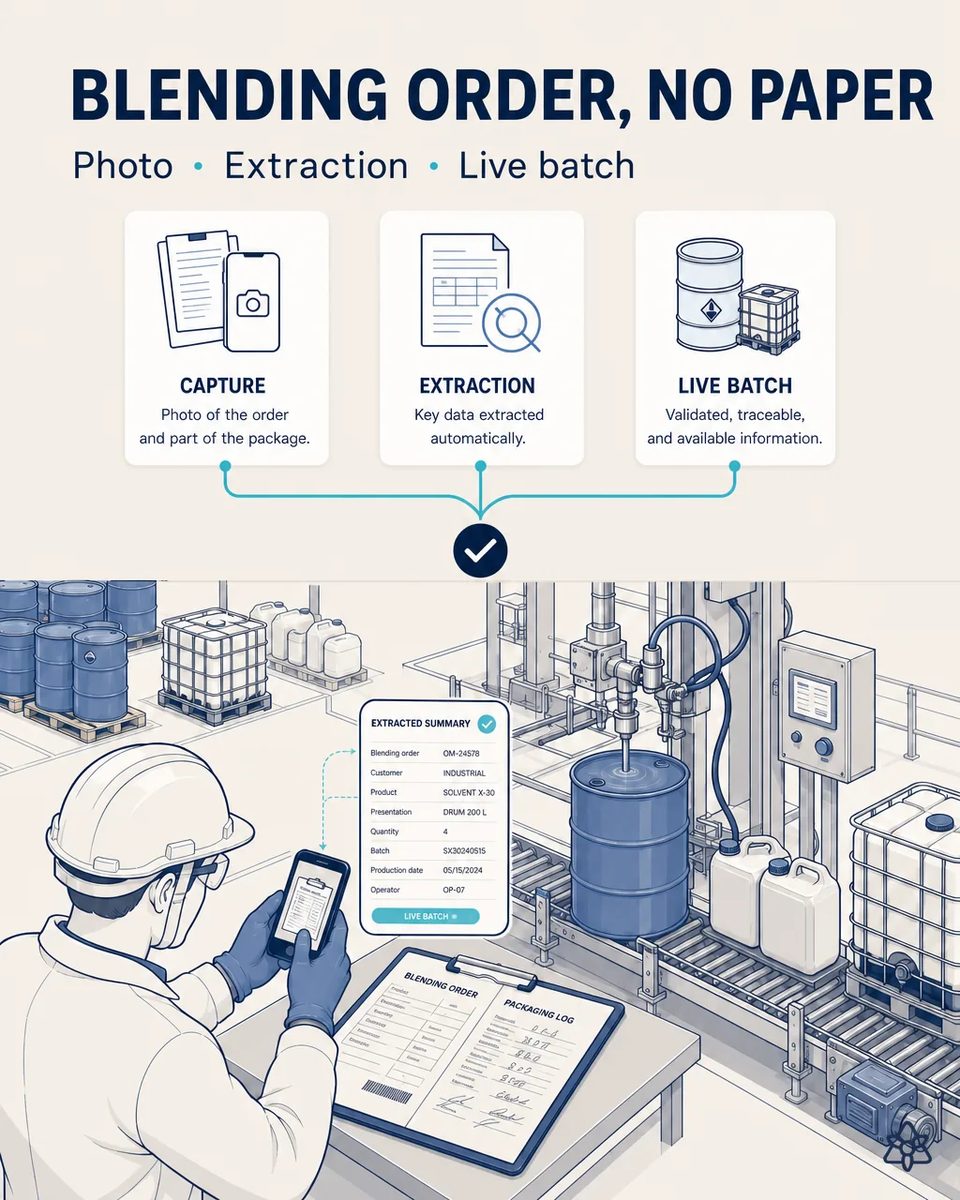
The batch lives on a clipboard for eight hours.
Between the order being printed and the log being closed lie the eight hours of the shift. During that time nobody outside the line knows how many drums have been filled or whether average weight is drifting off target. Planning works from yesterday's picture and quality cannot anticipate anything. When the log reaches the office it is either typed in a hurry or typed wrong. And there is a silent loss nobody accounts for: the margin notes — "source tank changed", "second batch came out denser" — are exactly the ones that explain a deviation, and they never get transcribed. The cost is not just the clerk's time. It is that the plant loses the ability to explain itself: when someone asks weeks later why that batch came out the way it did, the answer is on a filed sheet nobody is going to look for.
- The blending order comes down from technical office with product, formula, source tank and target batch, and the operator hangs it on the clipboard at the filling station. From that moment until the shift closes, nobody outside the line can see it.
- The packaging log is filled in by hand as drums, jugs and IBCs come off the scale: container count, weight per container, start and end time. Average weight drifting off target shows up when the log is typed, not while it is happening.
- The margin notes are the most valuable part and the first to be lost: "source tank changed to T-4", "second blend came out denser". They explain the deviation, and they never reach the system.
- When the log gets to the office it is typed in a hurry, and often typed wrong. A month later a customer complaint lands and the answer is on a filed sheet nobody will find in time.
Connect in photo mode — the operator keeps the clipboard, and adds two photos.
Connect in "photo of the analog" mode.
Nothing changes on the line: the order is still printed, the log is still filled in by hand. What changes is that the batch exists in central memory from the first minute, with its handwritten notes searchable, instead of from the morning after. And because the two photos are taken at start-up and at close, the plant sees the batch opened and closed on the same screen, with container count and average weight against target while there is still time to correct the fill. That is why it is usually the first case a plant approves.
- The operator photographs the blending order at start-up and the packaging log at close, with a phone or the line tablet.
- A model grounded in the document layout extracts the structured fields: product, formula, source tank, batch, pack size, container count, weight per container and handwritten notes.
- The data is stored in central memory and linked to the batch.
- What is captured goes through early human verification (see case 5) before crossing into the management systems.
Zero habit change: the operator learns no new system and types nothing.
Today's blending order versus the captured blending order
| Aspect | Today, on paper | With iLEAN Connect |
|---|---|---|
| Latency line → system | 4-8 h, and a full weekend | Seconds |
| Container count and weights | Typed the next morning | Live, per batch |
| Margin notes | Never transcribed | Extracted and searchable by batch |
| Batch progress | A phone call to the line | On screen |
| Transcription per shift | One log, one clerk | Zero |
| Operator's habit | — | Unchanged: two photos |
from 4-8 hours of latency between line and system to seconds · from lost handwritten notes to notes searchable by batch · from one log per shift to be transcribed to zero transcription · from batch progress known by calling the line to progress available on screen.
Impact estimate — to be validated with your numbers.
The block below is an estimate to be validated against your plant's actual data. We put it forward so the committee has an order of magnitude; we refine it during the assessment.
- Estimated payback 3-8 months, depending on the number of blending batches per day.
- Transcription time of the plant clerk and the shift supervisor recovered, batch after batch, which in a plant running six to ten blending orders a day is the better part of one person's morning.
- From 4-8 hours of latency between line and system down to seconds, and a weekend batch exists on Saturday, not on Monday.
- Planning and quality stop working from yesterday's picture: average weight drifting off target is visible while the batch is still open.
recovery of the transcription time of the plant clerk and the supervisor, plus visibility of the running batch. Estimated payback of 3 to 8 months depending on blending batches per day. *Estimate to validate.*
And the fair question from the production manager
“What if it misreads a weight or a batch number on the log?” — reading fields from a document with a known layout is an anchored task, where the best models drop below 1.5% error [1]. And there is a second net: every batch goes through early human verification on the line tablet (case 5) before it crosses into the management systems, so a low-confidence value is confirmed or corrected by a person who has the log in front of them.
[1] OpenAI paper "Why Language Models Hallucinate", 2025 — on the reliability of AI in anchored tasks.
What people ask about the paperless blending order
Do we have to redesign the blending order or the packaging log?
No. The model is grounded in the layout you already use, with the fields where they are today. Redesigning the form is the fastest way to make the operator stop filling it in. What is tuned is the extraction, once, on your real forms.
Does it read the handwritten notes in the margin?
Yes, and they are the part with the most value, because that is where the source tank change or the denser second blend is written. A note with low confidence is flagged for a person to confirm rather than silently accepted.
What about a toll order that arrives in the customer's own format?
Toll orders come in the customer's layout, and that is expected: the extraction reads document structure, not fixed positions, so a new customer format does not need a new template.
Do we need ERP integration on day one?
No. The batch lives in iLEAN's central memory from the first photo, and the push to the ERP is connected afterwards, once the plant has seen the data for a few weeks and trusts it. Most plants connect it in the second month, when the clerk has stopped retyping and the question becomes where the data should live.
Does the operator need a new device?
A phone or the line tablet is enough. If the plant already has an intrinsically safe tablet in the filling area, it is used as it is. The photo takes less time than initialing the log.
More cases from this series
- No liter should lose its identity between the tank and the customerFour coordinated verification rings from receiving to the branch: not one mis-identified drum, not one…
- The audit stops being a two-week projectEvery changeover, release and shipment leaves its evidence; Agents sorts it by standard and the auditor…
- The shift supervisor's knowledge stops dying at handoverThe supervisor talks while walking with gloves on and hands busy: iLEAN listens, structures, stores and…
- The laboratory releases batches without anyone retyping into the ERPiLEAN reads the lab sheet as it is saved, drafts the certificate of analysis and, once validated, posts…
- Modern machines still worked by hand: closing the last connectionThe ERP publishes product, batch and pictograms to the labeler, and the scale returns the real weight of…
- The solvent recovery panel, digitized without touching the machineA camera reads the isolated distillation column panel and delivers recovery yield run by run, without…
Tell us how many packaging logs get retyped by hand every week in your plant.
We work on your plant's real data, not ours. Assessment with no commitment.
Request estimated ROI within 48h ‹ See all cases of chemical distribution See chemicals