No liter should lose its identity between the tank and the customer
The core pain of a plant that blends, packages and distributes chemicals is a liter losing its identity. It has two faces and they are the same physical chain: the drum that leaves with the wrong product, batch or hazard label, and the liter that does not show up at month end. The flagship system coordinates the eleven previous cases into four verification rings that cross-check each other: if they do not match, the pallet does not leave the plant and the discrepancy is caught the same day.
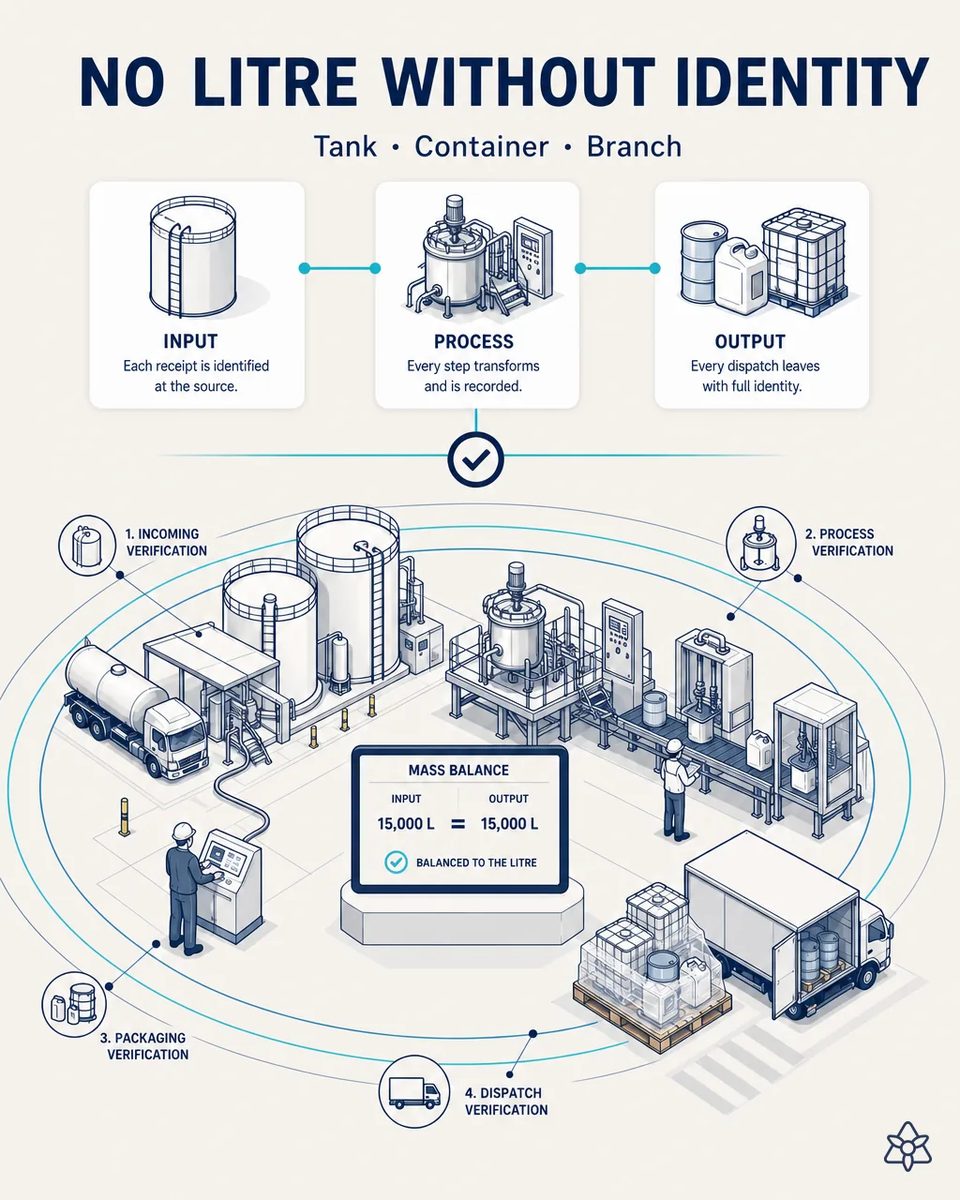
A liter loses its identity one hand-off at a time.
Between bulk receiving and delivery at the branch there are five or six pairs of hands and as many pieces of paper. Every hand-off is a chance for identity to break — product, batch, hazard, quantity — and a chance for a few liters to be left behind with no record. The first face is the one that keeps operations awake: a mis-identified drum is safety, claims and credentials at risk. The second is the one finance sees every month: bulk shrinkage left in the bottom of a tank, in a hose section, in the container that spilled and was replaced without a note, or in the manual inventory adjustment that squares the system without explaining anything. At month end, the difference between what came in and what went out is a number somebody has to justify without data. In a business with a tight gross margin, that number is not an accounting detail: it is the result.
- Between the tanker and the branch there are five or six pairs of hands and as many pieces of paper. Every hand-off is a chance for product, batch, hazard or quantity to break, and a chance for a few liters to be left behind without a record.
- The first face keeps operations awake: a mis-identified drum is safety, claims, a possible recall and the credentials that let you sell to large customers. Each control on its own passes; the concatenation is what escapes.
- The second face is what finance sees every month: bulk shrinkage in the bottom of a tank, in a hose section, in the drum that spilled and was replaced without a note, squared by a manual inventory adjustment that explains nothing.
- In a business with a tight gross margin, the difference between liters in and liters out is not an accounting detail: it is the result, and today somebody justifies it without data.
Four rings that cross-check each other — it is all of the above, orchestrated.
No single ring solves the problem: each one exists today in some form and the drum still leaves wrong. The strength is in the cross-check, because what gives the broken identity away is four independent sources ceasing to agree, and what gives the shrinkage away is a mass balance that closes per batch instead of per month.
- Ring 1 · Source identity (cases 1 and 7): photographed receiving gives the liter its identity — product, supplier batch, certificate, weighbridge figure — and the blending order defines what it will become. Nothing starts without those two pieces matched.
- Ring 2 · The line and the label (cases 5 and 8): before the valve opens, the operator validates on the tablet the product-tank-container-label match; the labeler prints what the ERP publishes, pictograms included, with no keying in between; the scale returns the real weight of every container.
- Ring 3 · The eyes and the stop (cases 9 and 10): the exit camera reads the freshly printed label and checks it against the active order; the changeover cameras guarantee the line was clean. If anything fails to match, JIDOKA AI stops the line before wrapping.
- Ring 4 · The balance and the dossier (cases 6 and 11): Agents closes the mass balance of every batch — liters into the tank against kilos packed plus declared residue — flags the deviation the same day and attaches the evidence. Every pallet leaves with its traceable pack.
- SMED AI speeds up product changeover so the four rings do not penalize line productivity.
The four rings, and what each one closes
| Ring | Which cases it draws on | What it closes |
|---|---|---|
| 1 · Source identity | Blending order (1) + tanker receiving (7) | Which supplier batch and which formula the liter comes from |
| 2 · The line and the label | Transfer check (5) + labeler and scale (8) | Product, tank, container and GHS label match; real weight per container |
| 3 · The eyes and the stop | Closure and label (9) + changeover (10) | The label read against the order; the line proven clean |
| 4 · The balance and the dossier | Lab COA (6) + evidence pack (11) | Mass balance per batch and a traceable pack per pallet |
| Supporting cases | Recovery panel (2), alerts (3), earpiece (4) | The still's yield, the late tanker and the supervisor's memory feed the same record |
| SMED AI | Across the rings | Changeover speed, so the rings do not cost line productivity |
from discrepancies explained at month end with an inventory adjustment to deviations flagged the same day and with a cause · from mis-identified containers caught by the customer to discrepancies caught on the line · from traceability rebuilt by hand to traceability published.
Impact estimate — to be validated with your numbers.
The block below is an estimate to be validated against your plant's actual data. We put it forward so the committee has an order of magnitude; we refine it during the assessment.
- Estimated payback 6-12 months, measured against the first quarter with the mass balance closing per batch.
- Substantial reduction of unexplained bulk shrinkage: every point recovered drops straight to the result, in a business where gross margin is tight.
- Virtual elimination of shipments with the wrong product, batch or hazard label, and with them the recall exposure and the shipment rejected in full.
- And traceability that is published instead of rebuilt: the customer audit of a batch is a link, not a week.
substantial reduction of unexplained bulk shrinkage — every point recovered drops straight to the result — and virtual elimination of shipments with the wrong identity. Estimated payback of 6 to 12 months against the first quarter with the mass balance closing. *Estimate to validate with operations and finance, against the history of bulk inventory adjustments.*
And the fair question from the production manager
“Do we have to deploy all twelve cases to get this?” — no, and framing it that way would be the way never to start. The rings are built in layers and each case pays on its own from the first month. With tanker receiving and the blending order you already have ring 1, and with the labeler and scale you have the weights the mass balance needs. Each layer's cross-check is an anchored task, where the best models drop below 1.5% error [1], and JIDOKA AI stops on a verifiable disagreement between sources, never on model uncertainty.
[1] OpenAI paper "Why Language Models Hallucinate", 2025 — on the reliability of AI in anchored tasks.
What people ask about the complete system
Where do you start?
With the case that has fewest dependencies and the shortest deployment, which in this matrix is the blending order or tanker receiving. What matters is that each layer pays for itself before the next is added.
What does the cross-check give that each control does not?
Exactly what escapes today: the concatenation. A wrong tank passes the operator's glance, a stale label passes the labeler, a rushed receipt passes the ERP, and the drum that adds the three leaves with the wrong identity.
How does the mass balance work?
Liters into the tank from receiving, against kilos packed from the scale, plus declared residue and recovery. Agents closes it per batch, flags the deviation the same day and attaches the evidence, instead of an adjustment at month end.
What if a ring flags a false discrepancy?
JIDOKA AI stops on a verifiable disagreement between sources, not on model uncertainty. When the doubt is the model's, the case is escalated to a person, and the pallet waits minutes, not days.
Can the return be estimated before committing?
Yes: with your bulk inventory adjustments over the last twelve months, the cost of your last mis-identified container and your changeovers per day, the return per layer is estimated before deciding the order.
More cases from this series
- The audit stops being a two-week projectEvery changeover, release and shipment leaves its evidence; Agents sorts it by standard and the auditor…
- From a paper blending order to a live batch at second zeroTwo photos, at start-up and at close, and the blending order and packaging log are in the central system…
- The shift supervisor's knowledge stops dying at handoverThe supervisor talks while walking with gloves on and hands busy: iLEAN listens, structures, stores and…
- The laboratory releases batches without anyone retyping into the ERPiLEAN reads the lab sheet as it is saved, drafts the certificate of analysis and, once validated, posts…
- Modern machines still worked by hand: closing the last connectionThe ERP publishes product, batch and pictograms to the labeler, and the scale returns the real weight of…
- The solvent recovery panel, digitized without touching the machineA camera reads the isolated distillation column panel and delivers recovery yield run by run, without…
Pull the value of your bulk inventory adjustments over the last twelve months and tell us the number.
We work on your plant's real data, not ours. Assessment with no commitment.
Request estimated ROI within 48h ‹ See all cases of chemical distribution See chemicals